Commercial Asphalt Paving & Parking Lots in Kansas City
Lots built for the loads they actually carry, phased so you can keep operating while the work goes in.
Keeping the lot open while we work
For most businesses the hard part of a paving job is not the paving. It is the week the lot is torn up while customers still need somewhere to park and deliveries still have to arrive. That is a scheduling problem, and it gets solved before any equipment shows up.
We phase the lot into sections and work them in an order that keeps at least one entrance and a usable route open throughout. Paving is the stage that needs its section completely clear, and that section is out of service for about a day. Everything else — tear-out, base work, striping — can usually be sequenced around your hours.
You get the phase map with the estimate: which rows are closed on which days, where deliveries should come in, and what the fallback is if weather moves a phase.
How a commercial section is built
A parking lot is not a thicker driveway. The loads are heavier, they concentrate in predictable places — dumpster pads, dock approaches, the drive lane every truck uses — and the build has to answer that.
Subgrade and base depth
Commercial base goes deeper than residential because the load is heavier and more concentrated. Depth is set by what actually uses the lot — a medical office and a distribution dock are different builds even at the same square footage.
Binder course
Heavier lots get built in two courses. The binder is a coarser mix laid first, and it carries most of the structural work. Skipping it to save a lift is why some lots rut in the drive lanes within a few seasons.
Surface course
A finer mix goes on top for the wearing surface — tighter, smoother, and what everything else gets judged on. It is the thinnest part of the build and the least structural.
Drainage and ponding
Water has to leave the lot. Flat spots that hold water after rain are where the surface fails first, and on a big lot they are easy to create by accident. We shoot grades against the existing inlets and curb lines before anything is placed.
Layout, stalls, and accessibility
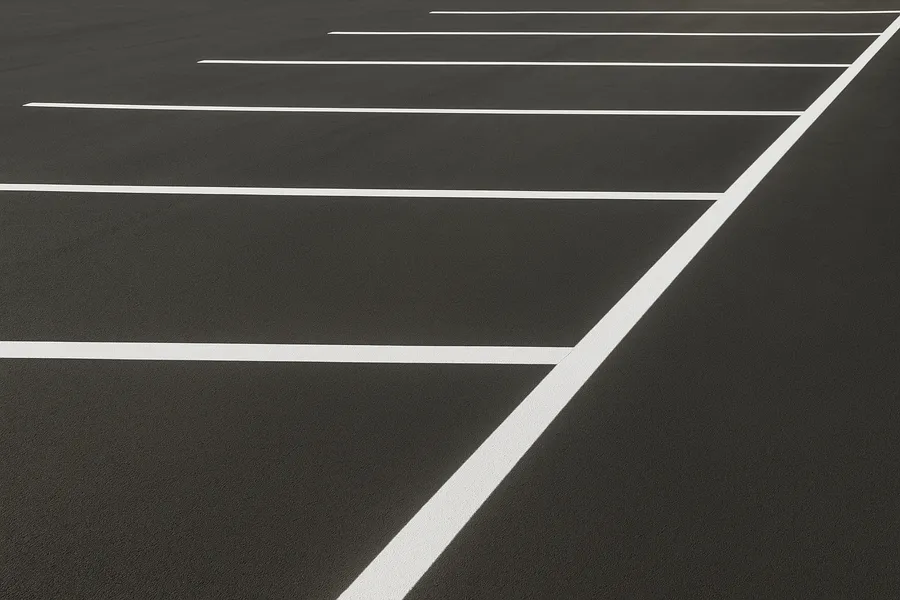
Layout decides how many cars the lot holds and how well it flows. Stall angle, drive-lane width, and where the traffic enters all trade against each other — angled stalls are easier to pull into and cost you total count; ninety-degree stalls fit more cars and need wider lanes.
Accessible parking is not just paint. The number of accessible stalls scales with the total space count, they need adjacent access aisles, and both the stall and the aisle have slope limits — which makes them a grading question during paving, not a striping question afterward. Getting that wrong means regrading, so it gets set at the start.
Once the surface has cured, striping puts the layout down — stalls, arrows, fire lanes, and the accessible markings.
Commercial paving across the metro
Retail, office, industrial, church, and multi-family properties on both sides of the state line.
Commercial paving in Kansas City, MO
Commercial paving in Lee's Summit, MO
Commercial paving in Independence, MO
Commercial paving in Blue Springs, MO
Commercial paving in Overland Park, KS
Commercial paving in Olathe, KS
Commercial paving in Shawnee, KS
Commercial paving in Lenexa, KS
Commercial paving in Lawrence, KS
We cover 46 cities — see the full service area.
Related services
Line Striping
Layout, stalls, fire lanes, and ADA spaces once the surface is down and cured.
Asphalt Overlays
Resurfacing when the base under a tired lot is still structurally sound.
Asphalt Repair
Targeted patching for the failed areas of a lot that is otherwise holding up.
Asphalt Paving
How the full build works, residential and commercial alike.
Commercial paving questions
Can we stay open while you pave the lot?
Usually yes. Most commercial jobs get phased — we take a section at a time, keep the entrances and a route through the lot usable, and schedule the disruptive stages around your hours where we can. Paving is the part that needs the surface completely clear, and that section is unusable for roughly a day. We map the phases with you before we start so you know which entrances and which rows are down on which days.
Does the new lot have to be ADA compliant?
If it is a lot serving the public, accessible stalls, access aisles, and a compliant route to the entrance are required, and the counts and dimensions come from the total number of spaces. The physical build matters as much as the paint: accessible stalls and aisles have slope limits, so they have to be graded for it, not just striped after the fact. We set that grade during paving and lay the stalls out to match when we stripe.
How long does a large lot take?
Days rather than weeks for most of them, spread across phases. The paving itself moves quickly; what sets the schedule is tear-out, base work, how many phases the site needs to stay operational, and the weather window — asphalt needs dry conditions in a workable temperature range. Striping waits for the surface to cure. You get a phase-by-phase timeline with the estimate.
How long should a commercial lot last?
Typically 15 to 20 years for the structure, with the surface needing maintenance well before that. Lots that get sealcoated on a sensible cycle, have their cracks sealed before water gets into the base, and were built with a section matched to their actual traffic reach the top of that range. Lots built to a car specification and then used by delivery trucks do not.
Ready to pave it right?
Get a straight estimate and a clear timeline. Tarmasters Asphalt Paving handles driveways, parking lots, and repairs across the Kansas City metro.
Call Now: (816) 789-0700