Commercial Asphalt Paving in Kansas City and Jackson County
Parking lots, truck courts, and service drives from the Crossroads to the Northeast Industrial District — built for the loads they carry, over ground that moves.
Tarmasters paves and rebuilds commercial parking lots across Kansas City, Missouri — from Crossroads infill sites to freight aprons in the Northeast Industrial District. Over Wymore series expansive clay, with roughly 40 freeze-thaw cycles a year, a lot needs drainage designed first, a compacted stone base, and a section matched to its real traffic. Insured and bonded, paving since 2014.
One city, three different paving problems
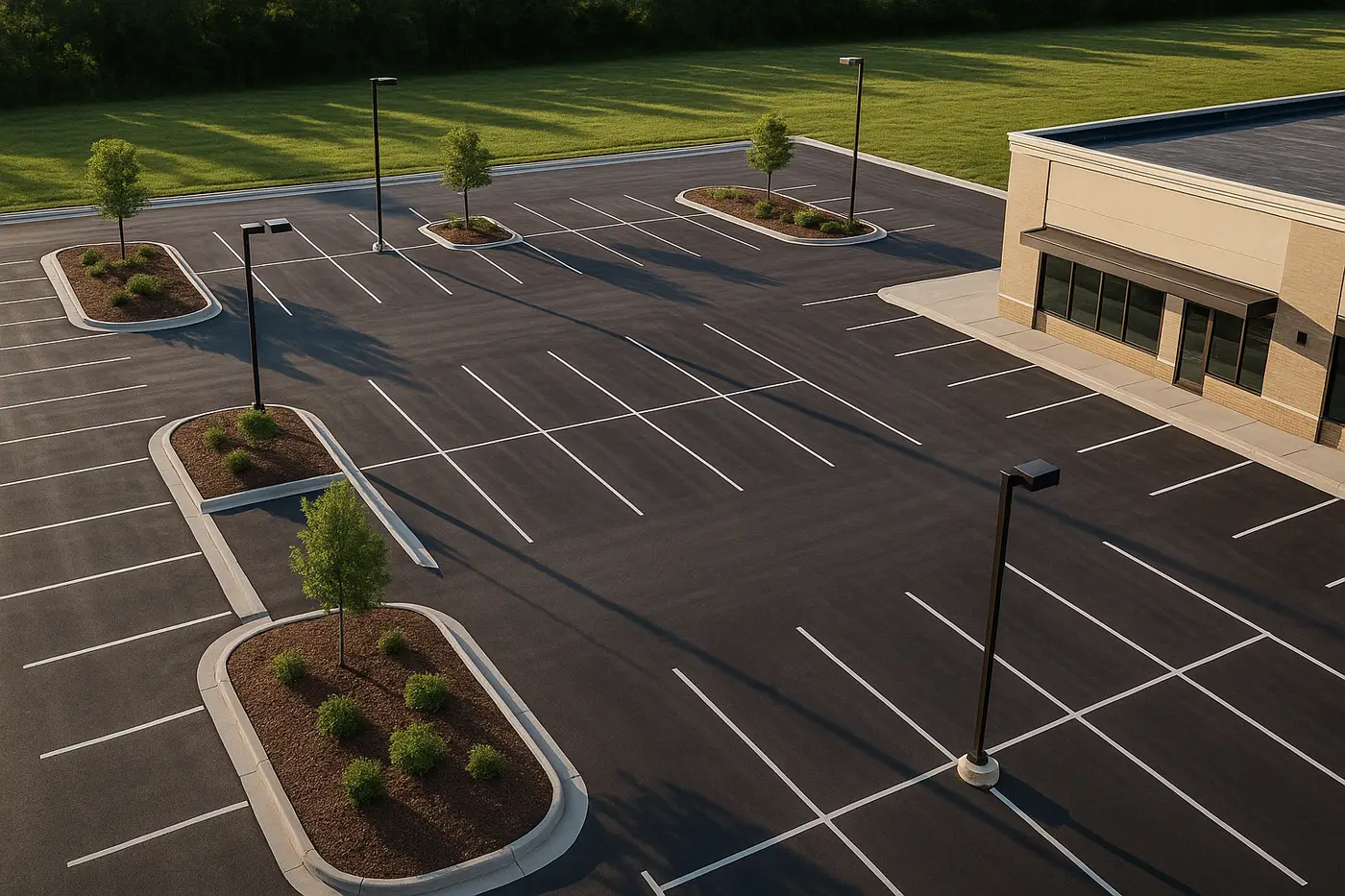
Most suburbs give a paving contractor one kind of lot. Kansas City gives you at least three, and they need different answers. A half-acre site in the Crossroads is an access and joint problem. A truck court off I-70 in the Northeast Industrial District is a structural one. A restaurant lot in Westport is neither — it is a scheduling problem with a striping deadline.
Quoting all three off the same square-foot number is how properties end up with a surface that looks right for two winters and then fails at the entrance. We price them as what they are: new lot construction, mill and overlay, or full-depth reconstruction of the sections that have actually failed.
What does not change across the city is the ground underneath and the winter above it — and that is the part most bids quietly leave out.
The commercial work we take on here
Urban infill and small lots
Tight sites downtown and through the Crossroads, often paved in a single continuous mat to keep cold joints out of a small lot. Utility cuts get rebuilt before anything new goes over them.
Freight and industrial pavement
Truck courts, loading aprons, and yard pavement along the riverfront and the I-70 corridor. Thicker base in lifts, heavier binder, and concrete where trailers pivot in one spot.
Retail, medical, and institutional
Strip centers, clinics, churches, and school lots across South Kansas City and the Northland — phased so the property never fully closes, then restriped to the layout the site actually needs.
Why proper prep matters here
Jackson County sits on Wymore series expansive clay. That is a shrink-swell soil — it takes on water and expands, then dries out and pulls back — so a lot built over it is being lifted and lowered by the ground it rests on. Add about 42 inches of rain a year and roughly 40 freeze-thaw cycles with frost reaching 36 inches, and any water that gets into the pavement has somewhere to go and something to do when it freezes.
What that means under asphalt
Expansive clay does not drain, and it does not hold a shape. Under a thin base it stays wet, loses strength in the spring thaw, and pushes fines up into the stone until the two layers become one soft layer. The pavement above it then flexes further than asphalt can flex, which is what alligator cracking is. A properly thick, well-graded stone base spreads wheel loads wide enough that the clay never sees a concentrated one — and a geotextile separator keeps the stone stone.
Drainage does the other half of the work. River-bottom ground near the Missouri, and the flat older lots along Broadway Boulevard and the Troost Corridor, hold water where a rolling upland site would shed it. Standing water strips the binder off the aggregate from the top down while it saturates the base from below, so the grade plan comes before the paving plan — not after. Once the surface is sound, sealing cracks as they open is what keeps the water out of it.
Matching the section to the duty it carries
Two lots of identical square footage can need completely different builds. This is roughly how we size a Kansas City commercial section before anyone quotes a number — bring it to whoever else is bidding.
| Property type | What it carries | Base | Asphalt | What goes first if it is under-built |
|---|---|---|---|---|
| Office and professional | Cars, one refuse truck a week | 6 in. compacted crushed limestone | 2 in. surface over 2 in. binder | Nothing structural for years — surface oxidation and cracking arrive first |
| Retail and grocery | Cars plus daily box-truck deliveries | 6–8 in., thickened at the service lane | 1.5 in. surface over 2.5–3 in. binder | Rutting down the delivery route while the customer rows stay sound |
| Restaurant and drive-through | Standing weight in the same wheel path all day | 8 in. with drainage away from the lane | Stiffer mix, or a concrete pad at the window | Shoving and washboarding in the queue — asphalt creeps under stationary load |
| Industrial and freight | Class 8 tractors, loaded trailers, turning | 10–12 in., over a separator on clay | 2 in. surface over 4–6 in. binder in lifts | Full-depth failure at the entry radius, then the whole approach |
Ranges, not a specification. The real numbers come off the site — subgrade condition, existing section, and drainage decide the final build.
How a Kansas City project runs
- 1
We walk it and read the drainage
Where the water goes, where it stops, where the section has already failed, and whether the base under it can be reused. On older lots we core it rather than guess.
- 2
You get a fixed price and a phase map
Measured, itemized, and sequenced — which sections close on which days, where deliveries go while they are closed, and what happens if weather moves a phase.
- 3
Removal, and the honest part of the job
Old surface comes off by milling or full removal. Soft subgrade gets undercut and rebuilt, and failed utility cuts get replaced in compacted lifts before anything covers them.
- 4
Base, then grade, then proof-roll
Crushed limestone placed in lifts and compacted each time, cut to the elevations the water plan needs, then loaded to find any soft spot before it is buried under new asphalt.
- 5
Paving — in daylight or after hours
Binder and surface course laid and rolled to full density while hot. Downtown and Plaza-area properties are usually paved overnight so the lot opens on schedule the next morning.
- 6
Layout and accessible routes
Accessible stalls and access aisles have slope limits, so they are set during grading rather than fixed with paint afterwards. Striping goes down once the surface has cured.
The company doing the work
Tarmasters is the asphalt division of Ford Concrete and Paving — Kansas City–owned, based in Lee's Summit, and paving across the metro since 2014. Insured and bonded, with crews and equipment we run ourselves rather than subcontract, which is the reason a phase map means something when we hand it to you.
On a Kansas City commercial job you get a measured fixed estimate, a written sequence, and a straight answer about whether the base under your lot can carry a new surface or whether that section has to come out. If an overlay will not hold, we say so before you buy one. More about the company.
Communities we serve around Kansas City
Commercial work runs the length of the city — Downtown/Power & Light, Country Club Plaza, Crossroads Arts District, and the Northeast Industrial District — with access off I-70, I-35, US-71 and Broadway Blvd. What the property needs changes by district:
Downtown, the Crossroads, and the River Market
Small, hemmed-in lots between buildings, most of them cut into repeatedly for utility work. Access is the hard part: a mixer truck has to get in, the mat has to be laid in one piece to avoid cold joints across a 40-foot lot, and the work usually has to fit around a business day. These are the sites where night paving earns its cost.
The Northeast Industrial District and the riverfront
Freight yards, loading aprons, and truck courts carrying Class 8 axle loads all day. Much of this pavement is at the end of its structural life and needs full-depth rebuilding rather than a surface fix. Bottom-land ground near the Missouri River drains slowly, so the drainage plan drives the design here more than anywhere else in the city.
Country Club Plaza, Westport, and Midtown
Dense retail and restaurant parking where appearance and layout matter as much as structure. Lots are tight, striping is worked hard, and the constraint is almost always keeping customer access open while a section is closed. Work gets sequenced so a route through the property stays usable.
South Kansas City, Waldo, Brookside, and Martin City
Neighborhood retail strips, churches, schools, and medical offices on larger, flatter parcels. Rebuild economics are better here because there is room to stage, and the lots are usually straightforward to phase. This is where a full reconstruction is most often the right call rather than another overlay.
Commercial paving in neighboring cities
You can also see how we handle commercial lots across the metro, every service we run in Kansas City, or the whole service area.
Questions from Kansas City property managers
Can you pave downtown at night or over a weekend?
Yes, and for a lot of Downtown, Crossroads, and River Market properties it is the only sensible option. Asphalt can be placed after hours as long as the mat is rolled to full compaction before it cools, which sets a practical temperature floor rather than a clock. We schedule the plant load, the haul, and the crew around your closed hours and hand back a striped, usable lot in the morning.
Our lot is cut up with utility patches. Do we patch again or overlay?
Utility cuts across the Crossroads and Downtown are usually a backfill problem, not a surface problem. If the trench was replaced without compacting the backfill in lifts, the patch keeps settling and a new overlay will dip in the same places within a season or two. The fix is to rebuild the failed cuts full depth first, then overlay — otherwise you pay for the overlay twice.
What does Wymore clay under Kansas City mean for a parking lot?
Wymore series expansive clay is a high shrink-swell soil: it takes on water and expands, then dries and pulls back. Under asphalt that means the surface is being lifted and dropped seasonally, and any water that reaches it stays there. On commercial work we answer that with a compacted stone base thick enough to spread the load, a separator fabric where the clay would pump fines up into the stone, and drainage that gets water off the lot instead of through it.
Why does our pavement bunch up at the entrance off the highway?
That is shoving, and it shows up where heavy vehicles brake and turn onto a lot — common at entries off I-70, US-71, and the industrial approaches. It means the mix or the section underneath is not built for that stress. Rebuilding the entry radius full depth with a heavier binder course, or putting concrete at the pinch point, is what stops it coming back.
Free estimates across the Kansas City metro.
Driveways, parking lots, and repairs across the Kansas City metro, since 2014.
Call Now: (816) 789-0700Tarmasters Asphalt Paving
Lee's Summit, MO 64063 | Serving the Kansas City metro | Insured | Bonded