Asphalt Milling in Kansas City
Cold planing that takes the old surface down to the depth you need — so the new one goes on at the right elevation.
Cold planing, in plain terms
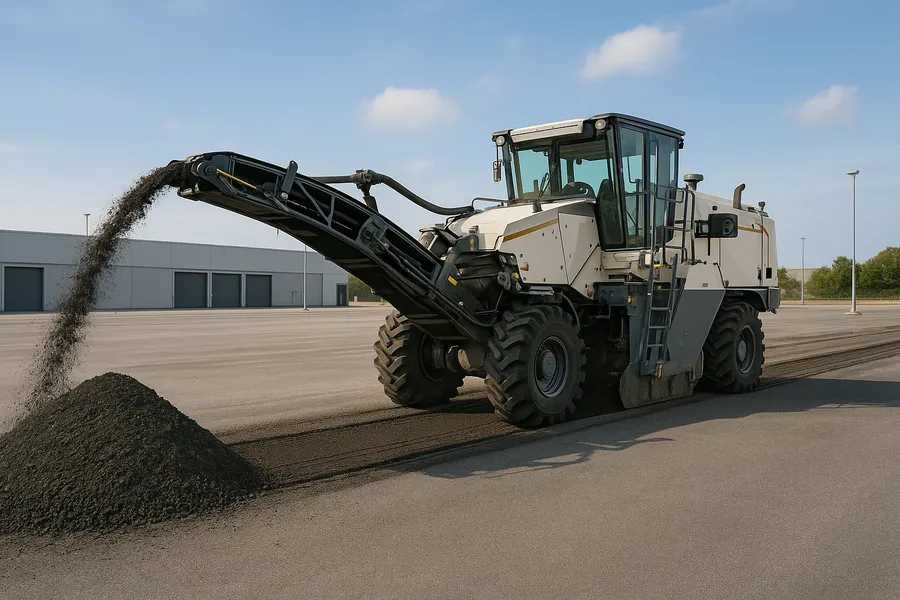
A milling machine runs a rotating drum set with carbide teeth across the pavement and cuts away the surface to a set depth. It is called cold planing because nothing is heated — the material is cut, not softened — and the depth is controlled precisely enough to follow a grade rather than just skim a fixed amount off the top.
The cut material comes up a conveyor and goes straight into a truck. What is left behind is a uniform, grooved surface at the elevation you asked for, ready to be swept and paved.
Depth depends on the job. A partial-depth cut takes off the wearing surface ahead of an overlay. A deeper cut removes more of the structure where the upper layers have failed. On most commercial lots we are removing a surface layer, not the whole pavement.
Four reasons to mill
Milling is rarely the goal in itself. It is what makes the work that follows it come out right.
Holding elevation
Every layer added to a lot raises it. Curb faces get shorter, gutters stop draining, door thresholds and ADA routes shift, and drain inlets end up proud of the surface. Milling off what you are about to add keeps all of those where they were designed to be.
A surface to bond to
A milled surface is grooved and freshly exposed rather than smooth and weathered. New asphalt keys into that texture instead of sitting on a slick, oxidized layer, which is a large part of whether the two behave as one pavement afterward.
Removing the worst material
The top of an old pavement is the part that has taken the sun, the water, and the traffic. Milling it off takes the most oxidized and cracked material away instead of burying it under something new.
Correcting the profile
Milling can cut a new shape into an existing surface — taking down high spots, restoring fall toward the inlets, and fixing the flat areas where water stands. That is grade correction you cannot do by adding material alone.
Where the millings go
What comes off the lot is reclaimed asphalt pavement, and it has value. Asphalt is among the most recycled materials in the country: RAP goes back to the plant, gets crushed and screened, and is blended into new mix. The binder in it is still binder.
It also works as a surface in its own right. Compacted millings make a durable, low-cost surface for alleys, farm and rural drives, equipment yards, and overflow areas — firmer than loose gravel and far cheaper than paving. If you want the millings from your own job kept on site for something like that, say so before we start and we will stage them for you.
Milling across the metro
Commercial lots, drive lanes, and dock approaches on both sides of the state line.
Related services
Asphalt Overlays
The usual reason to mill — the new surface that goes on after.
Asphalt Paving
Full removal and rebuild when milling and resurfacing will not be enough.
Asphalt Repair
Failed areas get repaired at depth before a milled surface is resurfaced.
Commercial Paving
Most milling work is commercial — lots, drive lanes, and dock approaches.
Milling questions
Why mill instead of just paving over the top?
Mostly elevation. A lot has fixed heights it must respect — curb reveal, gutter flow lines, door thresholds, ADA routes, drain inlets, and the tie-in at the street. Add two inches without removing two inches and you have shortened every curb in the lot and started ponding water at the inlets. Milling also strips off the most weathered material and leaves a keyed surface for the new asphalt to bond into, which paving over a smooth oxidized surface does not give you.
What happens to all the millings?
They are reclaimed asphalt pavement — RAP — and they are a material, not waste. Asphalt is one of the most recycled materials in the country: millings go back to the plant to be reprocessed into new mix, or get used as a compacted surface for alleys, rural drives, and yards. On some jobs the client keeps them on site for exactly that. Either way they do not go to landfill.
Do you always mill before an overlay?
No. Where there is room to add height without breaking curb reveal, drainage, or thresholds — an open lot with no curb, or a drive where the edges are free — a straight overlay can be the right and cheaper call. Milling becomes necessary when elevations are constrained, when the existing surface is too deteriorated to bond to, or when the profile needs correcting. We tell you which case yours is when we look at it.
What does milling cost?
It is priced by square footage and depth, and it is usually a line item within a resurfacing job rather than a standalone purchase. Deeper cuts, tight areas that need smaller equipment, and work around utilities or islands cost more per foot than long open passes. The value of the RAP offsets part of the disposal side, which is why milling is not the expense people expect.
Ready to pave it right?
Get a straight estimate and a clear timeline. Tarmasters Asphalt Paving handles driveways, parking lots, and repairs across the Kansas City metro.
Call Now: (816) 789-0700