Sealcoating in Kansas City
Protection for asphalt that is still sound — and a straight answer when it is not what your surface needs.
What sealcoating does, and what it does not
Sealcoating is oversold more than any other work on asphalt, so it is worth being exact about what you are buying.
What it does
It puts a sacrificial layer between your asphalt and the two things that age it from above: ultraviolet light and water. Sunlight oxidizes the binder that holds the aggregate together — that is why old asphalt turns grey, then starts shedding stone.
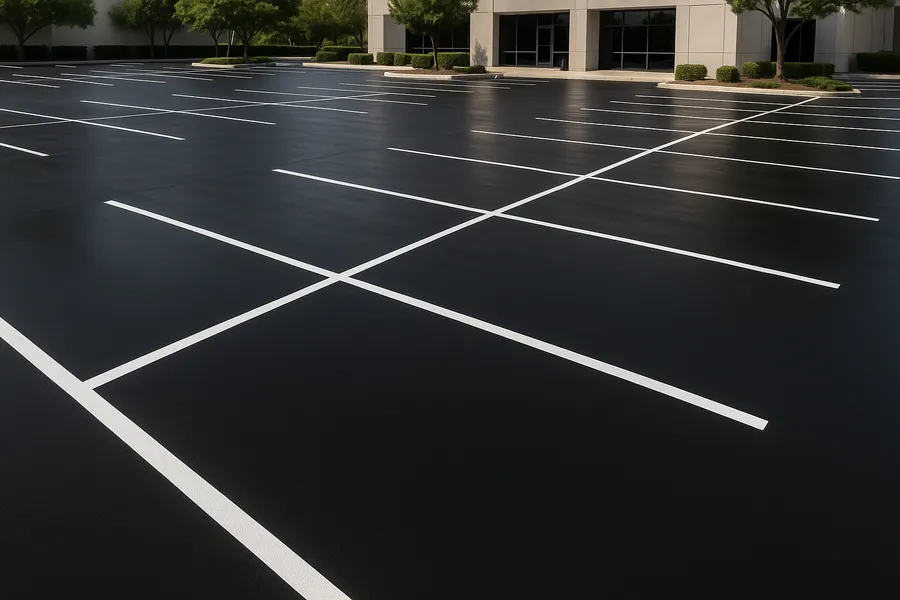
It also resists the fuel and oil drips that soften asphalt where cars park, and it restores the black finish, which is the part everyone actually notices.
What it does not do
It is a coating measured in fractions of an inch. It adds no structural strength, so it does nothing for a failing base, rutting, or alligator cracking — over those it is cosmetic, and the failure continues underneath at the same rate.
It does not fill cracks either. Those need routing and hot-pour sealant first. Sealcoat is maintenance for a sound surface, not a repair.
Material and application
Sealers come in two families. Coal-tar emulsions resist fuel and oil aggressively and wear hard, which is why they have been the commercial default for decades. Asphalt emulsions are the lower-odour, lower-VOC option and are what some municipalities and HOAs require. We will tell you which applies to your property and why.
Application is either squeegee or spray. Squeegee works the material into the surface and leaves a heavier, more uniform coat — better on rougher or more porous asphalt. Spray is faster and lays a lighter, more even film — better on smooth surfaces and large lots. Plenty of jobs use both: squeegee the first coat, spray the second.
Either way the surface has to be clean and dry, oil spots need priming or the sealer will not bond over them, and the work needs a dry weather window with warm enough days. Cure is a matter of hours before foot traffic and typically a day before vehicles, longer in cool or humid weather. On lots, striping goes back down after the coating cures.
Timing and the re-seal cycle
Two to three years is the honest interval for most surfaces here. Annual sealing is a sales cycle, not a maintenance schedule — coats stacked on coats get thick enough to crack and peel on their own, and you end up paying to remove them.
Season matters too. Sealer needs warm, dry conditions to cure, which in Kansas City means late spring through early fall. A coat rushed onto a cold or damp surface in November does not bond, and it will show you that by spring.
Sealcoating across the metro
Driveways and commercial lots on both sides of the state line.
Sealcoating in Kansas City, MO
Sealcoating in Lee's Summit, MO
Sealcoating in Independence, MO
Sealcoating in Blue Springs, MO
Sealcoating in Overland Park, KS
Sealcoating in Olathe, KS
Sealcoating in Shawnee, KS
Sealcoating in Lenexa, KS
Sealcoating in Lawrence, KS
See the full service area — 46 cities across Missouri and Kansas.
Related services
Crack Sealing
Done before sealcoating — sealant belongs in the cracks, not bridged over them.
Asphalt Repair
Failed areas get repaired first. Sealcoat over a failure hides it, briefly.
Line Striping
Sealcoating covers existing markings, so lots get re-striped afterward.
Asphalt Overlays
When the surface is past the point where a coating helps.
Sealcoating questions
How often should asphalt be sealcoated?
Every two to three years suits most driveways and lots in this climate. More often than that is mostly waste — coats applied over coats can build up thick enough to crack on their own — and much less often lets oxidation get ahead of you. The right interval depends on sun exposure, traffic, and how the surface is holding, so we look at it rather than working off a calendar.
Does sealcoating fix cracks?
No. Sealcoat is a thin coating, not a filler — it spans a hairline and does nothing structural for anything wider. Cracks get routed and filled with hot-pour rubberized sealant first, then the sealcoat goes over the top. Anyone who tells you a seal coat will take care of your cracks is describing a surface that will look better for a season and be in the same condition underneath.
When can new asphalt be sealcoated?
Not right away. Fresh asphalt needs to cure and release its oils before it will accept a coating — commonly several months, and often best left until the following season. Sealing too early traps those oils, keeps the surface soft, and can leave you with a coating that never bonds properly. New asphalt does not need the protection yet anyway; it is at its most water-resistant when it is new.
What does sealcoating cost?
It is priced by square footage and it is the cheapest thing you can do to asphalt per year of life gained — an order of magnitude below repaving the same area. Costs go up if the surface needs cleaning, oil-spot priming, or crack sealing first, which most surfaces do. Those are not upsells: sealer will not stick to an oil-stained or dirty surface, and coating over open cracks wastes the coating.
Ready to pave it right?
Get a straight estimate and a clear timeline. Tarmasters Asphalt Paving handles driveways, parking lots, and repairs across the Kansas City metro.
Call Now: (816) 789-0700