Local Asphalt Paving in Independence, MO
Truck courts, retail lots, and residential drives — built for the axle loads eastern Jackson County actually puts on them.
Tarmasters builds and repairs asphalt across Independence, Missouri — industrial truck courts, retail parking, and residential drives. Two things drive the work here: heavy truck load on the M-291 and US-24 corridors, and Wymore series expansive clay underneath it. Insured, bonded, working the metro since 2014.
Independence carries more heavy vehicle traffic than its size suggests. About 121,629 people live here, but the pavement question is set by what rolls across it: continuous Class 8 volume on M-291 and US-24 serving the industrial corridors, and truck staging at Carefree Industrial Park. One loaded semi does more damage to a surface than thousands of cars, and that is not a figure of speech — it is how pavement design works.
So the first thing we ask on a commercial job here is not square footage. It is what parks on it, how often it turns, and where it stops. Those three answers set the base depth and whether the section needs a binder course under the surface. Getting that wrong is the reason lots that look fine in the middle are rutted at the entrance.
We are based in Lee's Summit, a short run south. Insured and bonded, and we quote the structure the property actually needs — whether that is a full commercial build, repair in the loaded zones only, or a residential driveway that needs nothing exotic at all.
Why the base matters in Independence
The soil under the city is Wymore series expansive clay. Jackson County's clay soils swell when saturated and shrink during dry spells. This volume change cracks pavement from below, especially on flat lots near Noland Road that lack engineered drainage. Every Independence project needs geotechnical-aware base design.
Put heavy load on top of that and the two problems compound. Braking and turning at the I-70 interchanges works the surface sideways, which is why the damage there reads as rutting and shoving rather than the cracking you see on a quiet lot. The response is structural: a deeper compacted base, a grade that gets water away from the clay, and extra thickness where the load concentrates instead of spread evenly over ground that does not need it.
Subgrade
Wymore clay
Expansive — changes volume with moisture, year in and year out.
Truck load
Class 8, daily
Continuous on M-291 and US-24 into the industrial zones.
Lot vintage
1970s–80s
Much of the commercial stock is past a 25-year lifecycle.
Freeze-thaw
40 a year
Frost to 36 in. — open cracks become base failure.
Paving and repair in Independence
Commercial paving, repair, and driveways each have their own Independence page. The rest is covered on the metro service pages.
Retail and industrial lots built for the load they actually carry — truck courts, staging aprons, and the regional retail parking around the Independence Center District.
Full-depth patching of rutted entries and alligator-cracked bays. Common work on the Noland Road strips, where lots have run past a normal service life.
Replacing drives on the ranches and split-levels that make up most of the housing stock, plus new work in the east-side subdivisions.
Mill-and-overlay on lots whose structure is still sound. The most common answer on 1970s and 80s commercial pavement that was built well the first time.
Taking a surface down to grade so a resurfaced lot still drains where it drained and still meets the door thresholds it always met.
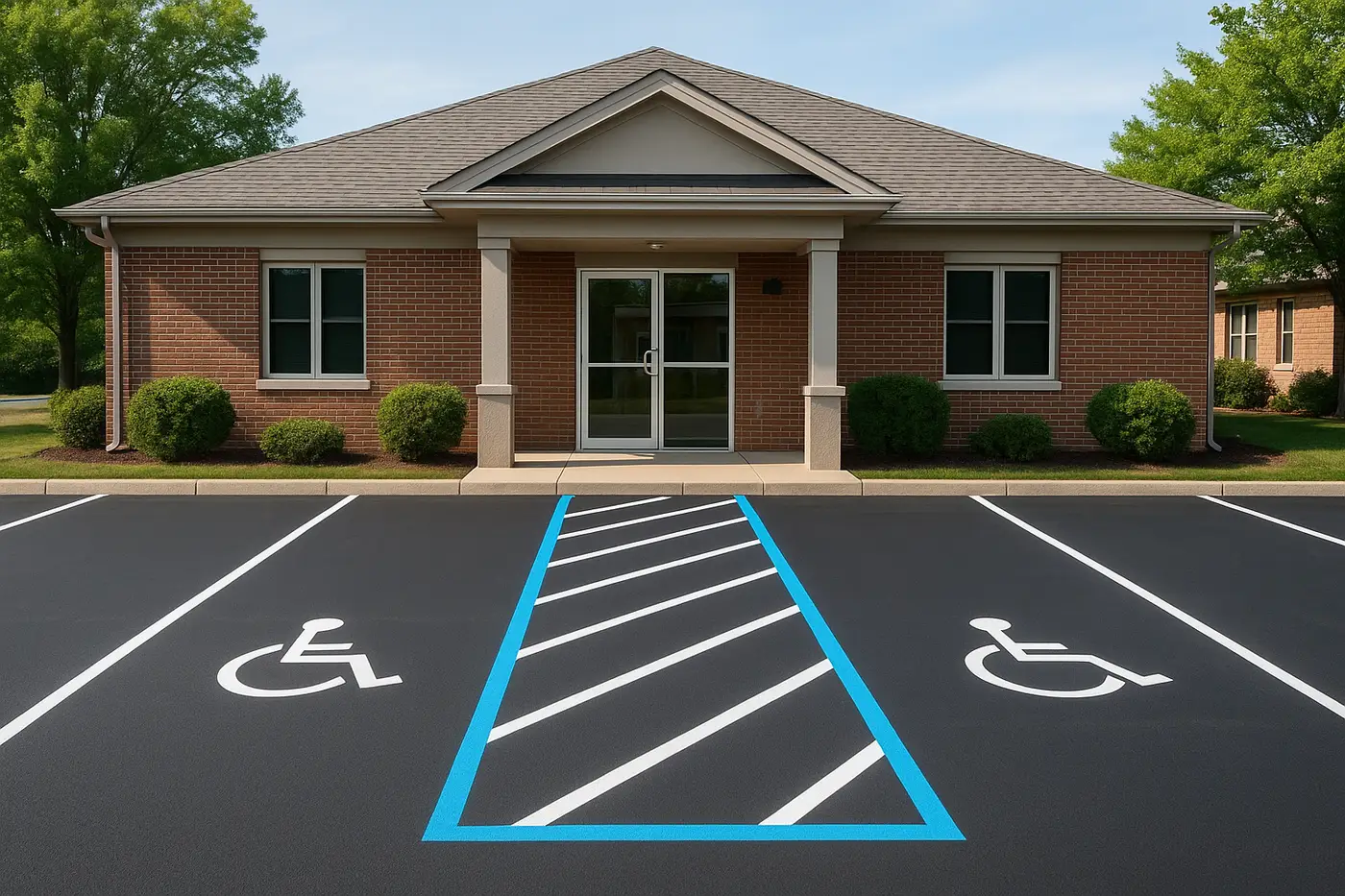
Layout and accessible-route marking. Older strip-retail lots here often predate current accessible-parking standards and need a real re-layout, not a repaint.
Sealing before winter is the cheapest structural work you can buy on clay — roughly 40 freeze-thaw cycles a year do the damage.
Binder protection on surfaces that are sound. Worth doing after repairs, not instead of them.
Maintenance intervals by property type
"Seal it every three years" is not advice — it is a slogan. What a surface needs depends on what uses it. These are the property classes we actually work on in Independence.
| Property type | Where | What to watch for | Sensible cadence |
|---|---|---|---|
| Industrial truck court or staging apron | Carefree Industrial Park, US-24 corridor | Rutting in wheel paths, shoving at turn-in points | Inspect yearly; expect full-depth repair in loaded zones long before the rest of the lot |
| Regional retail lot | Independence Center District | Alligator cracking in drive aisles, ponding in flat bays | Crack seal every 2–3 years, overlay at roughly 18–22 years if the base held |
| Medical or institutional campus | Centerpoint area | Ambulance-lane fatigue, accessible-route slope drift after patching | Sweep and seal every 3 years; re-check accessible routes after any repair |
| Strip retail from the 1970s–80s | Noland Road, US-40 | Faded layout, non-compliant accessible stalls, edge ravelling | Re-stripe every 2–3 years; treat a re-stripe as the moment to fix the layout |
| Residential driveway | Glendale, Fairmount, Rock Creek | Cracks over 1/4 in., soft spots after rain, edge crumbling | Seal every 3–4 years once cured; repair cracks the season they appear |
None of that helps if the base has already gone. Where it has, the honest answer is reconstruction of that section rather than another round of surface treatment.
Working in Independence
Tarmasters is Kansas City–owned, based in Lee's Summit, and the asphalt division of Ford Concrete and Paving. We have worked across the metro since 2014, which in practice means a great deal of Jackson County clay and a great deal of commercial pavement built in the same decades as Independence's.
Commercial work here falls under City of Independence building codes, and on a lot that is being re-laid rather than patched, accessible parking and stormwater are usually part of the conversation. We raise those at the estimate rather than mid-job.
Insured and bonded. Measured estimate, fixed price, firm sequence — and a plain answer about what the surface needs.
Serving Independence and nearby areas
We cover the whole city — the Independence Square and Truman Heritage District on the historic side, the retail and industrial corridors along Noland Rd and US-24, and the newer subdivisions out toward Little Blue Parkway / EastGate.
- ▸ Bingham Estates
- ▸ Glendale
- ▸ Santa Fe Trail
- ▸ Susquehanna
- ▸ Rock Creek
- ▸ Independence Square
- ▸ Noland Road Corridor
- ▸ Independence Center District
- ▸ Carefree Industrial Park
- ▸ Englewood
- ▸ Fairmount
- ▸ Blue Ridge Crossing
- ▸ Truman Heritage District
- ▸ M-291 Commercial Corridor
- ▸ US-24 Industrial Corridor
- ▸ Santa Fe Trail / Square
- ▸ Little Blue Parkway / EastGate
Cities next door
East of here we work Blue Springs and Buckner; south is Lee's Summit and Raytown; west is Kansas City, and north across the river, Liberty. See every city we cover.
Independence paving questions
Why do the flat lots near Noland Road crack so badly?
Two reasons stacked on each other. Wymore series expansive clay swells when it is saturated and shrinks when it dries, which cracks pavement from below. Flat lots built without engineered drainage keep that clay saturated, so the movement never stops. That combination is why the same lot can look fine on the sloped end and be failing at the low end.
Can asphalt take constant Class 8 truck traffic?
Yes, if it is built for it. A truck court is a different structure from a car park — thicker base, a binder course under the surface course, and often a stiffer mix at the points where trailers turn and stop. Where operators run into trouble is putting a standard parking-lot section under staging traffic. It ruts in the wheel paths within a couple of seasons.
Our older retail lot has non-compliant accessible parking. Can that be fixed with paving?
Usually, and repaving is the right time to do it. Accessible stalls and access aisles have slope limits in every direction, so on an existing lot the fix is often regrading a corner of the surface rather than repainting lines in the same place. We identify what needs to move at the estimate and price it as part of the job.
How long should a parking lot last in Independence?
Fifteen to twenty years is the normal structural range, with surface maintenance well inside that. Much of the commercial stock along Noland Road and the I-70 corridor went in during the 1970s and 80s, so a large share of it is past that window. Whether a lot in that condition needs an overlay or a rebuild comes down to whether the base is still carrying load.
Do you do residential work as well as commercial?
Both, and residential is a real share of the work here. Most of the housing is 1950s–1980s ranches and split-levels dominate, so we see a lot of original drives that have outlived their base and a lot of second surfaces laid over the top of them without fixing what was underneath.
Free estimates across the Kansas City metro.
Driveways, parking lots, and repairs across the Kansas City metro, since 2014.
Call Now: (816) 789-0700Tarmasters Asphalt Paving
Lee's Summit, MO 64063 | Serving the Kansas City metro | Insured | Bonded