Asphalt Paving in Blue Springs
Driveways and commercial lots built so the water leaves before it can do anything — the thing that decides how long a surface lasts here.
Tarmasters paves driveways and commercial lots throughout Blue Springs, Missouri. What ends most surfaces here is water — standing on flat older lots, and soaking the Wymore series expansive clay underneath. So we design the fall first and build the base to match. Insured, bonded, paving the metro since 2014.
Most people assume traffic is what wears out a parking lot. In Blue Springs it is usually water. The older commercial strips near the downtown core were built with minimal storm drainage, and flat lots that hold water after a rain fail in a specific, recognisable way — the surface starts letting go of its own aggregate long before the traffic count would explain it.
The rest of the city is newer and drains better. This is a growing town of about 62,429, with residential development pushing south and east and commercial density running in a line along I-70 and MO-7. But the same rule applies to the new work as the old: get the grade right and the surface has a chance; get it wrong and nothing you put on top will save it.
We are based in Lee's Summit, fifteen minutes down MO-7. Insured and bonded, and we will tell you whether the honest fix is a repair, a resurface, or regrading a section so it stops collecting water in the first place.
Our Blue Springs service list
Driveways, commercial paving, and repair each have a dedicated Blue Springs page. The rest link through to the metro service pages.
| Service | What the job usually is here | Where it comes up |
|---|---|---|
| Driveway Paving | New drives in the growing south and east subdivisions, and replacements on 1970s–90s originals. | Chapel Ridge, Copper Leaf, Stone Canyon |
| Commercial Asphalt Paving | Retail and service lots built with the fall designed first and the surface laid to follow it. | Adams Dairy Landing, MO-7 corridor |
| Asphalt Repair | Full-depth patching of potholes and fatigue-cracked bays on arterial frontage. | Old 40 Highway, Woods Chapel Rd |
| Overlays & Resurfacing | A fresh wearing course over a base that is still carrying load — the usual answer on oxidised lots. | White Oak Plaza, downtown strips |
| Asphalt Milling | Removing surface depth so a resurfaced lot keeps its drainage path instead of trapping water at the curb. | Any lot already at curb height |
| Crack Sealing | Closing the route water takes into the base before roughly 40 freeze-thaw cycles work on it. | Every property, every autumn |
| Sealcoating | Slowing the oxidation that turns a black lot grey and starts it shedding aggregate. | Deferred-maintenance retail |
| Line Striping | Stall layout, fire lanes, and accessible routes — including school and athletic lots. | Retail, school, and church lots |
What we get right on Blue Springs jobs
The grade, before anything else
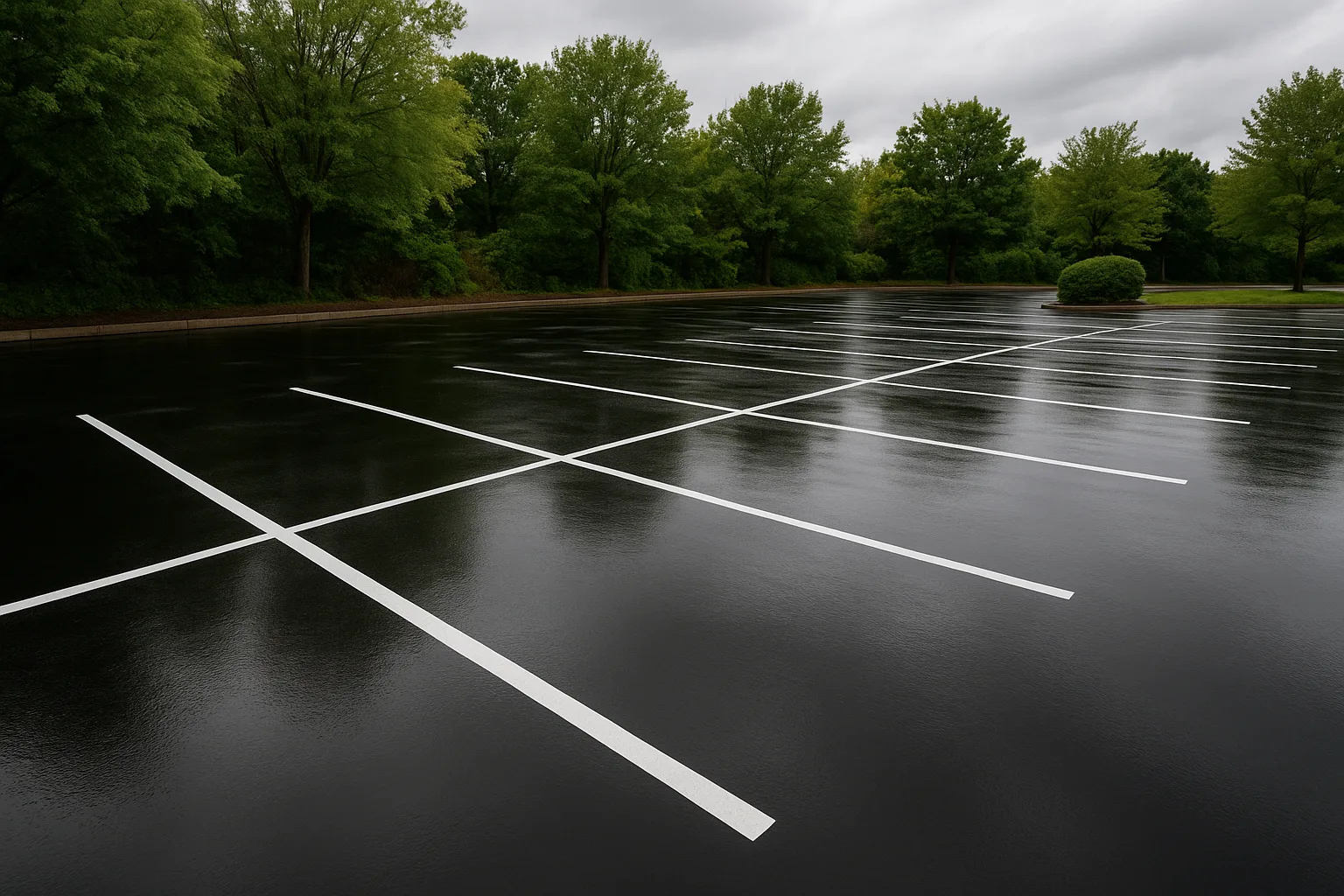
Older Blue Springs commercial strips near the downtown core were built with minimal storm drainage infrastructure. Standing water on flat lots accelerates stripping—the separation of asphalt binder from aggregate—and saturates the already-poor-draining clay beneath.
The subgrade the city actually sits on
Jackson County's clay soils swell when saturated and shrink when dry, generating vertical movement that cracks asphalt from below. Blue Springs lots—especially those built in the 1970s and 80s without proper subgrade engineering—show widespread fatigue cracking tied directly to clay heave.
Winter, which does the finishing
Blue Springs experiences 40 freeze-thaw cycles per year on average. Water that enters cracks freezes, expands, and widens them—then thaws and penetrates deeper into the clay base. This cycle turns hairline cracks into potholes within a single winter.
Where the load concentrates
MO-7 works as a north-south arterial carrying real truck volume, and the braking approach to the I-70 interchange shows up in nearby lots as shoved, rippled asphalt. On frontage property we build the entrance and drive aisle heavier than the parking bays, because that is where the damage starts.
What goes under the asphalt, by use
The depths below are ordinary industry practice. The last column is what Blue Springs' clay and its drainage history change about them — which is the part you will not find on a competitor's page.
| What uses it | Compacted base | Asphalt section | Why that, here |
|---|---|---|---|
| Residential driveway | 4–6 in. compacted aggregate | 2–3 in. asphalt | On clay we build to the top of that range, not the bottom — the base is what spans the movement. |
| Church, school, or employee lot | 6–8 in. | 3 in., one or two lifts | Load is light, but these lots are wide and flat. Fall across the surface matters more than thickness. |
| Retail lot with delivery access | 8 in. | 2 in. binder + 2 in. surface | Trucks reach the doors whether or not the site plan says they will. |
| Drive aisles and entrances | 8–10 in. | 2.5 in. binder + 2 in. surface | Turning and braking load concentrates here — this is where MO-7 frontage lots fail first. |
| Industrial or truck staging | 10–12 in., stabilised where the subgrade is soft | 3 in. binder + 2 in. surface | The failure mode is wheel-path rutting, not cracking, so section depth is the whole answer. |
| Dumpster pads and loading points | n/a | Concrete, not asphalt | A static point load plus a hydraulic lift will punch through any mat. We build these in concrete. |
Areas we cover near Blue Springs
Residential work runs heaviest through the newer subdivisions — Chapel Ridge, Copper Leaf, Saddle Ridge, Stone Canyon, and Whitetail — while commercial work concentrates at Adams Dairy Landing, 7 Highway Retail Corridor, White Oak Plaza. Access is off I-70, MO-7, US-40, and Adams Dairy Pkwy.
Neighbouring cities
Every city on our list, across both sides of the state line.
Working in Blue Springs
Tarmasters is a Kansas City–owned paving contractor and the asphalt division of Ford Concrete and Paving, working across the metro since 2014 with our own crews and equipment. Blue Springs is close work for us rather than an out-of-area trip, which matters more than it sounds: asphalt has to arrive hot enough to compact properly, and haul time is the thing that decides that.
Commercial jobs run under City of Blue Springs building codes. On a lot being re-laid rather than patched, stormwater handling and accessible parking generally come into scope, and we would rather raise that at the estimate than discover it halfway through.
Insured and bonded. A measured estimate with a fixed number, a firm timeline, and a straight answer — including when the answer is that your lot needs drainage work more than it needs asphalt.
Blue Springs paving questions
Why does water standing on a lot damage the asphalt?
Because asphalt is aggregate held together by binder, and prolonged water works the binder loose from the stone. The technical name is stripping, and once it starts the surface begins shedding aggregate and losing strength from within rather than from the top down. On a clay subgrade it is worse still, because the water that sits on the surface also keeps the ground underneath saturated and moving.
Can drainage be fixed without tearing up the whole lot?
Often, yes. Sometimes the answer is milling a low area and re-laying it to a corrected grade, sometimes it is adding an inlet or re-cutting a swale at the edge. It is only a full rebuild when the ponding has already taken the base out under a large share of the surface. We measure the fall before quoting so the answer is based on the actual grade, not a guess.
How does Wymore series expansive clay affect a Blue Springs driveway?
It moves. Expansive clay swells when it takes on water and shrinks when it dries, and that vertical movement cracks pavement from below. Drives built in the 1970s and 80s without engineered subgrade preparation are where we see the widest fatigue cracking. The fix is a properly compacted granular base deep enough to spread the load, plus a grade that keeps water off the clay.
Our retail lot has gone grey and is shedding stone. Is that structural?
Usually not, on its own. Grey, raveling surfaces are oxidation — the binder hardening and losing its grip on the aggregate through sun and age. If the base is still firm, that is an overlay or a sealcoat problem. If the greying is accompanied by connected cracking or areas that sink, the structure has gone too and a surface treatment would only hide it for a season.
Do you work around school and business hours?
Yes. Most commercial and school lots get phased so an entrance and a route through stay open, and the paving stage is scheduled for the window that costs the property least — often over a weekend or a school break. The sequence comes with the estimate so you can plan around it.
Ready to pave it right?
Get a straight estimate and a clear timeline. Tarmasters Asphalt Paving handles driveways, parking lots, and repairs across the Kansas City metro.
Call Now: (816) 789-0700