Grain Valley Asphalt Paving
Not everything that fails is a crack. Ruts and ripples are the pavement moving — and they need rebuilding, not resurfacing.
Tarmasters paves and repairs asphalt across Grain Valley, Missouri. Two forces work on pavement here: Wymore series expansive clay cracking it from below, and I-70 freight shoving it from above. Those are different failures needing different work. Insured, bonded, paving since 2014.
Ask most contractors about a failing lot and you will get a conversation about cracks. In Grain Valley, a good share of the damage is not cracking at all — it is the pavement moving. Ripples pushed up where trucks brake near the Buckner-Tarsney Road interchange. Parallel ruts in the wheel paths of newer industrial lots. Nothing has fractured; the material has deformed and stayed that way.
The distinction matters because the two need opposite work. A crack can be sealed or overlaid. A rut or a shove cannot — the section has to come out and be rebuilt, because whatever allowed it to move is still there. Resurfacing over deformation is how a lot gets paid for twice.
Grain Valley is growing quickly — around 16,450 people now, with a logistics corridor along I-70 and a redeveloping Main Street downtown. We work it from Lee's Summit, insured and bonded, and we tell you which of the two problems you have before quoting repair, an overlay, or a rebuild.
Asphalt work we do in Grain Valley
Commercial paving, repair, and driveways have dedicated Grain Valley pages. The rest run through the metro service pages.
Logistics and retail lots on the I-70 corridor, with the section set by axle load and the entries built heavier than the bays.
Removing and rebuilding shoved and rutted areas, which is different work from patching a crack.
New drives across the fast-growing subdivisions, and replacements on the older stock near downtown.
Before mid-autumn, every year. Properties that skip it routinely find blowouts by March.
Protecting the binder on surfaces that are still sound — most of the newer commercial stock qualifies.
A new wearing course on the downtown-area lots whose structure survived but whose surface has not.
Layout, truck routing, fire lanes, and school and stadium parking.
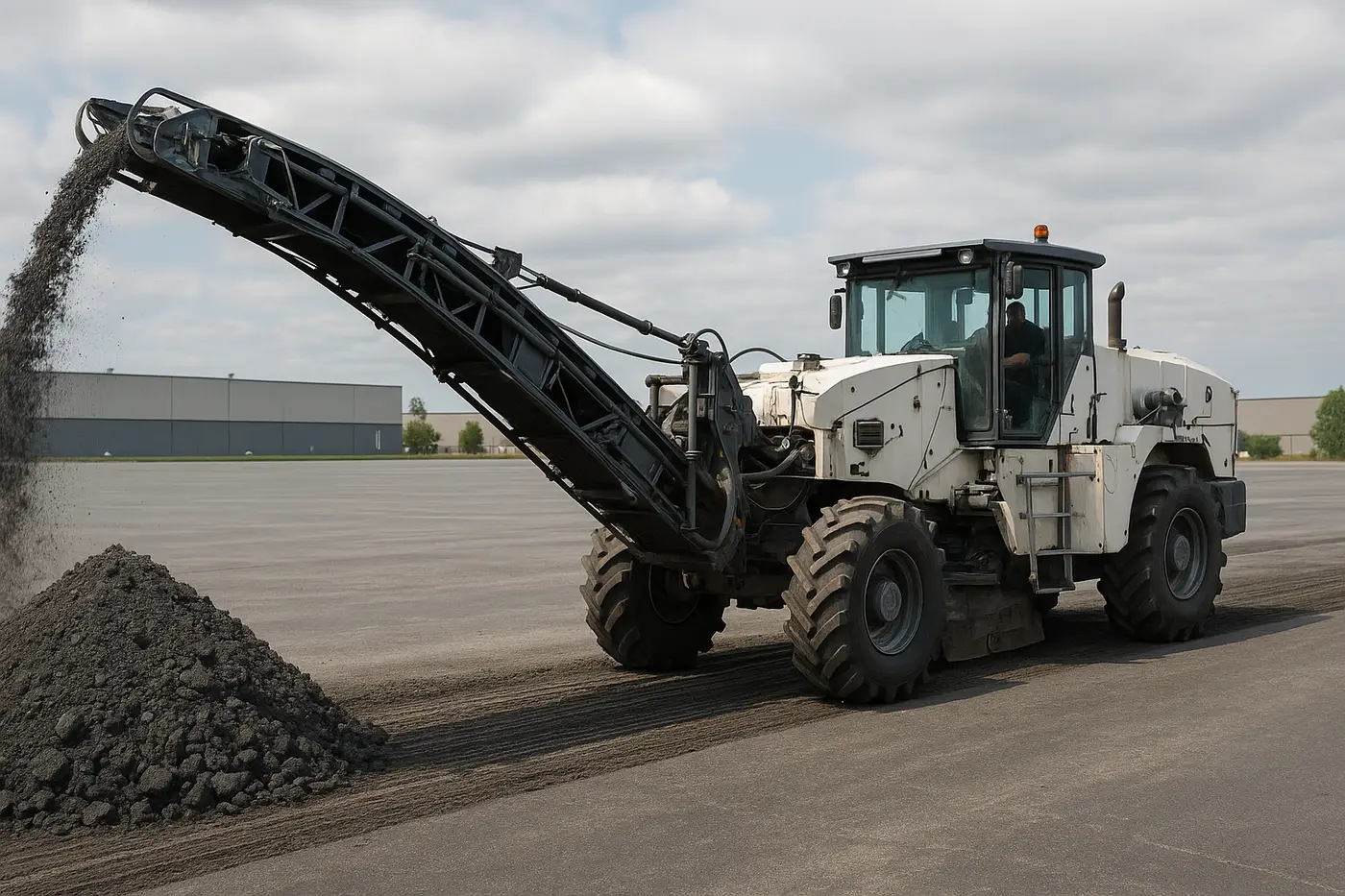
Cutting a deformed surface off to grade — the only honest starting point where a lot has shoved.
Why proper prep matters here
Jackson County's clay-dominant subgrade swells when wet and contracts when dry, creating cyclical movement that cracks asphalt from below. Every Grain Valley lot requires a minimum 8-inch granular base buffer and subsurface drainage to isolate the pavement structure from seasonal moisture fluctuation.
Grain Valley's topography is largely flat across commercial zones, so stormwater doesn't drain naturally. Standing water saturates base material and accelerates stripping of asphalt binder from aggregate — particularly visible along the US-40 retail frontage where sheet flow pools against buildings. Put I-70 freight loads on top of that and you get all six of the failures below, sometimes on the same property. Here is how to tell them apart.
| Failure | What it looks like | What causes it here | What it needs |
|---|---|---|---|
| Shoving | Ripples, humps, and a wave pushed up ahead of where vehicles brake or turn | The mat moving sideways under repeated braking and turning load — worst near the Buckner-Tarsney interchange | Remove the affected depth and rebuild the section. Overlaying ripples produces ripples. |
| Rutting | Two parallel depressions in the wheel paths, holding water after rain | Permanent deformation in the base or the mat under repeated heavy axles — the standard new-industrial failure | Full-depth reconstruction of the wheel-path zone with a deeper base and a binder course. |
| Fatigue (alligator) cracking | Interconnected cracks in a pattern like scales, usually in a defined area | The base flexing under load it cannot carry — often clay movement having taken the support away | Full-depth patch of that area. A surface treatment over it buys one season. |
| Thermal and shrinkage cracking | Straight, isolated cracks running across or along the lot | Temperature cycling and asphalt ageing, not load. Normal, and manageable if caught | Rout and seal, on cycle. This is the failure you want to have. |
| Ravelling | Loose stone on the surface and a rough, open texture | Oxidised binder that has stopped holding the aggregate | Sealcoat if caught early; overlay once the surface has opened up. |
| Stripping | The surface failing from within, often where water stands | Water separating binder from aggregate on flat commercial ground that does not drain | Fix the grade first. Any surface work done before that will fail the same way. |
The first three need structural repair. The last three are usually sealing, surface protection, or a drainage correction. Knowing which is which is most of the value of an inspection.
Working in Grain Valley
Tarmasters is a Kansas City–owned paving contractor and the asphalt division of Ford Concrete and Paving, working across the metro since 2014 with our own crews, pavers, and milling equipment. On deformation work that matters — milling a shoved area out properly is the whole repair, and it is not something we hand off.
Work here runs under City of Grain Valley building codes, and the downtown redevelopment area carries its own design standards that a paving job has to meet. We raise those at the estimate rather than at inspection.
Insured and bonded. Measured estimate, fixed price, firm sequence, and a straight answer about what your surface needs.
Nearby Grain Valley communities
Residential work runs through Rosewood, Greystone, Sni-A-Bar Farms, Woodbury, and the newer subdivisions off Buckner-Tarsney Rd (Main St). Commercial and logistics work concentrates at Downtown Overlay District, Northern Buckner-Tarsney Logistics Area, I-70 & Main St Retail, with access off I-70, US-40, and AA Hwy.
Cities around Grain Valley
Grain Valley paving questions
What is the difference between shoving and cracking?
Cracking is fracture — the material splits. Shoving is deformation — the material moves and stays moved. They look different, they are caused by different things, and they need completely different work. Sealing or overlaying a shoved area does nothing, because nothing has broken; the mat simply slid. That area has to come out and be rebuilt.
Why is the shoving worst near the interchange?
Because that is where heavy vehicles slow, stop, and turn, repeatedly, in the same few metres. I-70 is a primary freight artery and the Buckner-Tarsney Road interchange concentrates that braking and turning right where lots and frontage roads meet it. Sustained horizontal force on a surface that was not designed for shear is what produces the wave.
Our logistics lot went in around 2018 and is starting to rut. Is that normal?
It is common, and it is a structure issue rather than a quality issue in the asphalt itself. Rutting in the wheel paths means the section is deforming under the axle loads using it. The right response is rebuilding those lanes to a heavier spec rather than resurfacing the whole lot — the parking bays are usually fine and do not need the same section.
How deep does the base need to be over Wymore series expansive clay?
A minimum eight-inch granular base with subsurface drainage, and more where heavy vehicles run. The clay under Jackson County swells when wet and contracts when dry, so the base is what isolates the pavement from that seasonal movement. Thinner than that and the surface follows the ground rather than spanning it.
When should we crack seal?
Autumn, before the freezing starts. This county crosses the freezing point more than fifty times in a typical winter, and every one of those cycles drives water further into an open crack. Sealing in September or October is cheap; dealing with the pothole blowouts in March is not.
Ready to pave it right?
Get a straight estimate and a clear timeline. Tarmasters Asphalt Paving handles driveways, parking lots, and repairs across the Kansas City metro.
Call Now: (816) 789-0700