Asphalt Paving Serving Odessa and Nearby Communities
A lot of pavement here was built flatter than it needed to be. The useful question is whether that can be corrected without starting again.
Tarmasters paves, repairs, and regrades asphalt across Odessa, Missouri. Many lots here were built with less fall than sheet-flow drainage needs, and standing water on Grundy series heavy clay takes the base out from below. We fix the water first. Insured, bonded, working the metro since 2014.
A large share of the commercial pavement in Odessa was laid with less slope than it needed. Not badly built otherwise — just flat, and below the roughly 1.5 per cent at which water stops moving across a surface and starts finding low points instead. On the level ground here, that decision was made once and the lot has been living with it ever since.
So the question we get asked most is not "should we resurface" — it is whether the grade can be corrected without rebuilding the lot. Sometimes it can: mill a low area out, re-lay it to a proper fall, tie it back in. Sometimes the honest answer is that the whole surface is under grade and the correction costs close to reconstruction. Either way, it starts with measuring what is actually there.
Odessa is a commuter and logistics town of around 5,593 on the I-70 corridor, with retail at the MO-131 interchange and industrial traffic running south. We work it from Lee's Summit, insured and bonded, and we will tell you whether you need milling and a reprofile, structural repair, or a rebuild.
Five things that decide whether a flat lot can be corrected
We work through these before quoting a regrade. Between them they separate a targeted, affordable fix from a job that is really a reconstruction wearing a different name.
How much fall does the lot actually have right now?
Shot with a laser across the whole surface, not judged by eye. Under about 1.5% you do not have sheet-flow drainage, and water will sit regardless of how good the asphalt is. Knowing the current number is the difference between a targeted fix and a guess — and it usually takes an hour.
Where is there room to raise, and where is there not?
Kerbs, door thresholds, drainage castings, and the tie-in at the street are all fixed points. Adding material to correct a grade only works where the finished level still meets them. Where it does not, the correction has to come from milling down instead of building up, which is a different job and a different number.
Is the ponding one low area or the whole lot?
A single low corner is a localised fix: mill it out, rebuild it to a corrected grade, tie it back in. A lot that is uniformly too flat is not — that is a full-surface reprofile, and it is worth being honest that the cost sits much closer to reconstruction than to a repair.
Has the standing water already taken the base?
This decides everything. Many Odessa lots were graded with minimal slope — less than the 1.5% minimum needed for sheet-flow drainage. Standing water saturates pavement through cracks, softens Lafayette County's clay subgrade, and triggers base failure that spreads outward from the ponding zone. Where that has already happened, correcting the surface grade over a softened base just gives you a well-drained lot that fails from underneath. Those areas need excavation and rebuilding before any regrade is worth doing.
Can an inlet solve it instead?
Sometimes, and it is always worth checking before committing to a reprofile. Adding a catch basin at a low point and piping it out can drain an area that has nowhere else to send water, at a fraction of the cost of re-laying a surface. It only works if there is somewhere to discharge to.
The base under an Odessa job
Five conditions and what each one changes about the build.
| Condition | In Odessa | What we do about it |
|---|---|---|
| Grade | Many lots built with less than the 1.5% needed for sheet flow | Measure first, then reprofile the areas that need it — or add collection where reprofiling is not possible |
| Subgrade | Grundy series heavy clay | Subgrade moisture assessment and compaction testing before a base design is committed |
| Freeze-thaw | About 38 cycles a year, 50 or more in a hard winter | Crack sealing on cycle. Two winters of open cracks can take a lot from serviceable to failing |
| Freight load | I-70 as the primary logistics artery, plus agricultural traffic on MO-131 | Heavier sections at entrances, drive aisles, and anywhere trucks turn between the highway and the yard |
| Asset age | Frontage retail 20 to 30 years old and at the end of a structural lifecycle | An honest rehabilitation assessment rather than another surface treatment over a spent structure |
Odessa's native soils are heavy clay and clay-loam that swell when saturated and shrink during summer drought. This seasonal volume change breaks subbases from beneath — a mechanism that's invisible on the surface until cracks propagate and potholes form. Every Odessa job starts with subgrade moisture assessment and compaction testing.
Odessa paving services
Commercial paving, repair, and driveways have dedicated Odessa pages. The rest run through the metro service pages.
Logistics, retail, and service lots built to a designed grade rather than to whatever the site already does.
Excavating and rebuilding the areas where ponding has already softened the base beneath.
The tool that makes a regrade possible without raising a lot past its kerbs and thresholds.
A new wearing course on the I-70 frontage retail — worth doing only where the structure is sound.
Long approaches on the larger rural lots and replacements in the older parts of town.
The single cheapest thing standing between an open crack and a saturated clay subgrade.
Slowing the oxidation showing on aging retail near the interchange — after the drainage is sorted.
Layout, truck routing, fire lanes, and accessible parking across retail and industrial property.
Our Odessa-area coverage
Commercial work concentrates at the I-70 & 131 Interchange, the Main Street Retail District, and the Odessa Industrial Park. Residential and rural work runs out from the town centre. Access is off I-70, MO-131, Old 40 Hwy, and 2nd St.
Cities around Odessa
East along the river is Lexington; west down I-70 are Oak Grove, Grain Valley, and Blue Springs; north-west are Buckner and Independence. Orrick sits inside the same run. Every city we serve.
Working in Odessa
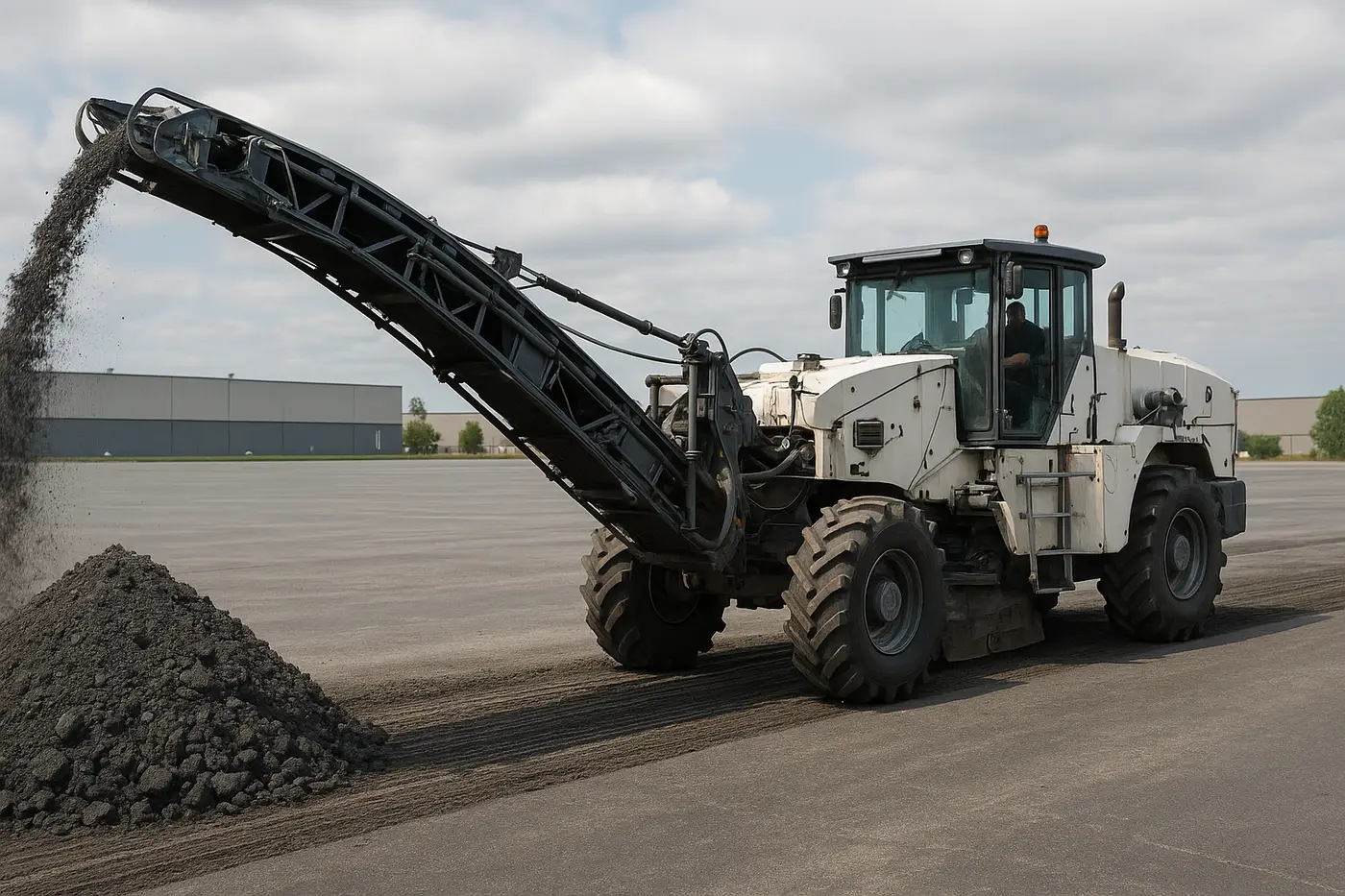
Tarmasters is a Kansas City–owned paving contractor and the asphalt division of Ford Concrete and Paving, working the metro since 2014 with our own crews, pavers, grading equipment, and milling machine. Regrading work in particular depends on owning the milling side — otherwise "take another inch off" becomes a negotiation.
Work here runs under City of Odessa / Lafayette County codes. On commercial property, stormwater handling and accessible parking come into scope on a lot being re-laid — and a regrade is a good moment to settle both.
Insured and bonded. Measured estimate, fixed price, firm sequence, and a straight answer about what your surface needs.
Odessa paving questions
Can a lot that was built too flat be fixed without tearing it all out?
Often, yes — it depends on where the problem is and how much room there is to work with. A single low area can be milled out and re-laid to a corrected grade. A lot that is uniformly too flat needs a full-surface reprofile, and at that point the honest comparison is against reconstruction rather than against a repair. We measure the existing fall before saying which one you have.
Why 1.5%?
Below roughly that gradient, water stops moving as sheet flow and starts finding low spots instead. It is not an arbitrary number — it is the point at which surface tension and minor irregularities in the pavement win. Many lots here were graded under it, which is why ponding is such a common complaint in a town with no drainage disadvantage otherwise.
What does standing water actually do to the pavement?
More than it looks like. It works the binder loose from the aggregate at the surface, and it soaks through cracks into Grundy series heavy clay beneath, which loses strength when saturated. Base failure then spreads outward from the ponding zone rather than staying put. That is why fixing the water usually has to come before fixing the surface.
Our lot is on the I-70 frontage and is rutting. Is that drainage too?
Probably not — that is load. I-70 carries heavy logistics traffic and MO-131 takes intense axle stress between the interstate and the agricultural hubs to the south. Rutting in wheel paths is permanent deformation under axle weight, and the fix is rebuilding that zone with a deeper base and a binder course, not correcting a slope.
How old is most of the commercial pavement here?
Twenty to thirty years for the retail along the frontage, which puts a lot of it at a genuine decision point. Those properties are past where surface treatment is meaningful and into the question of whether the base still carries load. We will tell you which side of that line your lot is on.
Ready to pave it right?
Get a straight estimate and a clear timeline. Tarmasters Asphalt Paving handles driveways, parking lots, and repairs across the Kansas City metro.
Call Now: (816) 789-0700