Crack Sealing in Kansas City
The cheapest work you can do on asphalt, and the one with the most years in it — if it is done before winter finds the crack.
What sealing a crack actually prevents
Nearly every expensive asphalt failure starts as a crack somebody left open through a winter.
Water reaching the base
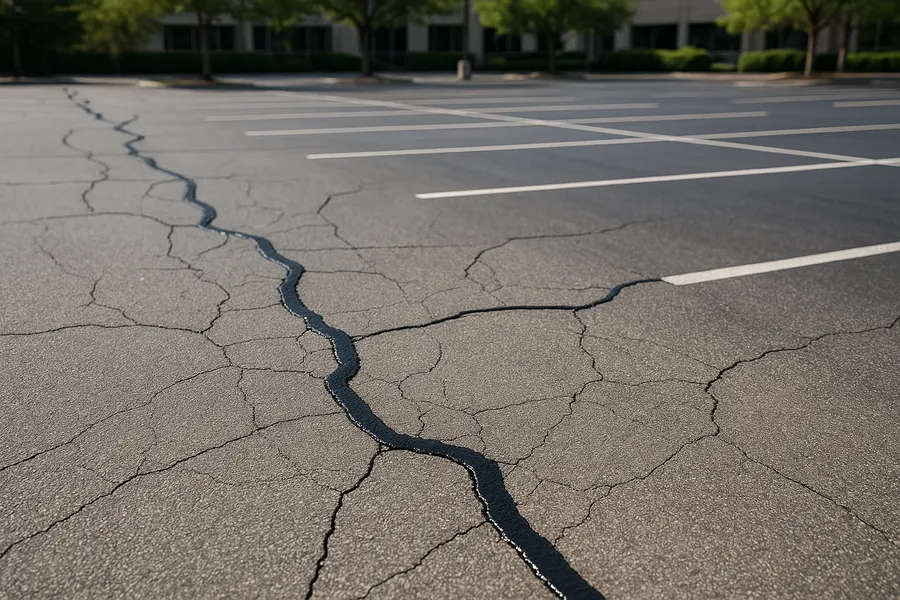
An open crack is a funnel. Every rain puts water straight past the surface and into the stone base, where it softens support and starts the failure that shows up later as a pothole.
Freeze-thaw widening
Water in a crack freezes, expands, and pushes the crack wider. Kansas City runs through that cycle repeatedly each winter, so a hairline in November is a quarter-inch gap by March.
Transverse cracking
Cracks running across the pavement, usually from thermal contraction in cold weather. They are normal on aging asphalt and are exactly what sealing is designed for.
Longitudinal cracking
Cracks running along the direction of travel, often at a paving joint or along the wheel path. Sealable while they are still isolated lines rather than a connected pattern.
Block cracking
Large rectangular patterns from an aging, hardening surface. Sealing the pattern slows water intrusion, though a surface at this stage is usually heading toward resurfacing.
Edge and joint cracks
Openings where the pavement meets a curb, gutter, or another surface. These take on a lot of water because everything drains toward them.
Routed, cleaned, and filled hot
Routing cuts the crack into a consistent channel with square walls. It sounds like extra work for no benefit and it is the difference between sealant that stays put and sealant that peels out in a season — a ragged natural crack gives the material almost nothing to grip, and no consistent depth to flex across.
Cleaning comes next: compressed air, and heat where the crack holds moisture. Sealant will not bond to dust, dirt, vegetation, or a damp wall. This is the step most commonly skipped, and skipping it is why some crack sealing looks like a black line sitting on top of the pavement a year later.
Hot-pour rubberized sealant goes in melted, flows to the walls of the channel, and bonds as it cools. It stays flexible, which is the entire point — the crack will keep moving with temperature, and a rigid filler would simply crack again. Deeper cracks get backer rod pushed in first so the sealant sits at a workable depth instead of disappearing into the void.
It sets up quickly. Most areas take traffic the same day.
Crack sealing is not sealcoating
The names are close enough that people book the wrong one. Crack sealing is targeted: flexible material into individual cracks to stop water reaching the base. Sealcoating is a thin coating across the entire surface that slows oxidation and resists fuel and oil.
Order matters. Cracks first, coating second. Sealcoat spread over open cracks drapes into them, splits within months, and leaves you having paid for a coating that is already failing along every line it was supposed to hide.
Crack sealing across the metro
Driveways and commercial lots on both sides of the state line, ahead of winter wherever we can.
Related services
Crack sealing questions
Which cracks can be sealed, and which cannot?
Isolated cracks in otherwise sound pavement seal well — transverse, longitudinal, joint, and edge cracks, roughly a quarter-inch to an inch wide. Below that they are too narrow to take sealant properly; a hairline is better left until it opens. What cannot be sealed is alligator cracking, the interconnected scaled pattern that means the base is flexing. Filling those lines does nothing structural, and the area needs full-depth repair or resurfacing instead.
How long does crack sealing last?
Typically three to five years per application, depending on how much the pavement moves and how hot the surface gets in summer. Properly routed and filled cracks last at the top of that; sealant poured into an unrouted, dirty crack pulls away from the edges much sooner. It is normal to re-seal new cracks every couple of years as they appear — that is maintenance working, not failure.
Is crack sealing the same as sealcoating?
No, and the names cause real confusion. Crack sealing puts a flexible rubberized material into individual cracks to keep water out — a structural-protection job. Sealcoating spreads a thin coating across the whole surface to slow oxidation and resist fuel and oil — a surface-protection job. They solve different problems and they are done in that order: seal the cracks first, then coat the surface. A sealcoat applied over open cracks just drapes over them and splits.
When is the best time to have it done?
Spring and fall are ideal. Cracks are at a moderate width then — in high summer heat the pavement expands and closes them up, which makes proper filling difficult, and in deep cold they are at their widest and the surface is too cold for good adhesion. The important thing is doing it before winter, so water is not sitting in open cracks through the freeze-thaw season.
Ready to pave it right?
Get a straight estimate and a clear timeline. Tarmasters Asphalt Paving handles driveways, parking lots, and repairs across the Kansas City metro.
Call Now: (816) 789-0700