Asphalt Driveway Paving in Kansas City
New driveways, replacements, and gravel conversions across the metro — sloped to drain, with edges that hold.
Driveways fail at the edges
A parking lot usually has curb holding it in. A driveway almost never does. The asphalt just ends at the grass, and that unsupported edge is where the failure starts — a wheel drops off it, the edge crumbles, water gets into the break, and the crumbling works inward a few inches a year.
Supporting the edge means backfilling against it so the asphalt is held rather than cantilevered over air. It costs very little on the day and it is the single biggest difference between a drive that looks square at year twelve and one that has lost six inches off each side.
The other two failure points on a residential drive are the slope — water running at the garage instead of away from it — and the freeze-thaw cycle working on anything that holds water. Around here that cycle runs dozens of times a winter, so a driveway that ponds does not get a quiet season to recover.
What a driveway build involves
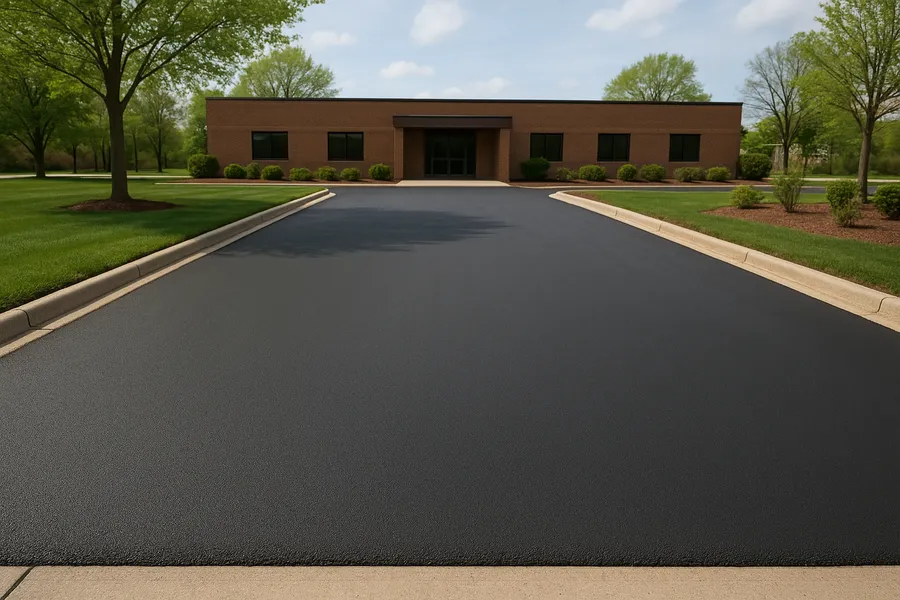
Driveway paving is the same sequence as any asphalt paving work — sub-base, aggregate base, hot mix, compaction — specified for passenger loads instead of delivery trucks. That means a thinner section than a commercial lot, which makes the base and the drainage matter proportionally more, not less.
Most residential work falls into three jobs: a replacement where the old drive has failed past repair, a conversion from gravel, or a new drive on a property that has not had one. All three run the same way once the ground is open.
How a driveway goes in
Most drives are a single day on site once the schedule opens up.
Tear-out and sub-base prep
The old surface comes out and the sub-base gets shaped and proof-rolled. Soft spots get dug out and replaced rather than bridged over — a driveway is narrow enough that one bad area under the wheel track shows up fast.
Slope and drainage
We set the slope so water leaves the drive and does not run at the garage. On most lots that means a slight crown or a consistent fall to one side, tied into whatever the yard and the street already do.
Aggregate base
Crushed stone goes down and gets compacted. For passenger loads the base is thinner than commercial work, but it still has to be uniform — an inconsistent base is why one section settles while the rest holds.
Paving and rolling
Hot mix is laid at the thickness passenger vehicles call for, then rolled to compaction while it is still hot. Residential drives are usually a single course over a sound base.
Edges, apron, and transitions
The edges get support and the apron gets tied into the garage slab and the street so there is no lip. This is the step people skip, and it is the one that costs them.
The first few weeks
New asphalt is drivable long before it is fully cured. In the first weeks it stays soft enough that anything with a small contact patch can leave a mark — a kickstand, a trailer jack, the foot of a jack stand — and turning the wheel while stopped can scuff the surface. Sitting in the same spot through a hot afternoon can press in tire impressions.
None of that is a defect; it is asphalt behaving like asphalt while it hardens. Give it a few weeks of ordinary use and it firms up. We will tell you the timing for your job and the weather it went in under, and we will tell you when it is worth putting the first sealcoat on it — which is later than most people are told.
Driveway paving across the metro
Residential work on both sides of the state line, in established neighborhoods and newer subdivisions alike.
Driveway paving in Kansas City, MO
Driveway paving in Lee's Summit, MO
Driveway paving in Independence, MO
Driveway paving in Blue Springs, MO
Driveway paving in Overland Park, KS
Driveway paving in Olathe, KS
Driveway paving in Shawnee, KS
Driveway paving in Lenexa, KS
Driveway paving in Lawrence, KS
Outside these cities? Check the full service area or call (816) 789-0700.
Related services
Asphalt Paving
The full paving service — driveways, lots, and everything built the same way underneath.
Sealcoating
Protects a sound driveway surface from oxidation and water once it has cured.
Crack Sealing
Keeps water out of the cracks that open up over a few Kansas City winters.
Asphalt Repair
For a drive that has failed in places but does not need replacing yet.
Driveway questions
What drives the cost of an asphalt driveway?
Square footage, then how much comes out and what is underneath. A straight replacement over a sound base is the cheapest version. Costs go up when the sub-base has to be dug out and rebuilt, when the grade needs correcting so water stops running the wrong way, when access is tight enough to slow equipment down, and when the drive has to be widened or reshaped. We measure it and give you a fixed number before anything starts.
Can you pave over my gravel driveway?
Usually, and it is one of the more straightforward conversions — a gravel drive already has stone in place. What matters is whether that stone is the right depth, clean, and compacted, or whether it has been thinned and contaminated with dirt over the years. We check it, add and compact aggregate where it is short, set the slope, and pave. If the existing gravel is mostly mud by now, it comes out first.
How long before we can park on a new driveway?
Normal driving is usually fine after a day or two, depending on temperature and thickness. Parking is different from driving: leave a car in one spot on green asphalt in July and you can press in tire marks, and a motorcycle kickstand, trailer jack, or jack stand will dent it. Give it a few weeks before anything sits in one place, and avoid cranking the wheel while stopped.
How long does an asphalt driveway last?
Typically 15 to 20 years, and longer with sealcoating and timely repairs. The base and the drainage decide it. A drive that sheds water and sits on a compacted base outlasts one that ponds, no matter how good the surface looked the week it went in.
Ready to pave it right?
Get a straight estimate and a clear timeline. Tarmasters Asphalt Paving handles driveways, parking lots, and repairs across the Kansas City metro.
Call Now: (816) 789-0700