
Driveway Paving for Olathe Homes and Businesses
A city this new should not have this many failing drives. The reason is under them.
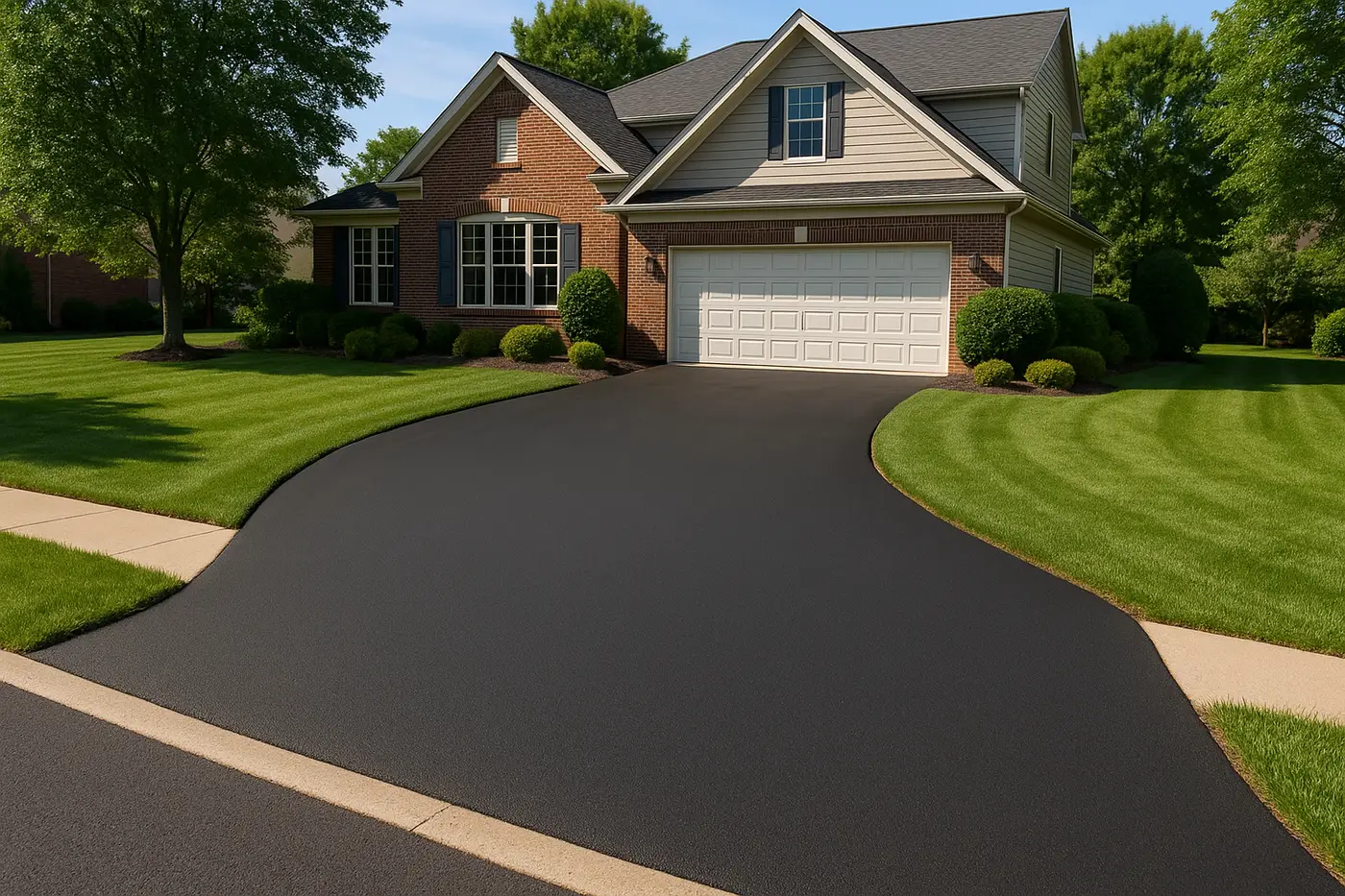
Tarmasters paves and replaces driveways across Olathe, Kansas. Because so much of the city was built at speed on Martin-Woodson series clay-loam, drives here often fail young — from disturbed fill and a thin base rather than from worn-out asphalt. We rebuild from the subgrade up. Insured and bonded since 2014.
Olathe went up fast and it is still going. The 1970s–1990s in central Olathe core around Havencroft and Heatherstone is now on its second or third driveway, while the growth on the south and west sides — out past Cedar Creek and the K-10 corridor — has produced thousands of drives that are barely twenty years old.
The calls we get come from both. Old drives wear out, which is expected. Young drives crack, which surprises people — and it has causes worth knowing before you pay to replace one. Commercial lots are covered under commercial asphalt paving in Olathe; patching and pothole work is asphalt repair.
Why proper prep matters here
Three reasons an Olathe driveway fails before its material life is up. None of them are the asphalt.
The lot was mass-graded before the house went up
On a subdivision built at speed, the ground under a driveway is rarely undisturbed. It has been cut, filled, and moved, and unless that fill was placed in lifts and compacted properly it will consolidate under load later — which is what a dip in a ten-year-old drive is telling you.
The clay under it swells more than most
Martin-Woodson series clay-loam in this part of Johnson County carries a strong montmorillonite fraction: it expands noticeably after rain and shrinks back in a dry summer. Without a separator between clay and stone, the clay works its way up into the base and the base stops being a base.
The drive was built to a builder schedule
New-construction drives go in against a closing date. Base depth gets set by the budget rather than by what the ground needs, and the paving happens whenever the schedule allows. That is the difference we are usually correcting on the first replacement.
What you park on it changes what goes under it
Driveways get quoted as though they are all the same build. They are not. Typical ranges for this ground — the exact numbers come from what the subgrade does when we load it.
| What uses it | Base | Asphalt | Why |
|---|---|---|---|
| Cars and light SUVs only | 4–6 in. compacted crushed limestone | 2–3 in. of hot mix | The standard residential build. Depth goes to the upper end wherever the clay is soft. |
| A heavy pickup or a work van daily | 6–8 in. | 3 in. | Concentrated axle loads in the same wheel path are what rut a thin mat. |
| RV, boat, or trailer parked on it | 8 in. or more under the parking area | 3 in. | Stationary point loads are harder on asphalt than moving ones. Jack pads spread the load. |
| Small business drive with delivery vans | 8 in.+, with the turning area built heaviest | 3–4 in., often in two lifts | Turning under load shoves asphalt sideways. Thickness and mix both matter here. |
The work itself
Replacement. The usual answer on a drive with connected cracking or settlement, because both start below the surface. Everything out, subgrade corrected, base rebuilt to the depth the use calls for.
Resurfacing. Worth doing where the base proof-rolls tight and only the surface is finished — more common on the 1990s builds in the middle of the city than on the newest subdivisions, which is not the order most people expect.
New drives, widenings, and RV pads. Extra parking on the larger south-side lots, third-car widenings, and gravel conversions. Anything that will hold a trailer or an RV gets built heavier under the parking area.
From grade to final coat
01Grade first, on paper
We work out where water is going before anything comes out — off the drive, away from the garage, and clear of the neighboring lot.
02Tear-out
Old surface and old base material removed and hauled off, down to the ground that decisions get made on.
03Proof-roll and correct
The subgrade gets loaded. Soft areas — usually old fill — come out and get replaced with compacted stone rather than covered up.
04Separator and base
Geotextile fabric where the clay is wet, then crushed limestone compacted in lifts to the depth the use calls for.
05Final coat
Hot mix placed and rolled to density while hot, edges backfilled and supported, apron tied flush at the street.
What you get from us
Tarmasters is Kansas City–owned, the asphalt division of Ford Concrete and Paving, insured and bonded, and paving across the metro since 2014 — Johnson County included, week in and week out.
A measured estimate with a fixed number. A build specified to what you actually park on it. And an honest read on whether your drive needs replacing at all — on a young drive with a few long cracks, the answer is often that it does not.
Where we work near Olathe
Central Olathe
Brougham Village, Heatherstone, Havencroft, and the streets off Santa Fe St. Second and third drives, and the best candidates for a resurface when the original base was built properly.
West and the lake
Cedar Creek, Lake Olathe District, and the properties around Lake Olathe. Longer approaches, more grade, and more gravel conversions than anywhere else in the city.
South and the growth edge
The subdivisions building out toward the 175th Street corridor and beyond. Young drives, mass- graded lots, and the failures that come from both.
North and Persimmon Hill
Northgate, Heritage Park Area, and the older streets toward I-35. Established lots where root damage and edge failure are as common as clay movement.
Next door we cover Overland Park driveways, Lenexa, Shawnee, and Lawrence out along K-10. The service page is asphalt driveway paving; everywhere else is on the service areas page.
Olathe driveway questions
My driveway is only about ten years old and it is already cracking. Is that normal?
It is common here, which is not the same as normal. In a city that grew as fast as Olathe did, a lot of drives were laid on ground that had been graded and refilled shortly before, with a base sized to a builder budget. Add clay that swells hard after rain and you get failure earlier than the material itself would give you. The useful question is which kind of cracking you have: a few long cracks is a maintenance job, while connected cracking or dips means the base is done.
What is the fabric for?
A geotextile separator sits between the clay subgrade and the crushed stone. Without it, saturated clay pumps up into the voids in the stone every time a vehicle loads the surface, and over a few seasons the base turns into a clay-and-stone mixture that no longer drains or spreads load. The fabric keeps the two materials apart. It is inexpensive, it goes in during the base stage, and on wet clay it is the difference between a base that lasts and one that quietly fails.
Do you handle HOA and city requirements?
We build to what your covenants and the city allow, and it is worth checking both before we quote a widening or a new parking area — Olathe is a permit-conscious city and the HOAs here are active. Dimensions and location are usually what is regulated; asphalt as a material is standard across the city.
How long does a driveway take?
Most residential drives are one day on site once the schedule opens, plus a day or two before you drive on it and a few weeks before anything heavy parks in one spot. Where the subgrade needs correction the removal and base work can add a day. With about 38 freeze-thaw cycles a winter here, the maintenance that keeps it lasting is sealing cracks as they appear rather than waiting.
Olathe driveway estimates — measured, fixed, and specified to the use.
Tell us what the drive is doing and what parks on it. We will tell you what it needs.
Driveways, parking lots, and repairs across the Kansas City metro, since 2014.
Call Now: (816) 789-0700Tarmasters Asphalt Paving
Lee's Summit, MO 64063 | Serving the Kansas City metro | Insured | Bonded