Commercial Asphalt Paving for Olathe Property Owners
End-of-life retail lots on Black Bob and 119th, freight pavement at the I-35 interchanges — rebuilt over Johnson County clay-loam, priced by what the lot actually needs.
Tarmasters rebuilds and resurfaces commercial lots throughout Olathe, Kansas. A large share of the city's retail pavement dates from the 1990s and has reached the end of its structural life, which makes reclamation and reconstruction — not another overlay — the honest answer. Over Martin-Woodson series clay-loam, base and separation decide the result. Insured and bonded since 2014.
When a lot is finished, you do not have to haul it away
The retail corridors along Black Bob Road and 119th Street were largely built during Olathe's 1990s boom. Twenty-five to thirty years on, a lot of that pavement has exhausted its structural capacity — not the surface, the structure. The tell is cracking that has gone from lines to interlocking networks, patches that fail again within a season, and an overlay history that has buried the drainage the site was designed with.
The instinct at that point is to ask for a price on resurfacing. The problem is that a new surface course over a failed base cracks through within a few winters, because nothing about the reason it failed has changed. What most owners are never told is that there is a middle option between another overlay and demolishing the lot.
Here are all four, laid out honestly, including what each one costs you in disruption.
Four ways to deal with a worn-out lot
Ranges are typical for a properly built commercial lot in this climate — your cores decide which row you are actually in.
| Approach | What it actually addresses | When it is right | Disruption | Expected life |
|---|---|---|---|---|
| Patch and seal | Surface only. Buys time on a lot that is fundamentally sound. | Isolated defects, base intact, budget year is wrong | A day or two, minimal closure | 1–3 years |
| Mill and overlay | Removes the worn surface course and replaces it. Restores ride, texture, and drainage if enough is milled. | Cores show a competent base under a spent surface | Phased over several days | 8–15 years |
| Full-depth reclamation | Pulverizes the old asphalt together with the base in place, and rebuilds that blend into a new stabilized base under new asphalt. | The base has failed but the material is still usable — the common answer on 25–30 year lots | Section by section; no export of old material | 15–20 years |
| Remove and replace | Everything out, new subgrade preparation, new base, new asphalt. | Subgrade or grades are wrong, or the site is being redesigned anyway | Longest, and the most trucking | 20+ years |
Related work, if you land in the top two rows: overlays, milling, sectional repair, and crack sealing.
What reclamation looks like on your property
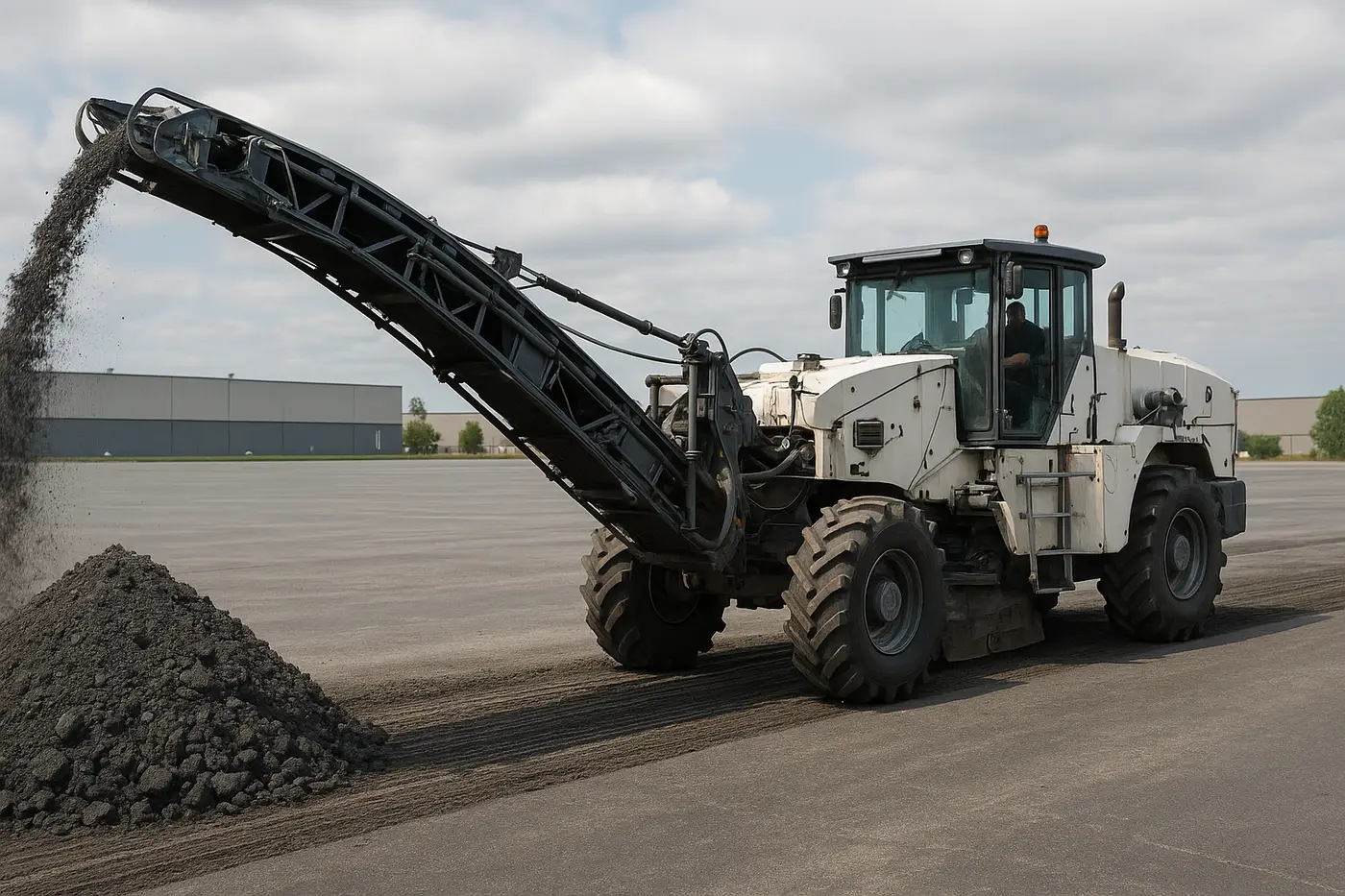
A reclaimer runs across the lot and grinds the existing asphalt together with the base material underneath it into a uniform blend. That blend is then graded to the elevations the drainage needs, stabilized, and compacted — and it becomes the new base course. New asphalt goes down on top of it.
The commercial arguments for it are straightforward. The failed structure is genuinely replaced rather than covered. There is almost no export of old material and no import of new base, which takes a great deal of truck traffic off your site and out of the price. And because the whole section is rebuilt, the grade can be corrected while it is open — so the low corner that has ponded for a decade stops ponding.
It is not always the answer. If the subgrade beneath is the problem, or the site is being redesigned, removal and replacement is the honest recommendation and we will say so.
Two Olathe problems that need naming
Rutting and shoving
Freight loads at the interchanges
I-35 runs freight through this city continuously, and the lots serving the 119th, 135th, and 151st Street interchanges take the braking and turning that comes with it. The result is not wear — it is deformation, asphalt pushed sideways into ruts and ridges.
The specification answer is a stiffer mix and a heavier structure: polymer-modified binder, which resists deformation under sustained heavy load far better than a standard mix, thicker base under the turning areas, and concrete where trailers pivot in a fixed spot.
Concrete, not asphalt
D-cracking in older curb lines
Older centers around Black Bob Road show closely spaced fine cracks running along joints and edges of the concrete curb and gutter. That is D-cracking: freeze-thaw damage acting on aggregate susceptible to it, working from inside the concrete outward.
It cannot be patched, because the material itself is failing. Those panels need replacing with an air-entrained mix using non-susceptible aggregate. We separate it out on the estimate so it is not buried inside a paving line item.
Built for Olathe's ground
Olathe sits on heavy montmorillonite clay that swells dramatically after rain and shrinks during summer drought. This constant volume change heaves pavement sections and fractures curbs. Geotextile separation and properly graded limestone bases are non-negotiable on every Olathe commercial project.
With around 38 freeze-thaw cycles a year and frost reaching 34 inches, the annual pattern is predictable: the clay takes on water, swells, and lifts sections; winter finds every crack that movement opened; and the following spring the base is softer than it was. That is why a reclaimed or rebuilt base gets a geotextile separator between clay and stone, and why we would rather spend money below the surface than above it. The rapid growth out toward Cedar Creek and the 175th Commerce Centre means plenty of newer pavement here too — and that stock needs its first seal on schedule rather than at year ten.
The steps on an Olathe job
Establish what you have
Cores through the pavement, drainage traced across the site, and the overlay history read off the edges and the curb reveal. This is what puts you in a row of the table above.
Recommend, with the alternative priced
You get our recommendation and the next option along, both with numbers. If reclamation and reconstruction are close on price, you should be the one choosing.
Phase it around trading hours
Retail work is sequenced so an entrance and a route through stay open. You get the phase map with the estimate, including where deliveries should come while a section is closed.
Rebuild the structure, then the surface
Reclaim or remove, correct the grade, separator and stone in compacted lifts, proof-roll under load, then binder and surface course rolled to density while hot.
Layout, curbs, and handover
Any concrete work kept as its own line, accessible routes set to grade during the build, striping once cured, then a walk-through with a maintenance schedule.
The outfit behind the estimate
Tarmasters is the asphalt division of Ford Concrete and Paving — Kansas City–owned, based in Lee's Summit, insured and bonded, paving across the metro since 2014. Having concrete in the same company matters on Olathe work specifically, because the curb and gutter question turns up on most of these older centers alongside the asphalt.
Johnson County holds high standards for commercial pavement and we build to them rather than around them. You get a measured fixed price, the core results, a phase map, and a clear statement of which approach we are recommending and why the others are not it.
Olathe and the surrounding communities
Retail and commercial
- 119th Street Retail District
- Black Bob Corridor
- Olathe Pointe
- Northgate Shopping Center
- Downtown Olathe
- Santa Fe Corridor
Industrial and logistics
- Great Plains Commerce Center
- Olathe Industrial Park
- 175th Commerce Centre
- Cedar Creek / Park 169 Hub
- K-7 frontage
- I-35 interchange lots
Next door we handle the same work in Overland Park, Lenexa, Leawood, and Shawnee.
Background reading: commercial paving in general, our full Olathe service list, and the areas we cover.
Olathe commercial paving questions
What is full-depth reclamation, and why would we choose it?
The existing asphalt is pulverized in place along with the base beneath it, and that mixed material becomes the new base — graded, stabilized, and compacted — with fresh asphalt laid on top. You are choosing it because it rebuilds the structure of the lot rather than just its surface, without the cost and truck traffic of hauling the old lot away and importing a new base. On a 25 to 30 year old lot with a failed base, it is frequently the best value on the table.
Our shopping center curbs have tight networks of fine cracks. Is that the same as the lot cracking?
No, that is D-cracking, and it is a concrete problem rather than an asphalt one. Closely spaced cracks running parallel to joints and edges are caused by freeze-thaw acting on aggregate that is susceptible to it — the damage originates inside the concrete, so patching does nothing. Those panels need replacing with an air-entrained mix using non-susceptible aggregate. It is common in older centers around Black Bob Road, and worth separating from the paving scope so you are not paying to patch something that cannot be patched.
Why do our entrances near the I-35 interchanges rut when the rest of the lot is fine?
Freight. The I-35 interchanges at 119th, 135th, and 151st carry constant heavy-truck braking and turning, and that repeated shear shoves asphalt sideways rather than wearing it down. Lots exposed to it need a heavier section and a stiffer mix — polymer-modified binder resists deformation under that kind of load far better than a standard mix — plus thicker base beneath the turning areas, or concrete where trailers pivot on the spot.
We are resurfacing an older strip on Santa Fe. Does that force accessibility work?
It frequently does, because resurfacing an accessible route brings the obligation to make what you altered compliant. Older Santa Fe Street properties predate the current standards, so excessive cross-slopes on accessible routes, non-compliant curb ramps, and non-standard signage are common findings. We scope that separately and honestly: what the pavement work forces, what is a grading fix, and what is simply worth doing while the lot is open.
Free estimates across the Kansas City metro.
Driveways, parking lots, and repairs across the Kansas City metro, since 2014.
Call Now: (816) 789-0700Tarmasters Asphalt Paving
Lee's Summit, MO 64063 | Serving the Kansas City metro | Insured | Bonded