Commercial Asphalt Paving Throughout Shawnee, KS
Retail lots on Shawnee Mission Parkway, industrial pavement out the K-7 corridor — built for the few vehicles that actually do the damage, on ground that never sits flat.
Tarmasters paves and rebuilds commercial lots across Shawnee, Kansas. Two things drive the specification here: the heavy vehicles a property actually takes, and the city's rolling ground, which makes drainage a design decision rather than a slope. Over Martin-Woodson series clay-loam both sit on top of a properly separated base. Insured and bonded since 2014.
Your customers are not what is wearing out your lot
This is the single most useful thing to understand before buying commercial pavement, and it is counterintuitive: damage to a pavement structure rises with roughly the fourth power of the axle load. Double the weight on an axle and you do about sixteen times the damage. It is the basis of how pavement is designed, and it means the traffic count on your lot is almost irrelevant next to its heaviest few vehicles.
That has direct commercial consequences in this city. The K-7 corridor and Westgate Industrial Park carry contractor fleets, equipment trailers, and daily freight, and the retail properties fronting Shawnee Mission Parkway take heavy commuter in-and-out movement across a handful of entry aprons. Every one of those is a small area doing most of the structural work.
Build to the average and the heavy areas fail early. Build the whole lot to the heaviest case and you have overpaid across acres of parking. The number below is what tells you where the line goes.
What each vehicle actually costs your pavement
Relative damage per pass, measured against the 18,000 lb reference axle used in pavement design. Approximate — real figures depend on suspension, tire pressure, and the pavement itself — but the orders of magnitude are the point.
| Vehicle | Typical axle load | Relative damage per pass | What it means for your lot |
|---|---|---|---|
| Passenger car | ~2,000–3,000 lb per axle | About 1/2,000th of a standard axle | Effectively zero. Customers do not wear out parking lots. |
| Pickup or delivery van | ~4,000–5,000 lb | Roughly 1/300th | Still negligible on a properly built section. |
| Loaded box truck, rear axle | ~12,000–15,000 lb | Roughly a fifth to a half | Daily deliveries start to matter — down one fixed route. |
| Standard reference axle | 18,000 lb single axle | 1 — the unit everything else is measured against | The benchmark used in pavement design. |
| Refuse truck, loaded rear axle | ~20,000–22,000 lb | Roughly 1.5 to 2 | And it stops in the same spot every week, which is why dumpster pads fail first. |
| Dump truck or loaded equipment trailer | ~20,000+ lb, often tandem | Several, per pass | The contractor and landscaping fleets working out of the K-7 corridor. |
Practically: we map the truck route, the dumpster pads, and the entry aprons, build those to a heavy specification, and build the parking bays to a normal one. It is the cheapest correct answer available on most Shawnee properties.
Doing it right in Shawnee
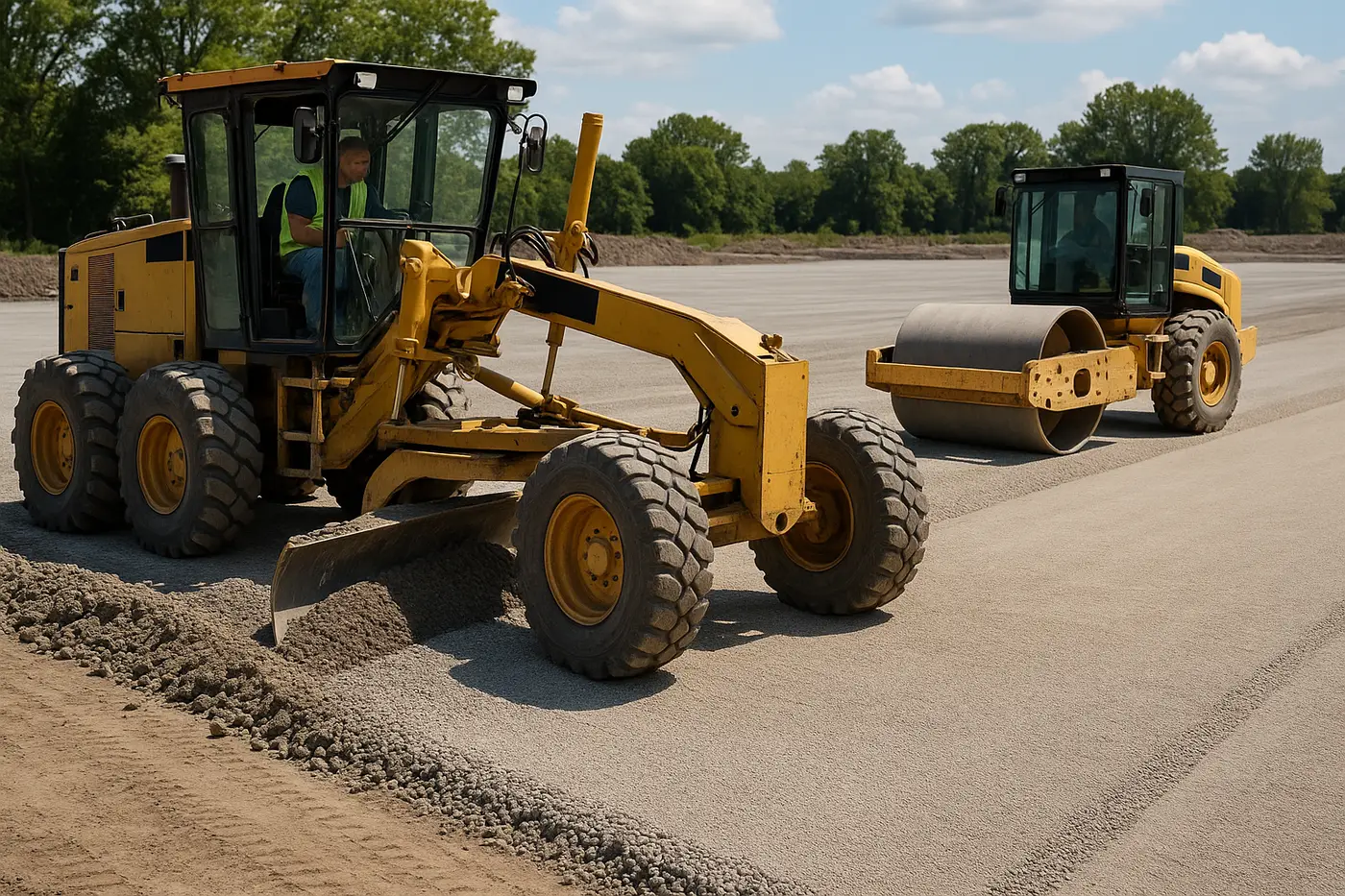
Unlike flat-graded areas in eastern Johnson County, Shawnee's topography features natural slopes that complicate parking lot drainage. Poor grading sends water toward buildings or traps it in low spots, accelerating base failure on the clay subgrade.
That is the second half of the specification here. On a sloped site the grade is doing real work — it decides whether a storm leaves the property or arrives at a building, whether water crosses an accessible route and freezes there, and whether the low corner becomes the place the base fails first. It is a design question, and it gets answered before anything is paved.
Underneath it all, Martin-Woodson series clay-loam swells wet and shrinks dry, so a compacted limestone base with a geotextile separator is not optional. Add about 38 freeze-thaw cycles and frost to 34 inches, and a single skipped season of crack sealing genuinely can double the repair scope by spring.
What we build here
Heavy-duty zones
Truck routes, staging areas, dock aprons, and dumpster pads — thicker base, heavier section, concrete where machines load or pivot.
Parking areas
Standard commercial section, correctly based and drained — the majority of most lots, and the part that should not be over-specified.
Resurfacing and repair
Overlays on raveled but sound lots, sectional rebuilds where the base has gone, and milling where drainage has been buried.
Maintenance and markings
Crack sealing, sealcoating, and striping — including high-contrast markings where a trail or walkway crosses a lot.
Our paving process
-
01
Map the heavy traffic
Where trucks enter, where they turn, where they stop, and what equipment comes on site. That map decides the specification zones.
-
02
Shoot the grades
On rolling ground the levels matter more than anywhere flat. We establish where water goes now, and where it should go.
-
03
Core where it matters
Existing thickness and base condition, so an overlay recommendation is based on evidence rather than on how the surface looks.
-
04
Price it by zone
Heavy areas and normal areas quoted separately, with a phase map showing what closes when and how access is maintained.
-
05
Build from the bottom
Subgrade corrected, separator down, limestone in compacted lifts, proof-rolled, then binder and surface course rolled hot to full density.
-
06
Mark it and hand it over
Accessible routes set to grade during the work, striping once cured, and a written schedule for the first seal and the crack-sealing cycle.
Who is on the other end of the phone
Tarmasters is the asphalt division of Ford Concrete and Paving — Kansas City–owned, based in Lee's Summit, insured and bonded, and paving across the metro since 2014. On sites where machines stage and trailers load, the concrete side of the business is often part of the answer, and it is quoted by the same people.
The commitment is specific: a measured fixed price with the heavy zones itemized separately, a phase map, and a straight recommendation. If your lot is raveling but structurally fine, we will quote a wearing course rather than sell you a reconstruction. Ask for an estimate.
Areas we cover near Shawnee
The commercial ground splits east to west — established retail and professional property along Shawnee Mission Pkwy and Quivira Rd, and the newer industrial expansion out toward K-7:
Commercial paving next door in Lenexa, Kansas City, KS, Olathe, and Overland Park.
Or read about commercial paving across the metro, everything we do in Shawnee, and the full service area.
Shawnee property questions
Our lot is busy with customers all day. Is that what is wearing it out?
Almost certainly not. Pavement damage climbs roughly with the fourth power of axle weight, so a car does a tiny fraction of what one loaded truck axle does — the ratio runs into the thousands. What wears a commercial lot out is the small number of heavy vehicles: the refuse truck, the delivery route, and on the west side of the city the contractor and equipment trailers. That is why we build heavy where those vehicles go and normally everywhere else.
Water runs toward our building when it rains hard. Can that be corrected without repaving everything?
Usually yes, and it should be dealt with regardless. On sloped Shawnee sites the common fault is a lot graded to move water across it rather than away from it, so a heavy storm delivers everything to the low side — which is often where the building is. The fix is generally localized: regrade the affected area, add or relocate a collection point, and rebuild that section to a corrected elevation. It is a fraction of a full repave and it protects more than the asphalt.
The surface is shedding loose stone. What stage is that?
Raveling, and it means the binder has oxidized to the point where it no longer holds the aggregate at the surface. It is common on the 1990s and early 2000s lots along Shawnee Mission Parkway and around Downtown Shawnee that have gone without sealing. If the base is still sound the answer is a new wearing course rather than a rebuild — but it does accelerate once it starts, because every stone that comes out gives water another way in.
Do steel-tracked machines damage asphalt?
They can, badly, and it is worth planning for on any site with contractor traffic. Tracked equipment concentrates weight and, more importantly, turns by scrubbing — which tears the surface rather than rolling over it. Skid steers, tracked excavators, and outriggers set down on a hot summer surface all leave marks. On sites where that traffic is routine we put concrete where the machines load and stage, and keep the asphalt for driving on.
Free estimates across the Kansas City metro.
Driveways, parking lots, and repairs across the Kansas City metro, since 2014.
Call Now: (816) 789-0700Tarmasters Asphalt Paving
Lee's Summit, MO 64063 | Serving the Kansas City metro | Insured | Bonded