Driveway Paving in Blue Springs and Jackson County
On this ground, the drive that lasts is the one the water leaves first.
Tarmasters paves residential driveways in Blue Springs and across Jackson County. The local variable is grade: rolling ground near Fleming Park and Blue Springs Lake means every drive handles water differently, and water is what reaches the Wymore series expansive clay underneath. Insured and bonded, paving since 2014.
Two houses in Blue Springs can have the same drive, the same age, and the same asphalt, and one of them fails a decade earlier. The difference is almost always water. On the rolling lots toward Fleming Park Area and Stone Canyon the drive is a channel whether anyone designed it as one or not; on the flat stretches near Downtown Blue Springs water sits until it finds a crack.
Underneath both is Wymore series expansive clay, which softens as it takes on water and moves as it dries. So the drainage question and the base question are the same question. This page covers residential drives; parking lots are commercial paving in Blue Springs, and cracked or broken sections are asphalt repair.
Where does the water go on your drive?
Four things we look at on every Blue Springs drive before we quote it. Each one is a place water gets to the clay.
The roof line
Downspouts that discharge onto or across the drive put concentrated water at one point, every storm. It shows up as a soft area, then a depression, then a hole.
The fall to the garage
A drive that pitches toward the house sends water to the slab. On lots below the street this is the design problem we solve most often here.
The edges
With no curb, runoff cuts in beside the drive and undermines the shoulder. On the steeper lake-side lots that erosion is quick.
The apron
A low tie-in at the street collects water and holds it right where traffic loads are highest, which is why aprons crumble before the middle of a drive does.
How much slope changes about the build
Nobody quotes a driveway by its gradient, but the gradient is what decides half the details. A rough guide to where yours sits and what it means.
| Slope | How it feels | What the build needs | What to watch |
|---|---|---|---|
| Under 5% | Reads as flat underfoot | Fall has to be designed in, not inherited. Cross-slope does the work here. | Standing water and a low corner at the garage — the most common failure on flat lots |
| 5–10% | Noticeably sloped, comfortable to walk | The usable range. Water leaves on its own and the mat can be rolled evenly. | Where the slope meets the street: the apron needs to flatten out before the curb |
| 10–15% | Steep. You feel it in the car. | A level landing at the garage and a transition at the street, so nothing bottoms out. | Winter traction, and water running the length of the drive rather than off the side |
| Over 15% | Very steep — common only on the lake-side lots | Grade breaks, a drain or valley across the drive, and edge containment so runoff cannot cut in beside it. | Sheet flow eroding the shoulder, and scuffing where cars turn on the slope |
What we take on here
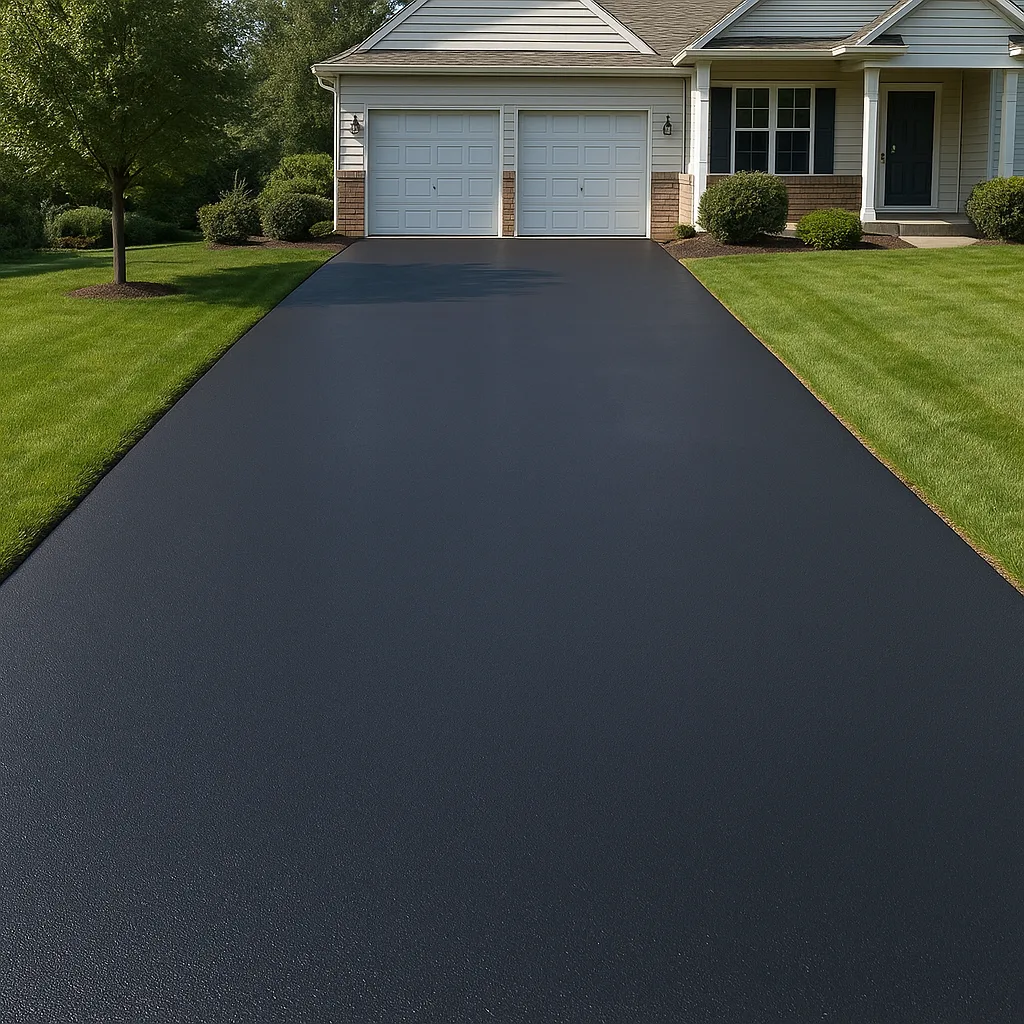
Replacements. The whole drive out, the subgrade corrected, the base rebuilt. On the 1970s and 80s streets this is common, because those drives went in before subgrade preparation was routine.
Resurfacing. A new wearing course where the base is still carrying. Frequent on the 1990s and 2000s subdivisions, where the build was sound and only the top has worn out.
New drives, widenings, and boat pads. Long lake-side approaches, extra parking for a trailer, and gravel conversions where the stone is already in place. On a slope these all come back to grade before they come back to asphalt.
The base under a Blue Springs job
- Subgrade proof-rolled and soft areas dug out — not bridged over
- Compacted crushed limestone base in lifts, at a consistent depth across the full drive
- Geotextile separator where wet clay would otherwise pump up into the stone
- Grade set to move water off the drive before it can reach the clay
- Hot mix laid at residential thickness and rolled to density while hot
- Edges backfilled and supported; apron tied flush at the curb line
Once it is down, the maintenance that matters is crack sealing on a two- to three-year cycle, and sealcoating to slow the oxidation that turns a black drive grey.
How a Blue Springs project runs
Walk the water
Before anything else we work out where water arrives, crosses, and leaves. On rolling lots that decides the whole design.
Remove
Old surface out, kept tight to the drive line so the lawn either side stays intact.
Proof-roll
The subgrade is loaded to find the soft spots that this clay hides under a sound-looking surface.
Base and grade
Limestone compacted in lifts, with the fall built in rather than copied from the old drive.
Pave and finish
Hot mix rolled to density, edges supported, apron flush. One day on site for most drives.
Straight answers on what your drive needs
Tarmasters is Kansas City–owned, based a few miles west in Lee's Summit, and the asphalt division of Ford Concrete and Paving. Insured and bonded, paving across the metro since 2014.
You get a measured estimate with a fixed number and a clear timeline, and an honest answer about drainage — including the cases where the fix is bigger than the driveway. We would rather tell you that before we pave than have you call us back about the same puddle in two years.
Areas we cover near Blue Springs
We work the whole city — the older streets off US-40 and MO-7, the subdivisions along Woods Chapel Rd, and the newer construction out toward Adams Dairy Pkwy.
Same crews cover driveways in Independence, Lee's Summit, and Kansas City. For the service in general, see asphalt driveway paving; for everywhere we work, the service area list.
Blue Springs driveway questions
My driveway runs downhill to the garage. What can be done?
Quite a lot, usually. The first move is to stop water reaching the bottom in the first place: a cross-slope that pushes it off the side, a grade break partway down, or a valley across the drive that catches and diverts it. Where the fall is severe and the garage sits low, a trench drain at the apron of the slab is the reliable answer. What we avoid is simply laying new asphalt on the same profile — that rebuilds the problem in a fresh surface.
Is a steep drive harder to pave?
It is more work to get right, yes. Hot mix wants to move under the roller on a slope, so it goes down and gets compacted in a way that keeps the mat even. The other differences are practical: a level landing at the top so cars are not parking on the pitch, and a flattened transition at the street so bumpers clear. None of it is exotic — it just has to be planned before the truck arrives rather than adjusted on the day.
Why do drives around here crack in a pattern rather than one line?
Connected cracking in a rough grid is fatigue — the surface flexing over a base that no longer carries load. Over Wymore series expansive clay that usually traces back to drives built without much subgrade preparation, which describes a lot of the 1970s and 80s construction here. Once it is connected, sealing it is holding an outcome off rather than changing it. That is the point where a rebuild is the honest recommendation.
How soon can we use it?
Driving on it is normally fine after a day or two depending on temperature and thickness. Parking is the thing to be careful with — new asphalt stays soft for a while, so kickstands, trailer jacks, and turning the wheels while stopped can leave marks for the first few weeks. After that, keep the cracks sealed: with about 40 freeze-thaw cycles a winter, an open crack is a way in for water.
Blue Springs driveway estimates
Tell us where the water goes and we will tell you what the drive needs. Tarmasters Asphalt Paving — measured, fixed pricing.
Call Now: (816) 789-0700