Local Driveway Paving in Kansas City, MO
Narrow lots, tight aprons, and ground that moves. We build drives from Brookside to Briarcliff for both.
Tarmasters paves residential driveways throughout Kansas City, Missouri. Two things shape the work here: urban lots that leave little room to work, and Wymore series expansive clay that swells and shrinks under the mat. Both are handled at the base, not the surface. Insured and bonded, paving since 2014.
A driveway in Brookside and a driveway off Barry Road are the same product built under completely different constraints. In the older core the lot is narrow, the drive runs long and single-width past the house to a detached garage or an alley, and there is a street tree, a retaining wall, or a neighbor's slab eighteen inches away. North of the river and out toward Zona Rosa the drives are wider, the access is open, and the constraint is the grade rather than the geometry.
What does not change is the ground. Jackson County sits on Wymore series expansive clay, and the housing it carries runs from 1920s–1970s in urban core in the core to the newer subdivisions south and east — which means the age of the house is a fair predictor of what is under the drive. This page covers driveways. If you need a lot rather than a drive, that is commercial paving in Kansas City, and broken pavement of any kind is asphalt repair.
Why Kansas City driveways crack over Wymore clay
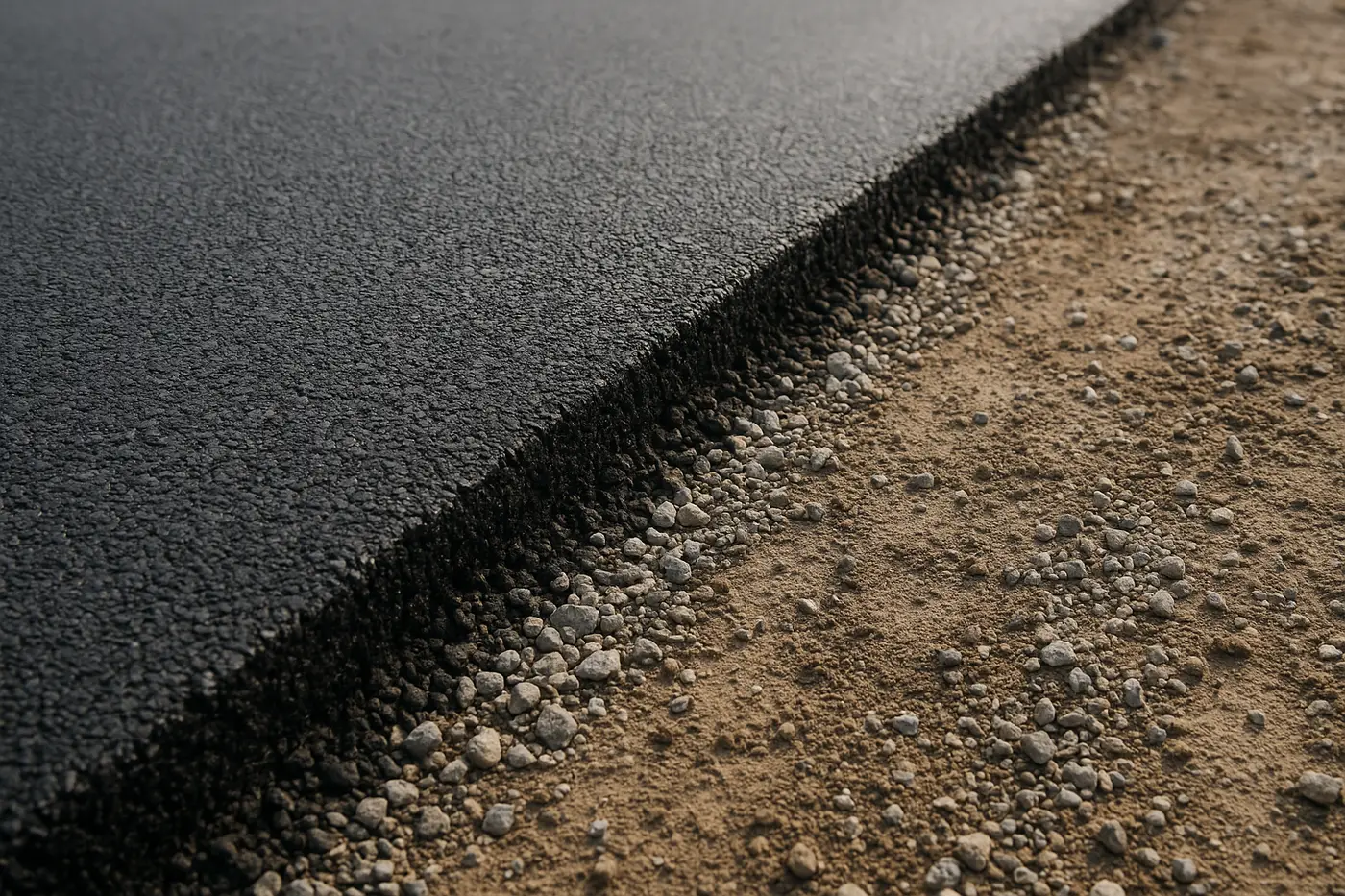
Wymore series expansive clay is an expansive soil. It takes on water and swells, then gives that water up and shrinks back. Under a driveway that means the ground is never still: it lifts a little in a wet spring and drops in an August drought, and the mat on top has to absorb the difference.
Asphalt is better suited to that than a rigid slab, because it flexes. What it cannot do is bridge movement on its own. That job belongs to the stone base, and a thin base — or no base, which is common on the pre-war drives around Pendleton Heights — passes every bit of that movement straight to the surface.
What that means for the build: depth of compacted crushed limestone, so load spreads across the movement instead of concentrating on it; a separator fabric where wet clay would otherwise pump up into the stone; and a grade that gets water off the drive before it reaches the clay at all. With 40 freeze-thaw cycles in a typical winter and frost reaching 36 inches, water that stays is water that moves things.
What the age of your house says about your driveway
We still check every drive before quoting it, but in a city with housing this old the era is a useful starting point. Here is what we typically find under each.
| Era and area | How it was likely built | What fails first | What it needs now |
|---|---|---|---|
| 1920s–1940s — Brookside, Pendleton Heights, Columbus Park | Single-width drive, often laid straight on graded clay with little or no stone | Longitudinal cracking down the wheel path; edges broken away where cars overhang | Full removal and a rebuilt base — there is usually nothing underneath worth saving |
| 1950s–1970s — Waldo, Red Bridge, Ruskin Heights | Thin stone base under a thin mat, sized for one car | Settlement at the apron and soft spots where downspouts drain across the drive | Subgrade correction where it has pumped, then a properly compacted base |
| 1990s–2020s — Briarcliff, Zona Rosa, Barry Road, Martin City | Builder-grade base, adequate depth but rarely generous | Surface oxidation and open cracks before the base ever gives out | Often a resurface rather than a replacement, if the base proof-rolls tight |
If the honest answer is a new surface rather than a new drive, that is an overlay, and if it is neither, crack sealing may be all your drive needs this year.
The driveway work we do in Kansas City
Replacement
The old drive comes out, the subgrade gets checked and corrected, and a new drive goes in over a rebuilt base. On the pre-war streets this is usually the only honest answer, because the original build has no base to work with.
Resurfacing
Where the base still carries load, a new wearing course goes over the existing drive. Cheaper, faster, and it holds — but only if what is underneath proof-rolls tight. We check before we recommend it.
New drives and widenings
Second parking pads, turnarounds, and the widenings that narrow older lots always need. Widening is where seams matter: a new strip alongside an old one moves differently unless the base under both is the same.
Gravel and alley approaches
Converting a gravel drive or paving an alley-side approach. The stone is usually already there; the questions are depth, how clean it is, and whether it will compact.
The steps on a Kansas City job
- 01
Access and measure
Urban lots are tight. Before anything is quoted we work out how the truck and paver get in, where the material stages, and whether the neighbor’s drive or a street tree changes the plan.
- 02
Tear-out and proof-roll
The old surface comes out and we load the subgrade to find soft spots. On expansive clay the weak areas are rarely visible from the top.
- 03
Grade correction
Water is the whole problem here. The grade is reset so the drive sheds toward the street or a yard, not toward the garage or a foundation wall.
- 04
Base and compaction
Crushed limestone in lifts, compacted each pass. Where the clay is wet enough to pump up into the stone, a geotextile separator goes down first.
- 05
Paving and rolling
Hot mix laid to residential thickness and rolled to density while it is still hot. Density is what keeps water out of the mat itself.
- 06
Apron and edges
The street tie-in is set flush so there is no lip at the curb line, and the edges are backfilled so they have something to lean on.
Doing it right in Kansas City
Tarmasters is Kansas City–owned and works both sides of the state line from a yard in Lee's Summit, about half an hour from most addresses in the city. We are the asphalt division of Ford Concrete and Paving, insured and bonded, and paving the metro since 2014.
The estimate is measured on site and fixed before work starts, and it says which of the answers above your drive actually needs. Some drives get a full rebuild. Some get a new surface. Some get told to wait a year and seal the cracks. Which one you hear depends on what we find when we look underneath.
Where we pave around Kansas City
The older core
Brookside, Waldo, Westport, Northeast / Pendleton Heights, and the streets around Country Club Plaza. Narrow lots, long single-width drives, and original bases that are usually a question mark.
South of the loop
South KC / Red Bridge, Hickman Mills / Ruskin Heights, and Martin City, reached off US-71. Post-war ranches on wider lots, where the apron and the downspout line are usually where the trouble started.
North of the river
Briarcliff, Zona Rosa, and the Barry Road Corridor area off MO-9. Newer stock, open access, and grade as the main design question.
We work the neighboring communities on the same trips — driveways in Independence, Lee's Summit, Liberty, and across the line in Kansas City, Kansas. You can also read how we handle driveway paving across the metro or check the full service area.
Driveway questions we get in Kansas City
Can you get equipment into a narrow Kansas City lot?
Usually, yes — most of the core was platted narrow and we work in it constantly. What we look at is the approach: whether the paver can reach the back of the drive, whether material can stage on the street or has to be barrowed, and whether an alley gives us a second way in. Where a machine genuinely will not fit, sections get placed and rolled with small equipment instead. It is slower, and we will tell you that up front rather than after we arrive.
My drive cracked straight down the middle. Is that the clay?
Most often, yes. A single crack running the length of the drive is what a thin section does when the ground under one wheel path moves differently from the other — which is exactly what expansive clay does as it takes on water and dries out again. Sealing it slows the water down and buys time. It does not fix the reason it opened, so if the crack keeps widening season to season the base is the thing that needs addressing.
Does the river bottom matter if my house is on a hill?
Not directly. The low-lying ground near the Missouri River behaves differently from the upland neighborhoods, and most residential drives here sit on the upland side. What matters on your lot is much more local: where roof water lands, whether the drive falls toward the garage, and how deep the stone under it goes.
How long does a new drive last here?
Fifteen to twenty years is the normal range for residential asphalt built on a proper base and kept sealed. What shortens it locally is water — 40 or so freeze-thaw cycles a winter drive water into every open crack, and a 36-inch frost depth means anything holding water is moving. Keeping cracks closed is the cheapest thing you can do for it.
Get a straight estimate on your Kansas City driveway.
We measure it, tell you what is under it, and give you a fixed number.
Driveways, parking lots, and repairs across the Kansas City metro, since 2014.
Call Now: (816) 789-0700Tarmasters Asphalt Paving
Lee's Summit, MO 64063 | Serving the Kansas City metro | Insured | Bonded