Asphalt Repair in Blue Springs and Jackson County
Ponding, stripping, cracked lots, and winter potholes — repaired with the water problem fixed at the same time, not left for next year.
Tarmasters repairs asphalt across Blue Springs, Missouri — potholes, cracking, rutted entries, and lots that hold water. Most failure here traces back to drainage over Wymore series expansive clay, so a repair that lasts corrects the fall and the base together. Insured and bonded, working Jackson County since 2014.
Almost every asphalt problem in Blue Springs is a water problem wearing a different hat. The rolling ground that makes this a pleasant place to live also makes drainage complicated, and the older commercial strips near downtown were built with very little storm infrastructure to begin with. Water sits, and everything else follows from that.
Owners usually describe it as the asphalt being bad. Nine times out of ten the asphalt was fine and the water had nowhere to go. That distinction changes what the repair should be — and it is the reason we walk a lot after rain when we can. For everything else in this market, see the Blue Springs paving hub or asphalt repair across the metro.
What fails on Blue Springs pavement, and where
Six problems, and each one sits in a particular part of this city for a particular reason.
Stripping under standing water
Older commercial strips near the downtown core were built with minimal storm drainage. Water sits on flat pavement and works between the binder and the aggregate until they separate — the surface loses cohesion from inside rather than wearing away on top. Patching over a stripped area repeats the failure; the fall has to be corrected too.
Polished aggregate and slick surface
High-volume traffic on Adams Dairy Parkway burnishes the exposed aggregate smooth. The pavement looks fine and skid resistance quietly drops, which becomes a liability question in the wet. The correction is a new surface with texture, not a sealcoat over a polished one.
Fatigue cracking on 1970s and 80s lots
The original commercial buildout along US-40 is 40 to 50 years old — a decade or more past a 20 to 25 year structural life. Cracking there has usually joined into a scaled, interconnected pattern, which is the base telling you it has stopped carrying load.
Shoving and rutting at entries
MO-7 works as a north-south arterial for heavy commercial traffic, and lots fronting it absorb repeated braking and turning. The asphalt displaces sideways into ridges and dropped entries. That is a thickness and mix problem; it does not respond to a surface repair.
Potholes out of winter
Water in a crack freezes, widens the opening, thaws, and goes deeper into the clay base. A hairline crack in November can be a pothole by March. The hole is the last stage of that sequence, and the failed area under it is always larger than what you can see.
Curb failure and lost edge support
When curb and gutter settle or break up, the asphalt beside them loses its edge restraint and starts breaking back into the lot. Repairing the asphalt without resetting the curb leaves the same open edge for water to get into next winter.
Repairing for Blue Springs conditions
Under the whole city is Wymore series expansive clay — clay that swells as it takes on water and shrinks as it dries out. That vertical movement cracks pavement from below, and it is why lots built in the 1970s and 80s without engineered subgrade preparation show fatigue cracking that has nothing to do with how much traffic they carry.
Add roughly 42 inches of rain a year and about 40 freeze-thaw cycles, and any opening in the surface becomes a delivery system. Water goes in, freezes, widens the opening, thaws, and travels further into a clay base that cannot drain it.
The lots that fail first are not the busiest ones. They are the flattest ones.
On the flat strips near the downtown core, water has no fall to follow and no drainage to reach. It stands, and it works into the pavement until the binder lets go of the aggregate. That is stripping, and it is a different failure from surface wear — it goes through the material rather than across it.
Meanwhile the busy pavement has its own version: heavy traffic on Adams Dairy Pkwy polishes the aggregate smooth, which quietly costs you skid resistance in exactly the weather where it matters.
Read your own cracks before you call anyone
Width and pattern tell you most of what a contractor should be telling you. Take a tape measure out to the worst area — it takes five minutes and it makes every quote you receive readable.
| Width | Pattern | What it means | What it needs |
|---|---|---|---|
| Under 1/8 in | Fine, isolated, no branching | Surface shrinkage and normal aging | Monitor; sealcoat protects the binder around it |
| 1/8 – 1/4 in | Straight, single, following a joint or edge | Movement at a seam, water not yet reaching the base | Crack seal — the cheapest hour anyone spends on a lot |
| 1/4 – 3/4 in | Open, edges spalling, some branching | Water has been getting in for a while | Rout and seal; patch where edges have broken down |
| Over 3/4 in | Wide, with material loss at the edges | Base is likely wet under the crack | Saw-cut patch, base checked and replaced as needed |
| Any width | Interconnected, scaled, block-like sections | Fatigue failure — the section has flexed past its limit | Rebuild that area; sealing it changes nothing |
| Any width | Following a low spot that holds water | Grade problem, and the crack is a symptom | Correct fall or drainage, then repair the surface |
Rows two and three are crack sealing work and cost a fraction of what row five costs. That is the entire argument for looking at a lot before the winter rather than after it.
Our repair process here
Watch where the water goes
On a Blue Springs lot the first walk happens with drainage in mind — where it ponds, where the fall runs the wrong way, which failures line up with the low ground.
Mark the real extent
Failed areas get marked to sound pavement, not to the visible damage. Under standing water the affected area is normally larger than it looks.
Cut, excavate, rebuild the base
Square edges, failed material out to depth, saturated stone replaced with compacted aggregate. On clay this step is the repair; everything after it is finishing.
Place, compact, and fix the fall
Asphalt in lifts, joints tacked and sealed — and where the low spot caused the failure, the repair is set to a grade that sheds water instead of holding it.
Where the surface is sound and only tired, the answer is an overlay or sealcoating rather than repair. Where it has failed structurally, it is reconstruction, and we will say so before anything is priced.
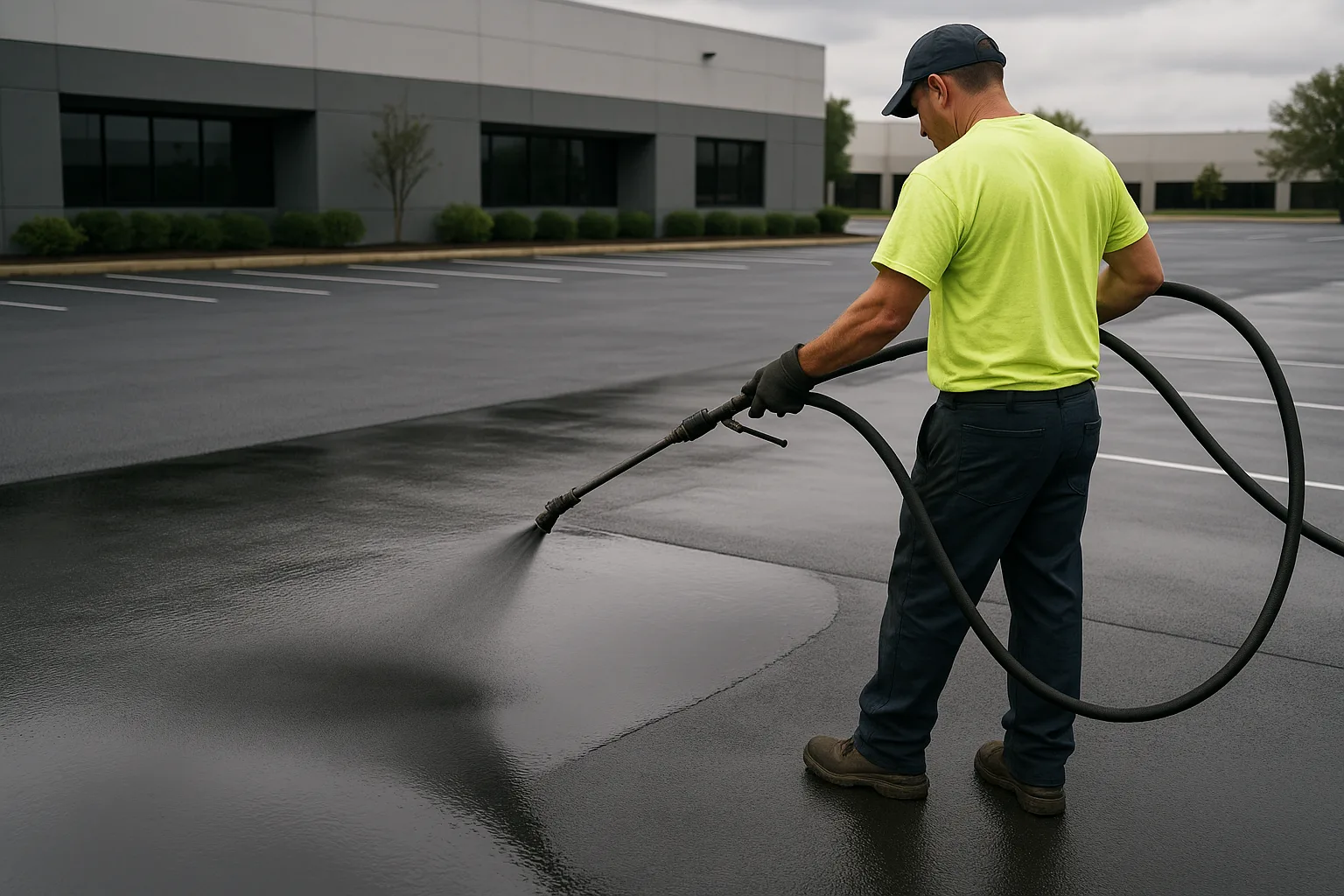
Protecting a sound surface is cheap. Rebuilding a failed one is not.
Blue Springs neighborhoods we serve
We work the whole city, off I-70, MO-7, US-40, Adams Dairy Pkwy. Commercial repair concentrates along the corridors; residential repair is mostly driveways in the subdivisions built from the 1970s onward, where aprons and edges go first.
Commercial and industrial
- Adams Dairy Landing
- 7 Highway Retail Corridor
- White Oak Plaza
- North 7 Highway Industrial
- Woods Chapel Corridor
- Old 40 Highway
- Downtown Blue Springs
Residential
- Chapel Ridge
- Copper Leaf
- Saddle Ridge
- Stone Canyon
- Whitetail
- Adams Pointe
- Pink Hill
- Burr Oak / Burr Oak Woods
Asphalt repair nearby
Also see driveway paving and replacement, milling, or the full service area.
Blue Springs repair questions
Q1 Water stands on our lot for a day after rain. Is that a repair job?
Yes, and it is one of the more worthwhile ones. Standing water is the single biggest accelerator of every other failure — it drives stripping, softens the base, and feeds the freeze-thaw cycle. Depending on the site, the fix is regrading the low area, milling back to design elevation, or adding drainage. Repaving at the same elevation reproduces the same puddle, so we would rather correct the fall while the area is open.
Q2 What is stripping, and how is it different from raveling?
Raveling is loss from the top down — aggregate works loose at the surface and the texture coarsens. Stripping is loss of the bond between binder and aggregate inside the asphalt, usually driven by water sitting in or under the pavement. Raveling you can often stay ahead of. Stripping means the material has lost integrity through its depth, and the affected area has to come out.
Q3 Our lot on the Old 40 corridor is original. Can it be resurfaced?
Only if the base is still carrying load, and after 40-plus years that is the thing to establish rather than assume. If cracking is interconnected across much of the surface and there are settled areas, an overlay will crack through on the same lines within a few seasons. Cores tell you properly. We would rather core a lot that size than have you buy a surface twice.
Q4 Can you make a slick lot less slippery?
Polished aggregate is fixed by giving the surface texture again, which means a new wear course — a mill and overlay, or a thin overlay if the structure allows. Sealcoat is protection for the binder, not a friction treatment, so a sealcoat on a polished surface does not solve the problem. On a lot where wet-weather traction is a real concern, that distinction matters.
Q5 When can repairs be done here?
Asphalt repair needs dry pavement and workable temperatures, so the practical season runs roughly spring through fall, with the shoulders depending on the week. With about 40 freeze-thaw cycles a year, work done in the wrong conditions does not hold — we would rather book you three weeks out than lay material into a cold, wet cut.
About the crew you would be hiring
Tarmasters is Kansas City–owned, based in Lee's Summit — the next city over — and the asphalt division of Ford Concrete and Paving. Insured and bonded, paving and repairing across the metro since 2014. You get the failed areas measured, a fixed price, and a written note of what we are deliberately leaving alone this year.
Get the water problem fixed with the pavement.
Tarmasters repairs cracked, ponded, and potholed asphalt across Blue Springs — measured, priced, and explained before anyone starts cutting.
Call Now: (816) 789-0700