Asphalt Repair for Lee's Summit Property Owners
Ruts, potholes, cracked driveways, and settled curbs — repaired by a contractor whose shop is on this side of the metro.
Tarmasters repairs asphalt driveways and commercial lots across Lee's Summit, Missouri — rutting, potholes, cracking, and settlement. Our shop is in this city. Over Wymore-Snead series expansive clay, repairs hold when the base under the failure is corrected, so that is where the estimate starts. Insured and bonded since 2014.
Tarmasters is headquartered in Lee's Summit — 906 SE 7th Terrace, Ste B, Lee's Summit, MO 64063. That is worth saying plainly on a repair page, because repair is the part of this trade where showing up matters: to look at it, to explain what caused it, and to come back if something needs a second look.
This city gives asphalt two distinct problems. Retail lots along US-50 are old enough to be into a second rehab cycle, while subdivisions built in the last fifteen years are settling on fill over clay. Different ages, same root cause underneath. For the wider market see the Lee's Summit paving hub, or asphalt repair across the metro.
Repair it or replace it? Count the ones that are true.
This is the check we run on a Lee's Summit lot before pricing anything. You can run it yourself in ten minutes with a tape measure and a hose.
Cracking is connected and scaled across more than about a third of the surface
Fatigue cracking that has joined up is base failure showing through, not a surface defect.
More than two areas have dished or settled
Multiple settlements means the subgrade is moving, which is the clay working under a base that cannot bridge it.
Potholes keep returning in the same places after being patched
The patch was fine; the support under it was not.
Ruts have formed in the queuing or drive lanes
Sustained wheel loads in one path have compressed a section that was built too thin for the traffic it carries.
Water stands on the lot 24 hours after rain
Grade is wrong or the surface has deformed. Both keep water in contact with the pavement and its base.
The surface is over 20 years old and has never been overlaid
Retail lots along US-50 built in the 1990s and 2000s are into their second major rehab window.
0 – 1 true
Repair territory. Patch the failures, seal what is still tight, and you buy real years.
2 – 3 true
Mixed. Usually section rebuilds where the failures are, plus an overlay if the rest holds up to a core.
4 or more
Reconstruction. Patching a lot in this condition is an annual bill, not a repair.
What we get called out for here
Six problems cover most of the repair work in this city. They are not interchangeable — each one points at a different cause, and the cause sets the method.
Ruts and depressions in queuing lanes
Vehicles sitting in the same wheel path at Summit Fair and Summit Woods Crossing put sustained weight on one line of asphalt. The binder compresses, a channel forms, water collects in it, and the winter finishes the job. Repair means rebuilding that lane at a depth and mix built for standing load, not filling the channel.
Fatigue cracking over seasonal clay
Clay under a lot swells wet and shrinks dry. Pavement over an unstabilized subgrade flexes with it until the cracking joins into a scaled pattern. Once it is connected, the section needs rebuilding with the subgrade addressed — lime stabilization, separation fabric, or over-excavation, depending on what we find.
Curb and gutter settlement in newer developments
Post-2010 subdivisions here have curbs failing already, and the cause is usually poorly compacted fill over native clay rather than the concrete itself. The asphalt beside a settled curb loses its edge support and starts breaking back, so the two get repaired together or neither holds.
Second-cycle wear on US-50 corridor lots
Lots built in the 1990s and 2000s are past their first surface life. Whether they take an overlay or need reconstruction depends on the existing structure, which is a core-sampling question rather than a walk-the-lot question when the numbers are large.
Shoving at truck entries on M-291 and Ward Road
The new industrial buildout has put semi and delivery traffic onto pavement designed for cars. Asphalt shoves where those vehicles turn and brake. The entry gets rebuilt thicker, and at true pinch points a concrete apron is the honest recommendation even though we are the asphalt contractor.
Faded markings and worn accessible routes
Medical and school-zone lots wear their markings faster than typical commercial sites. Faded lines restripe. Accessible stalls whose slopes have gone out of tolerance through settlement are a grading repair — paint cannot fix a slope.
Doing it right in Lee's Summit
The conditions here are specific: Wymore-Snead series expansive clay under a rolling upland site, about 40 freeze-thaw cycles a year, and roughly 43 inches of rain. Most of the city sits on upland ground above the creek corridors, so the water problem is rarely flooding — it is water that gets into the pavement and stays in the clay underneath, where it has nowhere to drain.
That clay swells when it takes on water and shrinks as it dries, and the movement cracks pavement from below. It is why a repair that only replaces asphalt on a lot off Colbern Road or in Summit Woods Crossing can fail on schedule while the pavement around it survives — the new material is sitting on the same moving ground the old material was.
Where a subgrade has to be dealt with, the options are lime stabilization, a geotextile separation fabric, or over-excavating and replacing with compacted stone. Which one depends on the area, the loading, and what the excavation shows. It is a real cost line, and it is the line that decides whether you are back here in three years.
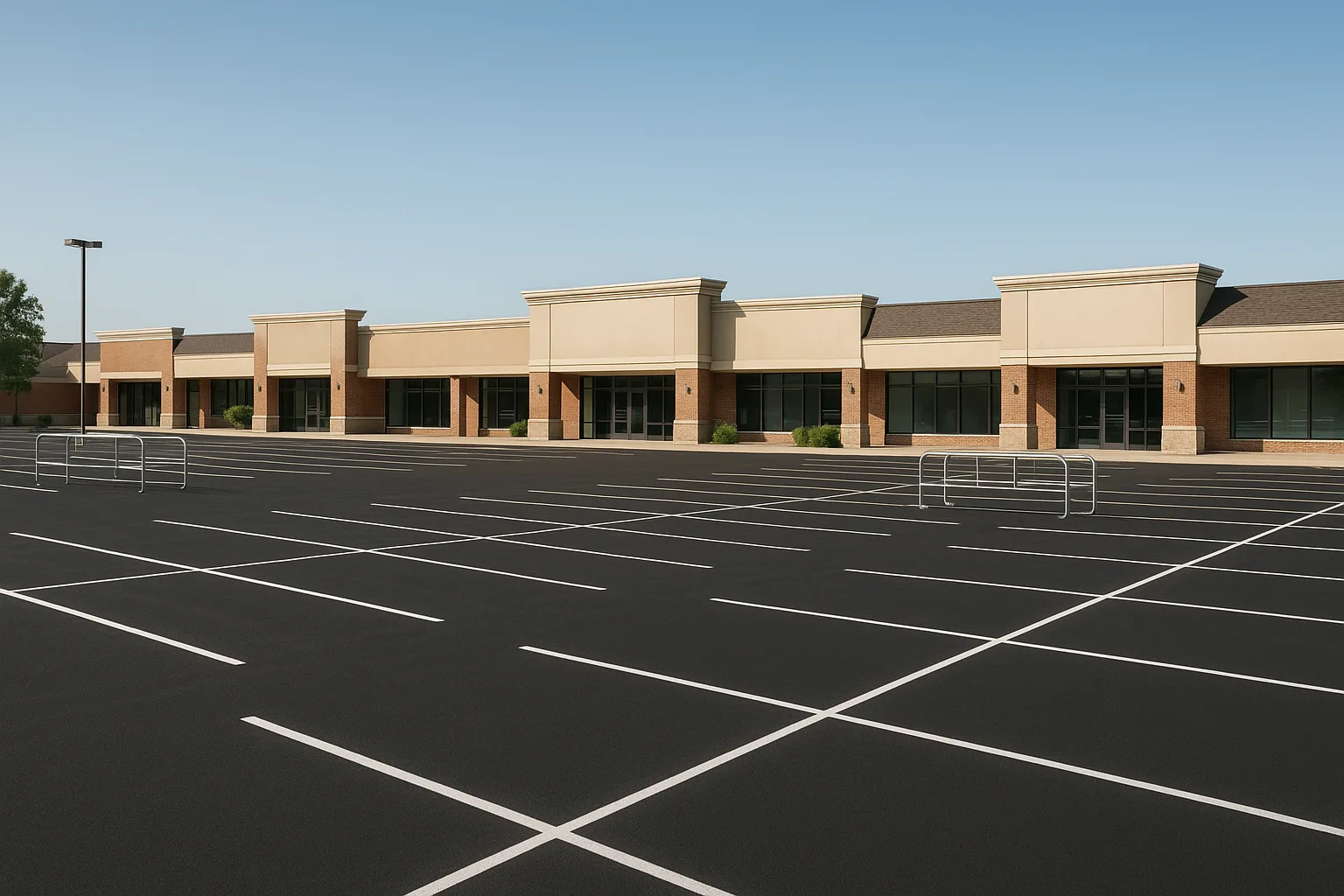
What a Lee's Summit repair job looks like
Open any step for the detail. The order does not change much; what changes is how deep step three has to go.
01 A walk with a straightedge and a marker
We mark every failed area, note which are surface and which reach the base, and check where water goes. Half of a good repair estimate is refusing to price areas that do not need work yet.
02 Cores, when the number justifies it
On a large lot facing an overlay-or-rebuild decision, core samples tell you what thickness and structure you actually have. It costs something to find out and it costs much more to guess wrong on a whole lot.
03 Saw-cut, remove, and fix what is underneath
Failed asphalt comes out to square vertical edges and to the depth the failure reaches. Wet or contaminated base material is removed and replaced with compacted stone, because on this clay the base is what decides the outcome.
04 Place in lifts, compact, tack the joints
New asphalt goes in and is compacted in lifts, with the vertical faces tacked so the repair bonds into the pavement around it. Then the perimeter joint is sealed.
05 A clear handover
You get told when it takes traffic and what to watch. If part of the lot was left alone on purpose, that is on the estimate in writing so nobody wonders about it next spring.
Tight cracks are cheaper handled as crack sealing than as patches later. A sound lot with a tired surface is usually an overlay, and a lot that has failed structurally is reconstruction.
The contractor doing the work
Tarmasters is Kansas City–owned and the asphalt division of Ford Concrete and Paving, working across the metro with our own crews and equipment since 2014. Insured and bonded. On a repair estimate you get the failed areas measured, a fixed price, and a written statement of which areas need full-depth work — including any we think should be left alone this year.
Repair work across the Lee's Summit area
Access is off US-50, M-291, I-435, Ward Rd. The repair mix changes by district — rutting and striping on the retail side, cracking and aprons on the residential side, entry rebuilds where the trucks are.
Retail and commercial
- Summit Fair / Summit Woods Crossing
- Lakewood Commercial District
- Lee's Summit Commerce Center
- Downtown Lee's Summit
Residential
- Lakewood
- Raintree Lake
- Winterset Valley
- Longview Farm
- Bent Tree
- Greenwood Estates
Employment and institutional
- Ward Road Industrial Corridor
- Missouri Innovation Campus Area
- John Knox Village
- Colbern Road Retail Corridor
Asphalt repair in nearby cities
See also driveway paving, line striping and ADA layout, or our full service area.
Lee's Summit repair questions
You are based in Lee's Summit. Does that change anything?
It changes the logistics rather than the price. Our shop is here, so a walk-through, a return visit, or a look at something that came up after the work does not involve crossing the metro. It does not mean we drop a schedule to run out for a pothole — asphalt still needs dry weather and a workable temperature — but the trip is short and the follow-up is easy.
Should the queuing lane be repaired or rebuilt?
If the channel is shallow and the surrounding surface is sound, a mill and inlay of that lane can work. If the rut is deep, has cracked along its edges, or is holding water, the section is too thin for the load it carries and inlaying the same depth reproduces the rut. Rebuilding one drive lane properly is usually cheaper than resurfacing it three times.
Do we need core samples before an overlay?
On a driveway, no. On a large commercial lot facing a five- or six-figure decision, yes — cores show existing thickness, layer condition, and whether the base can support a new wear course. An overlay placed on a base that has already failed cracks through on the same lines within a few seasons, and you have paid for a surface twice.
Why is our curb failing when the lot is only ten years old?
Almost always subbase settlement in fill soil rather than a problem with the concrete. Fill placed over Jackson County clay without proper compaction consolidates over five to ten years, and the curb rides down with it. The repair sets the curb back on properly compacted material and repairs the asphalt edge beside it, which has usually broken back once the support moved.
Can you repair a residential driveway, or is it lots only?
Both. Driveways here are usually cracking, edge break-up, or a settled apron at the street; lots are the ruts, potholes, and base failures above. The method is the same at a different scale. If a driveway is far enough gone we will say so and price replacement, rather than take money for patches that will not last.
Get a repair estimate from up the road.
Potholes, ruts, cracked driveways, and settled curbs across Lee's Summit — measured, priced, and explained.
Call Now: (816) 789-0700