
Asphalt Repair in Leawood
Settlement, cracking, dropped entries, and tired surfaces — repaired so the work holds and the finished lot still looks like it belongs here.
Tarmasters repairs asphalt across Leawood, Kansas — settlement south of 119th, cracking, dropped retail entries, and worn surfaces. Over Martin-Woodson series clay-loam that moves an inch or two seasonally, repairs are built back on compacted limestone base and squared so the finished lot looks right. Insured and bonded since 2014.
In most markets a repair is judged on whether it holds. Here it is judged on whether it holds and whether it looks deliberate afterwards. That is a fair standard on properties where the pavement is part of how the place presents itself — and it changes practical things about how the work is done, from where the saw cuts land to whether the area gets sealed afterwards.
It also runs into a genuine engineering problem. North of the retail corridors the pavement is mature and wearing out. South of 119th, lots that are barely twenty years old are settling into dips because of what they were built on. Both need honest answers rather than the cheapest patch. For everything else in this market see the Leawood paving hub, or asphalt repair across the metro.
What we are called out for in Leawood
Settlement over the Blue River alluvium
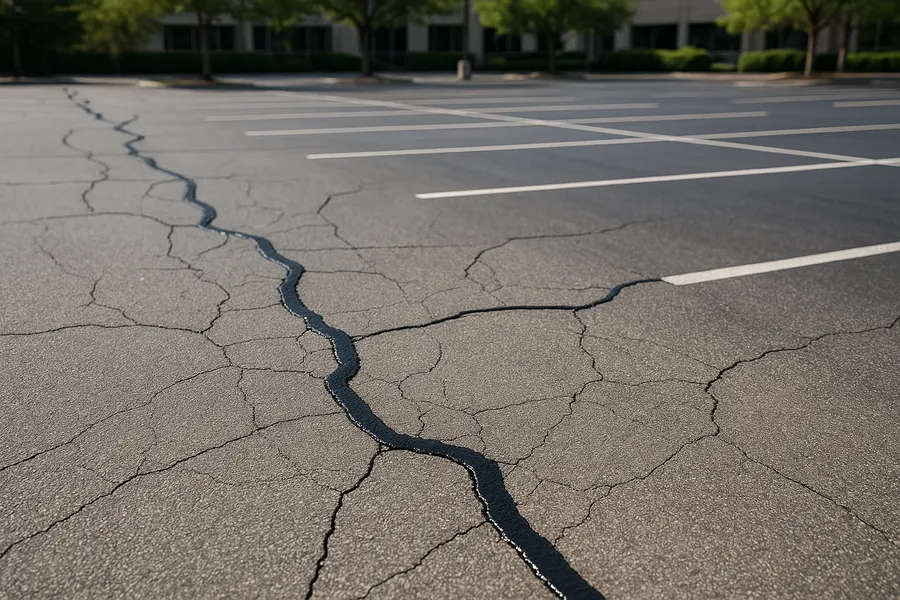
Newer developments sit on alluvial soils that compact unevenly under load. The result is localized settlement — dips, ponding, and cracking around them — on lots barely twenty years old. The repair is excavation and a rebuilt base at the settled area, not a skim of asphalt into the low spot.
End-of-life surfaces on mature lots
Pavement from the 1950s through the 70s in the north of the city, and 1990s pavement along the 119th and 135th corridors now reaching its first full mill-and-overlay. Where cracking is connected across the surface, patching is a holding action and everyone should know that.
Turning stress at the busy intersections
Delivery vehicles serving the retail districts turn constantly at 119th & Roe and 119th & Nall. That repeated turning shears the surface at entries, which shows up as scuffing, shoving, and eventually a dropped entry that needs rebuilding deeper.
Curb crumbling in high-irrigation areas
Where irrigation runs against curb lines and islands, the ground beside them stays wet. The curb goes first, the asphalt loses its edge restraint, and the pavement begins breaking back. Fixing the asphalt without addressing the water schedule invites a repeat.
Longitudinal and reflective cracking
Straight cracks along the line of a joint or a previous repair, and old cracks reappearing through a newer surface. Both are movement below telegraphing upward. Sealing keeps water out; where the pattern is widespread it is telling you about the layer underneath.
Oxidation and UV wear
Unsealed surfaces grey out, lose their binder, and start to look tired long before they fail structurally. In this market that is often the reason for the call — and it is usually the cheapest thing on the list to fix.
How we repair for Leawood ground and weather
The city sits on Martin-Woodson series clay-loam, and the seasonal vertical movement beneath a lot here runs to an inch or two — enough that new asphalt laid without a proper base can crack inside its first year. Compacted limestone with geotextile separation is not an upsell on this ground; it is the reason a repair still looks like a repair in five years instead of a scar.
South of 119th Street there is a second problem. Those newer developments sit near the Blue River drainage on alluvial soils that consolidate unevenly under load, which produces localized settlement rather than even wear. Dips, ponding, and cracking around them turn up on pavement far younger than anyone expects.
On top of both, about 38 freeze-thaw cycles a year and roughly 42 inches of rain work on every opening in the surface. Which is why sealing, on pavement that is still sound, is the highest-return money spent in this city.
Not sure whether yours needs sealing, patching, or resurfacing? We will tell you straight.
Call Now: (816) 789-0700
What a repair actually looks like when it is finished
Nobody in this trade writes this down, and in a market where appearance is part of the asset it is the thing people most want to know before they commit.
01Will the patch match the rest of the lot?
No, not at first. New asphalt is black; the surrounding surface is grey. The contrast softens over six to twelve months as the new material oxidizes, and a sealcoat over the whole area afterwards is what actually makes it read as one surface.
02Will the seam be visible?
A saw-cut repair leaves a straight, clean line. A torn or feathered edge leaves a ragged one that also fails sooner. If appearance matters, insist on square saw-cut edges — the neat version is also the durable version.
03Can several patches be made to look intentional?
Often, yes — by squaring repairs to lot geometry, running them to a stall line or a joint rather than stopping mid-bay. It costs a little more material and it is the difference between a repaired lot and a patched one.
04When is an overlay the aesthetic answer?
When the patch count has passed the point where any amount of squaring will look tidy. At that stage resurfacing a whole bay or the whole lot costs more but ends the conversation, and it is often the right call in a market where appearance is part of the asset.
05Does sealcoating fix appearance permanently?
It restores color and evens out contrast, and it protects the binder. It adds no structural strength. On a sound surface it is excellent value; on a failing one it is makeup, and we will tell you which situation you are in.
The steps on a Leawood job
Walk it with the finish in mind
We mark the failures, note what is structural and what is cosmetic, and talk about how the repairs will look once they are done — because on these properties that is a real requirement, not a nicety.
Square the repairs to the lot
Saw-cut edges set to stall lines, joints, or bay geometry wherever possible, so the finished work reads as deliberate rather than scattered.
Excavate to the real failure depth
Over Martin-Woodson series clay-loam — and over the alluvial ground south of 119th — the settled or failed material comes out entirely. Anything less and the dip returns.
Rebuild the base properly
Compacted limestone base with geotextile separation where the subgrade needs isolating. This ground moves an inch or two vertically through the seasons, and the base is what keeps that away from the surface.
Place, compact, seal — then unify
Asphalt in lifts, tacked faces, sealed joints. Where appearance matters, sealcoating the area afterwards is what brings the repairs and the original surface together.
Sound surfaces belong in sealcoating and crack sealing; tired ones in milling and an overlay; and finished lots usually want fresh striping to complete the job.
Leawood and beyond
Access off I-435, State Line Rd, Roe Ave, 119th St. The repair picture splits north to south — mature pavement in the north, first-generation end-of-life along the retail corridors, and settlement issues in the newer south.
Retail and professional
- Town Center District
- Park Place
- Camelot Court
- Leawood South Professional District
North and central neighborhoods
- Leawood Estates
- Wilshire
- Meadow Lane
- Village of Seville
- Camelot Court
South Leawood
- Hallbrook
- Mission Farms
- Whitehorse
- Worthington
- Ironhorse
- Tuscany Reserve
- Bridle Ridge
Asphalt repair in neighboring cities
Related: commercial lot paving, driveway paving, and the full service area.
Leawood repair questions
Our lot is twenty years old and already has dips. Why?
South of 119th Street, a lot of the newer development sits on alluvial soils near the Blue River drainage, and those soils consolidate unevenly under load. You get localized settlement rather than uniform wear — a dip here, ponding there, cracking around the edges of both. It is not a sign the asphalt was bad. It does mean the repair has to go down to the settled material and rebuild the base, because filling the dip leaves the cause in place.
How much does this ground actually move?
Enough to matter. Martin-Woodson series clay-loam across Johnson County swells with moisture and shrinks in drought, and the seasonal vertical movement beneath a Leawood lot runs to one or two inches. Without a properly compacted limestone base and a geotextile separator, new asphalt can crack within its first year — which is why base specification is the part of a repair quote worth reading closely.
Will the repairs be obvious to customers?
Fresh asphalt is black against grey and there will be visible seams — anyone who tells you otherwise is overselling. What can be controlled is how tidy it looks: square saw-cut edges, repairs squared to the lot geometry, and a sealcoat afterwards so the whole surface reads as one. Past a certain patch count, resurfacing a bay is the better-looking answer and we will say so.
Our curbs are crumbling near the landscaping. Is that connected to the asphalt?
Directly. Irrigation keeps the ground beside those curbs wet, the curb fails, and the asphalt beside it loses the edge restraint holding it together. It then breaks back into the lot. The repair is the curb and the asphalt edge together, and it is worth checking the irrigation schedule at the same time so the fix is not on a timer.
Can work be scheduled around a busy retail site?
Yes, and it has to be in a district carrying that kind of traffic. Repairs are phased bay by bay with access maintained, and the sequencing goes on the estimate rather than being improvised on the day. Fresh asphalt needs to be left alone until it can carry traffic, so that constraint is planned around rather than fudged.
The company doing the work
Tarmasters is Kansas City–owned, based in Lee's Summit, and the asphalt division of Ford Concrete and Paving. Insured and bonded, working the metro since 2014. On a Leawood job you get the failed areas measured, the method and depth stated per area, the finish discussed before the work starts, and a straight answer when resurfacing is the better spend.
Repairs that hold — and look right.
Settlement, cracking, entries, and worn surfaces across Leawood — measured, squared to the lot, and priced without a sales routine.
Call Now: (816) 789-0700