Local Asphalt Repair in Lenexa, KS
Reflective cracking, dock-lane depressions, ponding, and potholes — repaired to a written scope you can hold the work against.
Tarmasters repairs asphalt across Lenexa, Kansas — reflective cracking, potholes, dock-lane depressions, and lots that pond. Over Martin-Woodson series clay-loam, our repairs are built back on 6 to 8 inches of compacted crushed limestone with geotextile separation. Insured and bonded, working Johnson County since 2014.
Nearly every complaint we hear about a previous repair traces back to the same thing: nobody wrote down what was going to be done. Two quotes for the same lot can differ by half, and the difference is almost never the crew — it is that one of them is patching the surface and the other is replacing the base.
So this page starts with the specification rather than the sales pitch. Lenexa gives us both ends of the range to apply it to — Old Town pavement from the 1950s through the 70s that often needs rebuilding, and premium surfaces around City Center and 87th Street Parkway that are five to ten years old and worth protecting. For the whole market, see the Lenexa paving hub or asphalt repair across the metro.
Seven lines your repair estimate should contain
Use this on our estimate as readily as on anyone else's. A scope that cannot answer these is not a scope you can hold a contractor to.
1. The repair method for each area
Surface patch, full-depth saw-cut patch, mill and inlay, and reconstruction are four different prices. A scope that just says "repair damaged areas" is not a scope.
2. Cut depth and area, in numbers
Square feet and depth per area. Without them there is nothing to check the finished work against, and nothing to compare between bids.
3. Base treatment and thickness
On this clay we work to 6 to 8 inches of compacted crushed limestone with geotextile separation. If a quote is silent on the base, it is silent on the part that decides whether the repair lasts.
4. Compaction, in lifts
Asphalt placed in a single thick lift does not compact through its depth. The scope should say it is placed and compacted in lifts.
5. Tack coat on vertical faces
Without tack, the patch is a plug sitting in a hole. With it, the patch bonds to the pavement around it and the seam holds.
6. Joint sealing at the perimeter
The joint between old and new is the first place water tries to get in. Sealing it is a small line item and it is the difference between a five-year patch and a two-year one.
7. Return-to-traffic timing
When cars can use it and when loaded vehicles can use it are not the same answer, and it should be stated rather than guessed at on the day.
Want an estimate that reads like the list above? That is the only kind we write.
Call Now: (816) 789-0700
What goes wrong on Lenexa pavement
Six failures, weighted toward logistics loading and water — which is what a city built around distribution corridors and rolling ground produces.
- Reflective cracking in resurfaced streets
- When an overlay is placed over cracked pavement, the old cracks work their way up through the new surface within a few seasons. Older Old Town streets show it clearly. Preventing it means treating the layer beneath — milling, or full-depth repair at the worst joints — rather than covering it.
- Subbase depression in dock queuing lanes
- Trailers standing in the same spot for hours put static load on one strip of pavement. The subbase consolidates under it and a depression forms, then holds water. Repair means rebuilding that lane with a section sized for standing load, not resurfacing the dip.
- Ponding in the natural low spots
- The rolling ground here creates pockets on commercial lots where water gathers if the grading was not engineered for it. Standing water saturates the clay subgrade and the base fails there first, so the fix is grade and drainage as much as asphalt.
- Alligator cracking on 1950s to 70s pavement
- Old Town has pavement old enough that the honest answer is often reconstruction. Interconnected cracking across a large share of the surface means the structure is done, and patching it is a subscription rather than a repair.
- Potholes and base failure after winter
- Water into an open crack, freeze, expand, thaw, deeper. The hole is the last step. What matters is that the failed area beneath the surface always extends past the visible edge.
- Trail and lot connections out of tolerance
- This city has an unusual number of multi-use trail connections meeting parking areas. Where those transitions have settled, slopes and landings go out of tolerance — a grading repair, not a striping one.
What we get right on Lenexa jobs
The subgrade under this city is Martin-Woodson series clay-loam. It takes on water and swells, then shrinks as it dries, and that seasonal movement cracks pavement from below regardless of what drives over it. The rolling ground adds the second half of the problem: natural low spots that collect water on a lot unless the grading was engineered to move it.
Both problems are answered in the same place — the layer between the clay and the asphalt. Get that layer right and a repair behaves like new pavement. Skip it and you have bought time, which is a legitimate thing to buy as long as somebody tells you that is what it is.
Our standard section here
- 6–8 in compacted crushed limestone base
- Geotextile separation between stone and subgrade
- Asphalt placed and compacted in lifts
- Tacked vertical faces and sealed perimeter joints
How a Lenexa project runs
Site walk and scope
Every failure marked and measured, the water paths noted, and each area assigned a method and a depth. Anything we think can safely wait is listed as such rather than quietly dropped.
Written estimate against that scope
The quote follows the marked-up plan, area by area. If you are comparing bids, this is the document that makes them comparable.
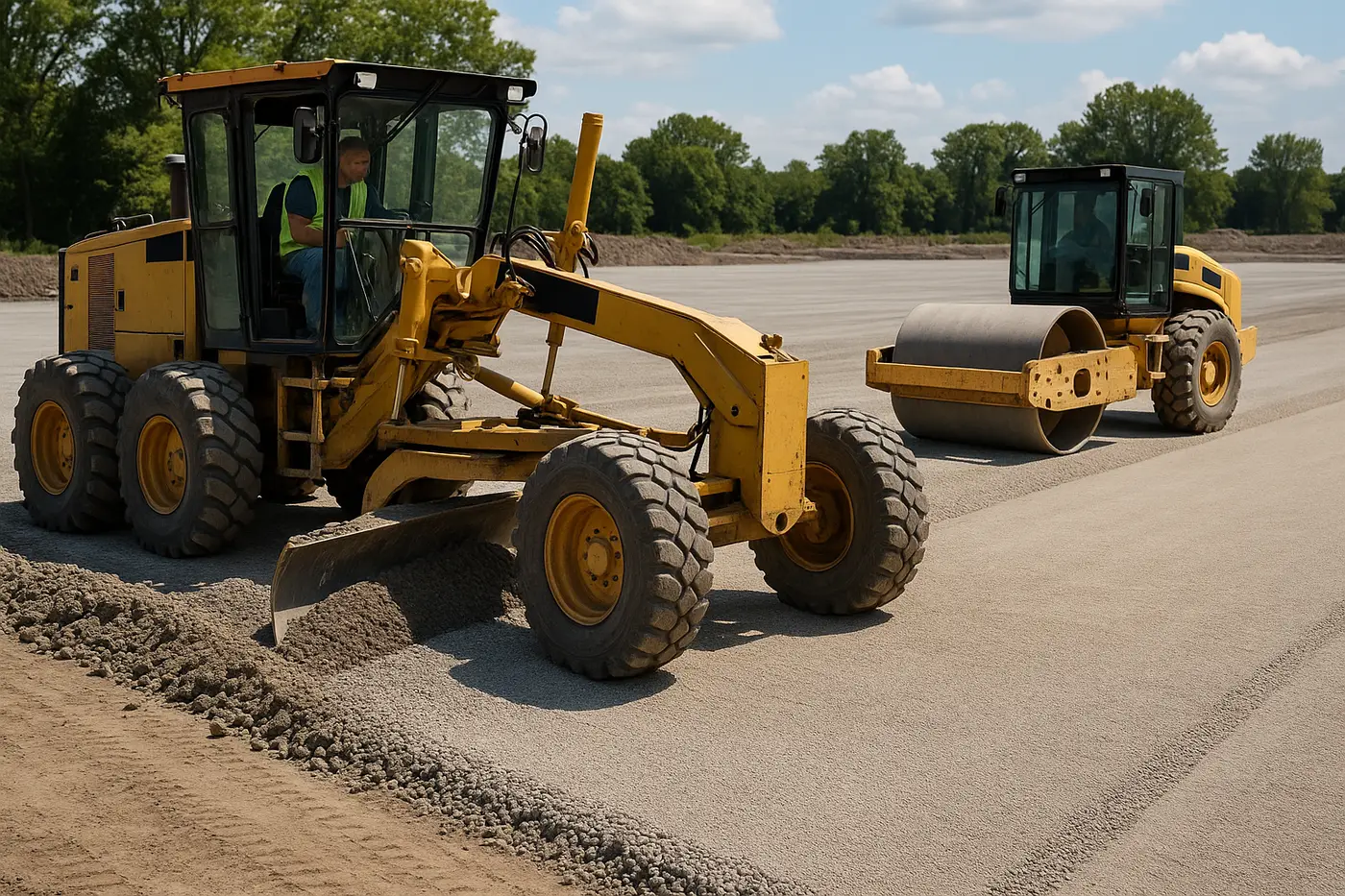
Saw-cutting and removal
Square vertical edges on sound pavement, failed asphalt out, and wet or contaminated base material removed rather than left in place and compacted over.
Base rebuild
Crushed limestone back in compacted lifts, with geotextile separation where the subgrade needs isolating from the stone.
Asphalt, compaction, joints
Placed and compacted in lifts, vertical faces tacked, perimeter joints sealed, and a clear statement of when the area takes cars and when it takes loaded trucks.
Where an overlay is the right call we quote resurfacing with the milling needed to control reflective cracking. Where the pavement is sound, it is crack sealing and nothing more.
Our Lenexa-area coverage
Access off I-35, I-435, K-10, 87th St Pkwy. Industrial work runs west and south along the logistics corridors; the business parks and City Center sit in the middle; the residential work is spread across the older east side and the newer west.
Industrial and logistics
Business parks and City Center
Neighborhoods
Asphalt repair in nearby cities
Related: commercial and industrial paving, striping and accessible layout, sealcoating, and the full service area.
Lenexa repair questions
Two quotes for the same repair came in miles apart. Why?
Usually because they are not the same work. One may be a surface patch and the other a full-depth repair with the base replaced; one may include joint sealing and compaction in lifts and the other may not mention either. Ask both for the depth, the base treatment, and the square footage per area. Once those are on paper the comparison is straightforward, and the cheaper number is sometimes still the right one.
Our new overlay is already cracking in the same places as the old surface. What happened?
That is reflective cracking. An overlay follows the movement of whatever is underneath it, so cracks and joints in the old pavement telegraph up through the new one within a few seasons. It is not a defect in the new asphalt; it is the consequence of resurfacing over cracking that was not addressed first. Milling, full-depth repair at the worst areas, or an interlayer are the ways to slow it.
How thick should the base be under a repair here?
Our standard over Martin-Woodson series clay-loam is 6 to 8 inches of compacted crushed limestone with geotextile separation between stone and subgrade. The clay swells and shrinks seasonally; the stone layer is what spreads the load and keeps that movement away from the asphalt. Sites with heavier traffic or softer subgrade get more, and we will say so rather than quietly building the same section everywhere.
The dock lane has a dip where trailers park. Is that a pothole problem?
No, and treating it as one wastes money. A depression under standing trailers is consolidation — static load compressing the layers below over months. Filling the dip puts new material on the same weak section. The repair is to rebuild that strip properly, and where loading is severe, concrete at the standing points is the honest recommendation even though asphalt is our trade.
Can repairs be scheduled around a working warehouse?
Yes, and on logistics sites it has to be. Work is phased by bay or lane so docks stay reachable, with sequencing agreed before anyone shows up. Asphalt needs to be left alone until it can carry traffic, so that constraint drives the plan and it is on the estimate rather than being sprung on you mid-job.
Who writes the scope
Tarmasters is Kansas City–owned, based in Lee's Summit, and the asphalt division of Ford Concrete and Paving. Insured and bonded, working the metro since 2014. The person who walks your lot is the person who writes the estimate, and the estimate says what will be cut, how deep, what goes back in, and when you can use it.
Get a repair scope in writing.
Areas measured, methods stated, depths given — for warehouse lots, business parks, and driveways across Lenexa.
Tarmasters Asphalt Paving · Insured · Bonded · Kansas City metro since 2014.
Call Now: (816) 789-0700Tarmasters Asphalt Paving
Lee's Summit, MO 64063 | Serving the Kansas City metro | Insured | Bonded