Liberty-Area Asphalt Repair
Two generations of pavement in one city — a historic core in rehab and new logistics pavement hitting its first maintenance window. Both need different work.
Tarmasters repairs asphalt for homes and businesses across Liberty, Missouri — potholes, cracking, rutted truck entrances, and failed base. Over Haig series silty clay, which shrinks and swells hard, repairs hold only when the granular base is rebuilt and compacted properly. Insured and bonded, working the metro since 2014.
Liberty runs two clocks. Around the historic Square and the older I-35 frontage, pavement is at the rehabilitation end of its life, where the questions are about how much is still worth doing. Out along MO-152 and at the Commerce Center, pavement laid between 2018 and 2024 is arriving at its first real maintenance decision — the point where a few hundred dollars of sealing decides whether there is a structural repair in five years.
Most repair advertising is aimed at the first group. The second group is where the money is actually saved. For the market as a whole, see the Liberty paving hub; for the methods, asphalt repair across the metro.
Why Liberty pavement fails — and how we prevent it
What you see on the left. What it is telling you on the right. The second column is where the repair decision actually gets made.
Ruts and dropped edges at industrial gates
Heavy vehicles turning into the Liberty Commerce Center and the distribution sites off I-35 put concentrated axle load exactly where pavement is weakest — the turning point. The subbase gives way under it, and the surface follows. Rebuilding the gate area deeper is the only repair that survives the next year of the same traffic.
Cracks that widen fast in dry weather
Haig silty clay shrinks as it dries and cracks the pavement above it. Because these soils hold moisture longer than upland clays, that movement carries on into months when other parts of the metro have settled down. Sealing early is worth more here than most places.
Potholes reappearing in the same spot
The patch was fine; the base beneath it was wet or never compacted properly. Water that gets into a saturated clay subgrade has nowhere to drain, so the support keeps failing under whatever is placed on top of it.
Surfaces going grey and losing texture
Oxidation on retail lots that have gone a few years without attention. It is not urgent, but it is a clock — brittle asphalt fractures at the edge of every patch, so the repair gets more awkward the longer it waits.
Accessible routes that no longer comply
Older sites around the historic Square were laid out before current standards. Stall counts, access aisles, and markings are striping work; ramps, landings, and slopes that have settled out of tolerance are paving and grading work.
Curb lines crumbling away from the asphalt
The pavement edge loses restraint once the curb goes, and it starts breaking back into the lot. Repaired together, it holds. Repaired separately, the same edge opens again the following winter.
What to expect on your Liberty job
01 · The walk-through
We mark the failures, look at where water runs, and note what is structural versus cosmetic. On newer pavement this often ends with us recommending sealing and a couple of small repairs rather than anything large.
02 · The written scope
Each repair area is measured, with its method and depth stated. You should be able to read an estimate and know exactly what is being cut out and how deep — if you cannot, ask whoever wrote it.
03 · Cut and excavate
Square saw-cut edges, failed asphalt and wet base removed to the depth the failure reaches. On these soils, moisture-controlled compaction of the replacement material is the step that decides everything.
04 · Rebuild and compact
Granular base back in lifts and compacted, then asphalt placed and compacted with the vertical faces tacked so the repair bonds instead of sitting as a plug.
05 · Seal and hand over
Perimeter joints sealed, area swept, and a clear statement of when it takes traffic. Where we have left something alone deliberately, that is written down too.
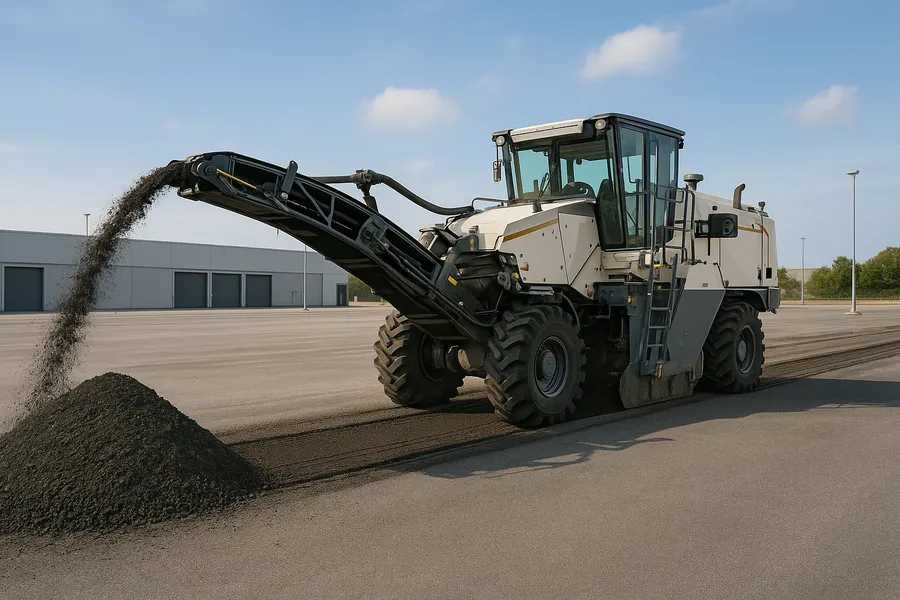
Where the surface has worn out but the structure underneath is sound, the honest answer is not repair at all — it is milling and an overlay. Where the cracks are still tight, it is crack sealing, which costs a fraction of what any of this does.
When each repair can actually be done
Asphalt work is weather-bound, and contractors are not always straight about it. This is the real calendar in this climate — worth knowing before someone quotes you hot-mix patching in February.
Crack sealing
Cool and dry — late fall through early springCracks are at their widest when the pavement is cold, so the sealant fills the full opening rather than a partial one.
Hot-mix patching
Roughly April to early NovemberHot mix needs plant availability, dry cuts, and enough ambient warmth to compact before it cools. Cold, wet conditions cost you the compaction.
Infrared surface repair
Extends further into cold weatherThe existing asphalt is reheated in place, so the bond does not depend on ambient temperature the way a cold-laid patch does.
Full-depth reconstruction
Spring through fallBase material has to be compacted at the right moisture content, and a frozen or saturated subgrade cannot be.
Sealcoating
Warm and dry, with a clear day afterIt needs surface temperature and cure time. Applied in the wrong window it does not cure properly and wears off early.
Line striping
Dry pavement, mild temperaturesPaint needs a dry, warm surface to bond. Fresh asphalt also needs to cure before it is marked.
Liberty repair questions
Our lot is only six years old. Why would it need repair already?
Because the first maintenance window is the cheapest one, and it comes sooner than people expect. On pavement built between 2018 and 2024 the work is usually sealing cracks before they open, repairing a couple of localized areas, and correcting anything that ponds. Done at that stage it is a small number. Left until the base gets wet, the same lot becomes a structural job.
What makes Clay County soil different from the rest of the metro?
Haig series silty clay has extreme shrink-swell behavior and holds moisture longer than the upland clays east and south of here, partly because of the river valley influence. Practically, that means ground movement stretches later into the dry months, and it means base thickness and moisture-controlled compaction matter more here — the granular layer has to isolate the pavement from a subgrade that will not sit still.
The entrance where trucks turn keeps failing. What actually fixes it?
A deeper, stronger section at the turning point. Trucks apply their heaviest stress where they brake and pivot, which shears asphalt sideways and works the subbase. Patching the surface there is a seasonal exercise. The repair that lasts is a full-depth rebuild of the turning area, and where the loading is severe enough we will tell you a concrete apron is the better answer even though asphalt is our trade.
Can repairs happen in winter?
Some can. Crack sealing is genuinely better in cold weather because the cracks are open at their widest, and infrared surface repair reaches further into the cold than a conventional hot-mix patch. Full-depth work needs a subgrade that can be compacted at the right moisture, which a frozen or saturated one cannot. If it is January and something has failed, call us — we will tell you honestly whether it is a now job or a March job.
Do you handle driveways as well as commercial lots?
Yes. In the subdivisions here that usually means cracking, a settled apron at the street, or edges breaking down where there is no restraint. The methods are the same as on a lot, at a smaller scale. If a driveway has gone past the point where patching makes sense, we will price replacement rather than sell you repairs that will not hold.
Serving Liberty and nearby areas
Access off I-35, MO-152, MO-291, US-69. What the repair looks like depends less on the address than on what drives across it.
Commercial and logistics
Rutting, gate rebuilds, striping
- Liberty Commerce Center
- I-35 Industrial Corridor
- MO-152 Retail Corridor
- Liberty Commons
- Wilshire Plaza District
Institutional and historic
Accessible routes, aging private drives
- Historic Liberty Square
- Liberty Hospital District
- William Jewell Campus Area
- Kansas Street Corridor
Residential
Driveway cracking, aprons, edges
- Benson Place
- Shoal Creek Valley
- Canterbury Estates
- Clay Meadows
- Woodneath Farms
Repair work in nearby cities
Related: commercial paving, striping and accessible layout, sealcoating, and the full service area.
The company behind the estimate
Tarmasters is Kansas City–owned, based in Lee's Summit, and the asphalt division of Ford Concrete and Paving — insured and bonded, working the metro with our own crews and equipment since 2014. On a repair job you get measured areas, a fixed price, the method and depth for each one, and a plain note of anything we think can safely wait.
Get it looked at while it is still small.
Crack sealing, patching, base repair, and entrance rebuilds across Liberty and Clay County — measured and priced without the sales routine.
Tarmasters Asphalt Paving · insured and bonded · working the Kansas City metro since 2014.
Call Now: (816) 789-0700Tarmasters Asphalt Paving
Lee's Summit, MO 64063 | Serving the Kansas City metro | Insured | Bonded