Asphalt Repair Throughout Kansas City, KS
Rutted truck lanes, failed gate entries, sinking river-bottom lots, and worn-out driveways — repaired for what is actually under them.
Tarmasters repairs asphalt driveways and heavy-duty lots across Kansas City, Kansas — rutting, potholes, gate failures, and settlement. The ground here is Mixed industrial fill and Kaw River alluvial clay, which varies across a single site, so repairs start by establishing what is underneath. Insured and bonded, working both sides of the metro since 2014.
In most of the metro you can make a reasonable guess about what is under a lot before you cut it. Not in Wyandotte County. Industrial ground here was filled and re-filled over a century, the river bottoms carry alluvial soils that settle, and the upland neighborhoods sit on native soil that behaves differently again. Two bays of the same lot can tell you two different stories.
On top of that, this is the metro's freight spine — pavement here does work that pavement in a retail suburb never has to do. So repair in this city is less about identifying the pothole and more about identifying the layer that quit. For the wider market, see the Kansas City, KS paving hub or our repair service across the metro.
The base under a Kansas City job — and the three layers above it
Pavement is four layers, and each one fails in a way you can read from the surface. This is the table we work from, and it is the fastest way to know whether a quote in front of you makes sense.
| Layer | What it looks like from above | Quick check | What it needs |
|---|---|---|---|
| Surface course | Greying, aggregate working loose, fine surface cracking, polished patches | Scuff it — loose fines and exposed stone mean the binder has oxidized | Sealcoat if sound, thin overlay if raveling has advanced |
| Binder course | Longitudinal cracking, deformation under load, ruts with cracked shoulders | Rut depth over about half an inch usually means the layer is moving, not wearing | Mill and inlay that area — the surface alone will not restore the section |
| Aggregate base | Potholes, edges spalling back, patches that sink, interconnected cracking | Standing water in the failure, or a soft feel underfoot at the edge of the hole | Saw-cut full-depth repair with the stone replaced and compacted |
| Subgrade | Whole areas dishing, repeated failure in the same footprint, heaving | The failure comes back after a correctly built patch | Over-excavate and rebuild, or reconstruct that section with a base built for the soil |
What we are called out for in Wyandotte County
Six problems, weighted heavily toward load and water — which is what you would expect in a city built around rail, freight, and two rivers.
Deep structural rutting in truck lanes
Class 8 movement on K-32 and Metropolitan Ave puts axle loads on pavement in the same wheel paths all day. Ruts here are rarely a surface issue — the section is deforming through its depth, and the repair has to replace that depth.
Gate and scale-entry failure
Where trucks slow, turn, and stop at an industrial entrance, the pavement takes braking and pivoting stress at its weakest point. Those areas fail first and fail hardest, and rebuilding them heavier is cheaper than repairing them yearly.
Subgrade failure in river-bottom lots
Low ground near the Kaw and Missouri carries alluvial soils and a high water table. Lots there settle in patterns rather than points, and a repair that does not deal with what is underneath simply relocates the problem.
Unpredictable fill under older sites
Much of the industrial ground here was made ground long before anyone documented it. Two bays of the same lot can behave completely differently, which is why we open a test area rather than assume a section thickness.
Event-surge wear at Village West
Retail and event parking sees enormous volume in short bursts, and surfaces polish and wear at the entries and drive aisles well before the parking bays do. Repair there is targeted, not lot-wide.
Older residential driveways breaking up
Pre-1950s housing in Strawberry Hill, Armourdale, and Argentine often has original or long-since-patched driveways with no real base. When the edges are crumbling and the middle is cracked through, replacement is usually the honest number.
Want to know what is under your lot before you spend anything? Start with a walk-through.
Call Now: (816) 789-0700
The conditions a repair here has to survive
Mixed
Ground conditions
Industrial fill, Kaw River alluvial clay, and native soils inside one city. Alluvial ground settles; undocumented fill behaves differently every hundred feet.
34"
Frost depth
Deep enough that water held in an open crack or a wet base freezes where it sits, then widens the opening it froze in.
41"
Rain a year
On flat river-bottom lots with a high water table, that water has nowhere to go but into the pavement structure.
24/7
Freight movement
Rail-to-truck transfer and manufacturing traffic run continuously. Pavement here is a working surface, not a parking surface.
Alluvial soils near the Kaw settle under load and lose bearing when they are wet; undocumented fill can be dense in one place and compressible six feet away. Neither of those is fixed by putting better asphalt on top. It is fixed by building the layer between the two — a properly graded, compacted stone base thick enough to spread the load the site actually carries.
Repairing a Kansas City, KS lot the right way
Find out what is actually under it
On a lot in this city that is not a formality. A test cut or a core tells us the section thickness, the base condition, and whether we are on fill or alluvial ground — and it changes the price and the method.
Separate load failures from water failures
A rut under a wheel path and a pothole in a puddle need different repairs. Getting that wrong is how a lot gets repaired twice.
Cut square, dig to sound material
Vertical saw-cut edges on solid pavement, failed asphalt and base out to the depth the failure reaches, wet material removed rather than compacted in place.
Rebuild for the traffic it carries
Base in compacted lifts, then asphalt in lifts with tacked faces. On truck routes and gate areas, the replacement section is built heavier than what was there — otherwise it fails the same way on the same schedule.
Seal, sweep, and state the cure
Joints sealed, the area cleaned up, and a clear statement of when it takes traffic and when it takes loaded traffic. Those are not the same day.
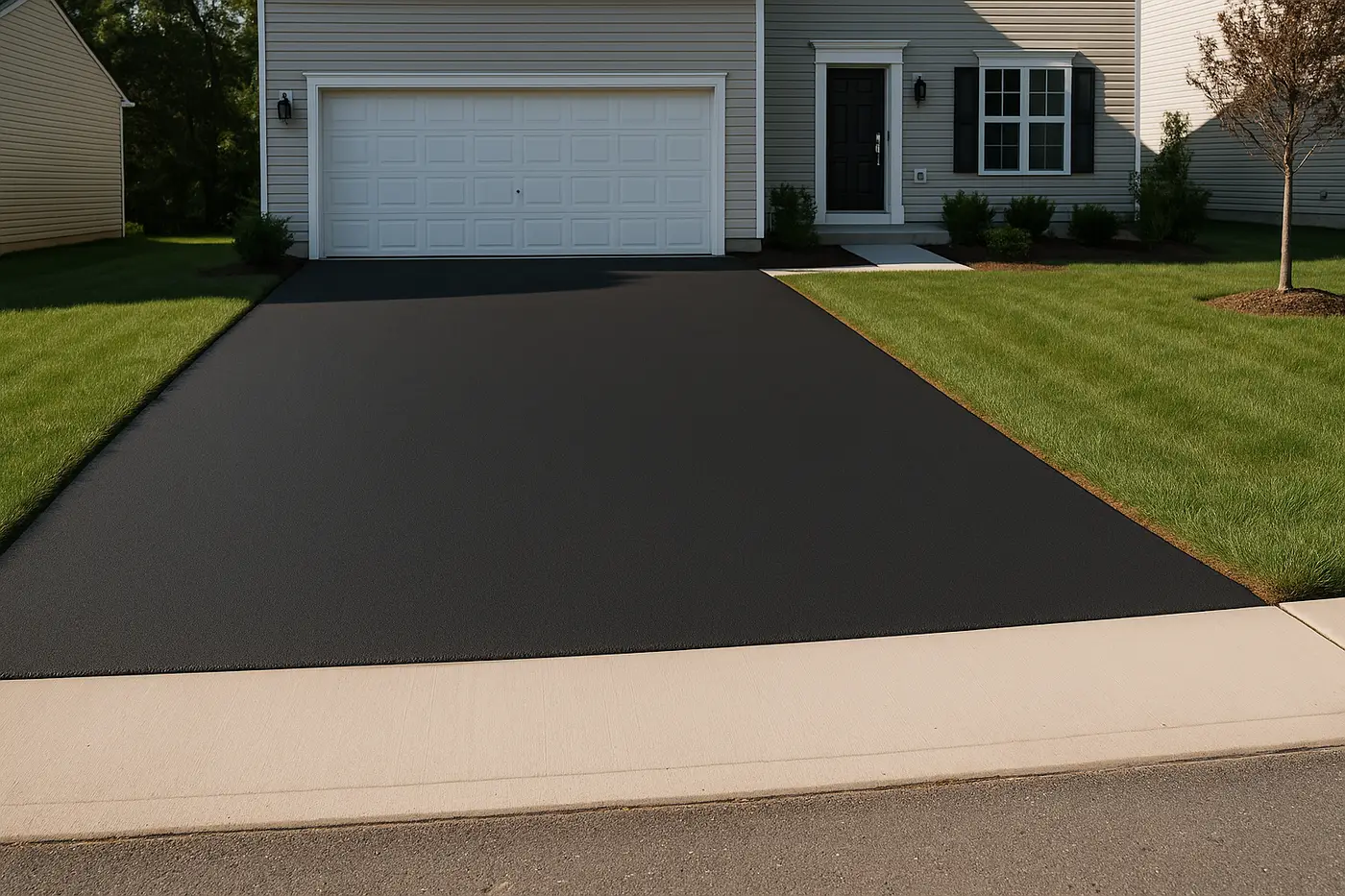
Residential work here is mostly driveways in the older neighborhoods — repair or replacement, depending on whether there is a base worth saving.
Communities we serve around Kansas City, KS
Access off I-70, I-435, K-7, K-32. The work splits cleanly three ways here, and the estimate looks different in each.
Industrial and freight
Urban core neighborhoods
West side and Village West
Asphalt repair in neighboring cities
Related work: commercial and industrial paving, milling, crack sealing, and the full service area.
Wyandotte County repair questions
Why do you want to cut a test hole before quoting our lot?
Because in Wyandotte County the ground is genuinely unpredictable. Mixed industrial fill and Kaw River alluvial clay means one part of a site can be on documented native soil and another on fill nobody has a record of. A test cut shows the real asphalt thickness, the state of the base, and whether water is sitting in it. Without that, a quote on a large lot is a guess dressed up as a number.
Our truck lot ruts again a year after every repair. Why?
Almost always because the repair replaced what was there instead of what the traffic needs. A section built for cars will rut under loaded trucks no matter how well it is laid. Where the load is heavy and slow-moving — gates, scales, dock approaches — the section has to be rebuilt deeper, with the right mix, and sometimes with concrete at the true pinch points. We would rather tell you that than sell you the same repair annually.
Can a lot in the river bottoms be repaired at all?
Yes, with the drainage and subgrade treated as part of the job rather than as an afterthought. Alluvial ground with a high water table will keep taking support away from pavement that sits on it. That means proper base depth, sometimes geotextile separation, and getting water off the surface and away from the structure. Done that way it holds. Done as a surface patch it does not.
Is it worth repairing an old driveway with no real base?
Often not, and we will say so on the walk-through. A driveway laid thin on native soil decades ago has usually failed everywhere at once — cracked through the middle, crumbling at the edges, no restraint left. Patching it is money spent on a delay. Removing it and rebuilding with a proper compacted base gives you a driveway that lasts, and we will price both so the comparison is in front of you.
Do you work in Wyandotte County as well as the Missouri side?
Yes. We are based in Lee's Summit and cover the whole Kansas City metro, both sides of the state line. Scheduling depends on weather and the work queue rather than which side of the river you are on.
Who turns up
Tarmasters is Kansas City–owned, based in Lee's Summit, and the asphalt division of Ford Concrete and Paving. Insured and bonded, working the metro since 2014. On heavy-duty sites we will tell you where asphalt is the right material and where it is not, and the estimate will say which repair areas are full-depth and why.
Repair built for the load it carries.
Truck lanes, gate entries, river-bottom lots, and driveways across Kansas City, Kansas — measured, tested, and priced properly.
Call Now: (816) 789-0700