Asphalt Repair Across the Leavenworth Area
Shaded lots that never dry out, bluff sites that shed water at speed, and ground that changes under a single property. Repairs scoped for all three.
Tarmasters repairs asphalt across Leavenworth, Kansas — potholes, raveling surfaces, undermined edges, and failed base. Over Grundy-Pawnee series clay and glacial till, bearing changes across a single lot, so we probe before scoping and vary base thickness to match. Insured and bonded, working since 2014.
Three things make pavement here behave differently from the rest of the metro, and none of them are about traffic. Shade, because the hills and the building orientation leave whole sections of lot that barely see sun in January. Slope, because this is bluff country and water crosses a parking surface instead of sitting on it. And the ground itself, which can be firm over a limestone shelf at one end of a property and considerably softer at the other.
A repair that ignores any of the three is a repair with a short life. For paving and resurfacing in this market see the Leavenworth paving hub, or how we handle repair across the metro.
What a lasting Leavenworth job takes
Lots that never dry out
North-facing pavement behind the buildings along 4th Street sits in shadow through the short winter days. It thaws late, stays damp, and cycles through freezing far more punishingly than the sunlit side of the same property. Those areas fail first, every time, and they are worth sealing first.
Sheet flow off the bluffs
On the western bluffs above the Missouri River, stormwater crosses parking surfaces at speed rather than trickling to a drain. Without proper curbing and valley gutters it scours base material out from under the pavement edges, and the edge fails from underneath within a few seasons.
Limestone close to the surface — in places
Grundy-Pawnee series clay over glacial till, with near-surface limestone in parts of the county. That means bearing capacity can change across a single lot: firm over the shelf, softer where the till runs deeper. Probing before scoping is how you avoid pricing one condition and finding another.
What we repair in this city
Raveling on the heavy-traffic corridors
Constant military, delivery, and commuter traffic on 4th Street and Metropolitan Avenue accelerates surface wear. Aggregate works loose, texture coarsens, and the surface starts shedding. Early it is a sealcoat or thin overlay call; advanced, the wear course is gone.
Potholes at entries and drive lanes
Where vehicles turn in and slow down, load concentrates and water finds every opening. The base under the failure is always wider than the hole, so the repair is a saw-cut full-depth patch rather than a fill.
Edges undermined by run-off
On sloped sites, water running across the surface takes material out from beneath the pavement edge. The asphalt looks fine until it breaks off in a strip. Repairing it means fixing where the water goes as well as replacing the edge.
Cracking through resurfaced lots
Overlays placed on cracked pavement without the underlying issue being addressed let the old cracks work back up through the new surface. It is not new damage — it is the old damage, reappearing on the same lines.
Mid-century lots at the end of the line
A lot of the commercial and institutional pavement here dates from the middle of the last century. Where cracking has connected across most of the surface and areas are sinking, the honest answer is reconstruction and we will say so.
Accessible routes in the historic core
Downtown predates current standards, and the gaps are usually ramps, landings, and slopes rather than paint. Those are grading and paving repairs; only the markings are a striping job.
What each repair costs you in downtime
On a hospital, school, or institutional lot, the disruption often matters more than the invoice. These are realistic figures, not best-case ones, and weather can move all of them.
| Method | Time on site | Cars back on | Loaded vehicles | Phasing |
|---|---|---|---|---|
| Crack sealing | Hours for a typical lot | Within about an hour of placement | Same day | Easily done in sections around a working site |
| Surface patch | Half a day per small area | Once it has cooled through, usually same day | Next day is safer | Localized; the rest of the lot keeps working |
| Saw-cut full-depth patch | One to two days for a handful of areas | Same day or next morning | Give it a day beyond that | Needs the area barricaded while the cut is open |
| Mill and inlay of a lane | One to three days depending on area | After compaction and cooling | Next day | Phase by lane so access is kept |
| Full reconstruction of a section | Several days to a week | After the surface course is placed and cooled | Allow additional cure time | Plan it around a quiet week; it cannot be rushed |
The work, step by step
Probe before promising
On this ground we check what the base is doing across the site rather than at one point, because a limestone shelf under half a lot and deeper till under the other half is a real possibility here.
Follow the water
On sloped sites we work out where run-off crosses the pavement and what it is doing to the edges. That usually changes the scope, and it is the reason some repairs here include curbing or a valley gutter.
Cut square and go to depth
Vertical saw-cut edges on sound pavement, failed asphalt and any wet base removed to the depth the failure actually reaches.
Rebuild with the base sized to the ground
Compacted stone in lifts, with thickness varied where bearing varies rather than one section used everywhere by default.
Place, compact, seal, hand over
Asphalt in lifts, tacked faces, sealed perimeter joints, and clear timings for when the area takes cars and when it takes loaded vehicles.
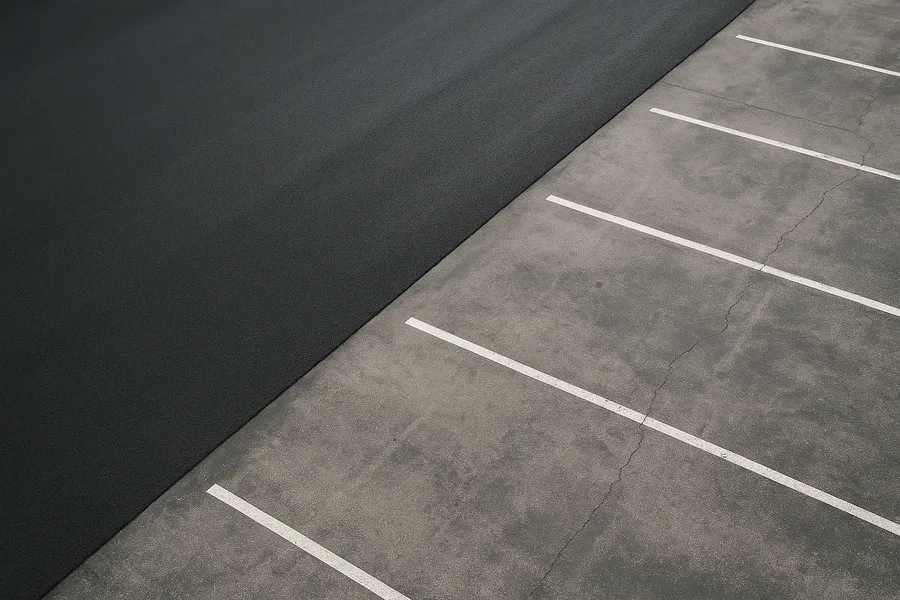
Where a lot needs the surface replaced rather than repaired, that is milling and an overlay; where the cracks are still tight it is crack sealing and very little money.
Around Leavenworth
Access off US-73 / K-7 (4th St), US-92, Metropolitan Ave, Eisenhower Rd. Commercial and institutional work runs along the corridors and the downtown core; residential repair is spread through the older neighborhoods and the bluffs.
Commercial and institutional
Historic Downtown · 4th Street Retail Corridor · Leavenworth Business & Industrial Park · Metropolitan Avenue District · Eisenhower Road Area
Residential and riverfront
North Broadway · Muncie · Limit Street · Shrine Park · Vilas Street · West Bluffs · South Leavenworth · Riverfront District
Asphalt repair in nearby cities
Related: commercial lot paving, driveways, striping, and the full service area.
Leavenworth repair questions
Why does the pavement behind our building fail faster than the front?
Shade. North-facing areas in winter thaw late and stay wet, so they spend far longer in the freeze-thaw range than the sunny side of the same lot. With roughly 40 cycles a year, that difference compounds. Practically it means the back of a property often deserves sealing and attention before the front, which is the reverse of how most maintenance budgets get spent.
Water pours across our lot when it rains. Is that a paving problem?
It becomes one. On the bluffs, stormwater moves fast across the surface instead of collecting and draining, and moving water pulls material out from under the pavement edge. You get an edge that looks solid and then breaks away in a strip. The repair is the edge plus the control — curbing, a valley gutter, or corrected fall so the water is directed rather than left to find its own way.
Can you work around a busy institutional site?
Yes, and the downtime table on this page is the honest version of what that involves. Crack sealing and surface patching barely interrupt a site. Full-depth repairs need the area closed while the cut is open. Reconstruction needs planning around a quiet stretch. We build the phasing into the estimate so nobody discovers on the day that half the lot is unusable.
Our overlay is cracking in the same pattern as the old surface. Is that a bad job?
Not necessarily — it is what happens when a resurfacing goes over cracking that was not dealt with first. The new asphalt follows the movement below it and the cracks come back through on the same lines. Preventing it means milling, repairing the worst areas full-depth, or using an interlayer before the new surface goes on. It is more expensive up front and much cheaper across ten years.
Is Leavenworth County ground better or worse than Johnson County clay?
Different rather than better. Grundy-Pawnee series clay over glacial till is generally more stable than the heavy clays south and east, and where limestone is near the surface, bearing is genuinely good. The catch is that it varies within one site, so a base design that suits one end of a lot can be wrong at the other. That is a reason to probe rather than to assume either way.
Who you are hiring
Tarmasters is Kansas City–owned, based in Lee's Summit, and the asphalt division of Ford Concrete and Paving. Insured and bonded, working since 2014. On institutional and commercial sites you get the failures measured, the phasing planned before we mobilize, a fixed price, and a written note of anything that can safely wait until next year.
Get the shaded, sloped, and soft spots dealt with properly.
Asphalt repair across Leavenworth and Leavenworth County — probed, scoped, phased, and priced.
Tarmasters Asphalt Paving · Insured · Bonded · working the Kansas City metro since 2014.
Call Now: (816) 789-0700Tarmasters Asphalt Paving
Lee's Summit, MO 64063 | Serving the Kansas City metro | Insured | Bonded