Residential & Commercial Asphalt Paving in Leavenworth
Campuses, medical lots, historic downtown frontage, and drives on the bluffs — phased so the property keeps working while we build it.
Tarmasters paves institutional, commercial, and residential asphalt across Leavenworth, Kansas. The subgrade is Grundy-Pawnee series clay over glacial till with limestone close to the surface in places, so bearing changes across a single lot and the base has to change with it. Insured, bonded, paving since 2014.
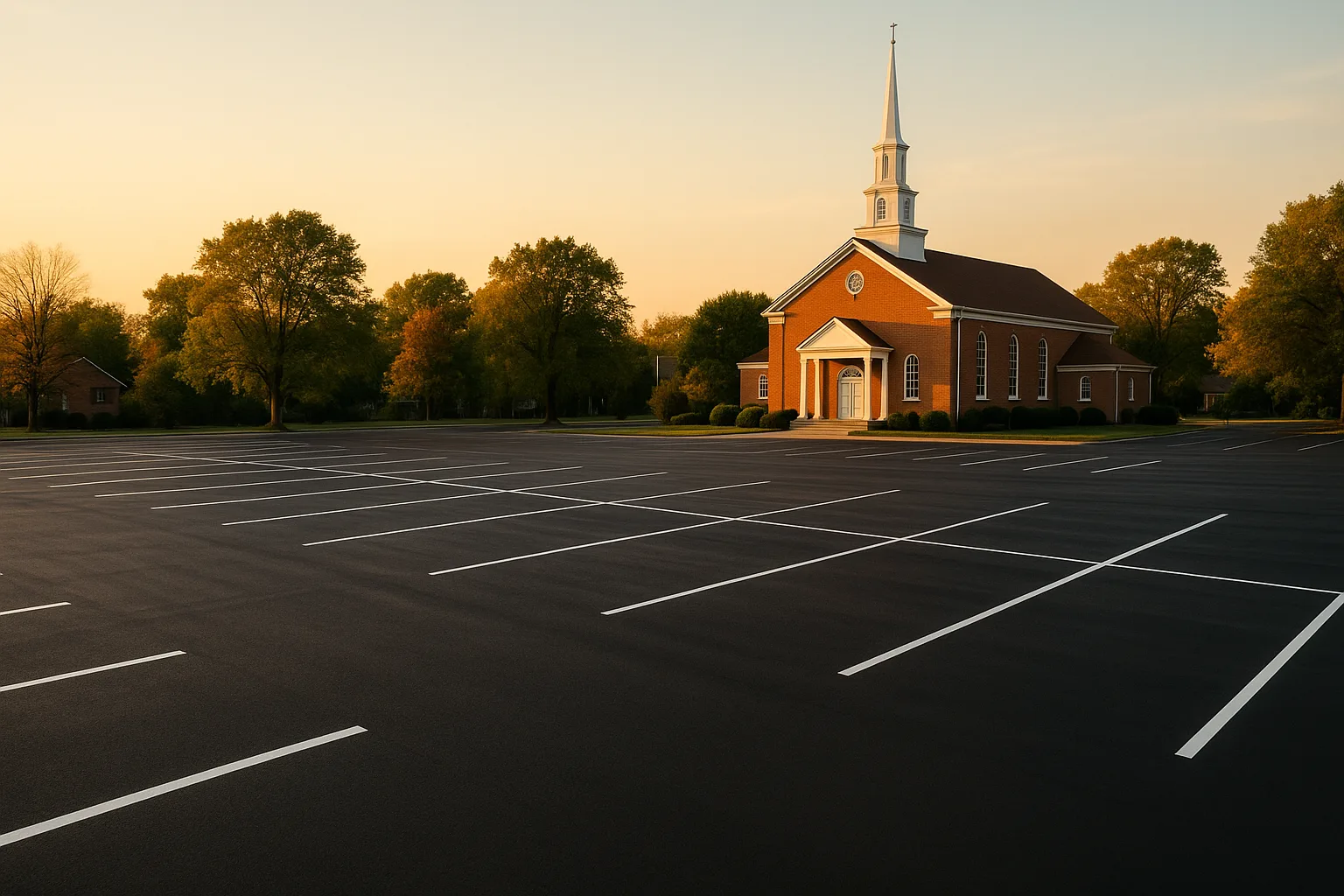
In most cities this size, commercial paving means retail lots. In Leavenworth a large share of the pavement belongs to an institution — the federal presence at Fort Leavenworth, the VA and hospital campuses, the school district, the county. Those properties have two things in common: they cannot simply close for a week, and much of their surfacing dates to the middle of the last century.
That shapes how the work gets done. A campus job is planned in phases before it is priced, with the access routes and a working share of the parking held open the whole way through. And on pavement that old, the honest first question is what is still down there — because the surface is frequently the newest thing about the structure.
We also do the ordinary work: drives on the West Bluffs, retail along the 4th Street corridor, and industrial lots at the Leavenworth Business & Industrial Park. Based in Lee's Summit, insured and bonded, and direct about whether a surface needs repair, resurfacing, or rebuilding.
What Tarmasters does in Leavenworth
Commercial paving, repair, and driveways have dedicated Leavenworth pages. The rest run through the metro service pages.
Institutional, medical, and retail lots — including the phased work a campus needs when it cannot close.
Full-depth repair on mid-century institutional pavement, where the surface is often the newest thing about it.
Drives on the bluffs and through the older streets, where the slope and the apron matter as much as the mat.
Resurfacing where the structure is sound — with the cracked layer milled out rather than buried under a new one.
The highest-value work on any lot here, and especially on the shaded north sides where surfaces stay wet.
Binder protection on sound surfaces, once the repairs that actually matter have been done.
Layout, fire lanes, and accessible routes — a recurring need in the historic downtown, where the grades are fixed.
Removing a spent or previously overlaid surface so a resurfacing job does not inherit the old crack pattern.
What separates a lasting Leavenworth job
The good news is that this is better ground than most of the metro. The catch is that it is not the same ground twice.
The subgrade
Rock in one corner, clay in the next
Leavenworth County's subgrade includes glacial till deposits with near-surface limestone in some areas. While more stable than the heavy clay found in Johnson or Jackson County, limestone shelves can create uneven bearing capacity across a single lot — requiring geotechnical probing and variable base thickness design.
The practical consequence is that a single base thickness applied across a whole lot will crack where the bearing changes. Variable design is not an upsell here; it is the job.
The water and the winter
Bluffs, sheet flow, and shade
Properties on Leavenworth's western bluffs overlooking the Missouri River sit on sloped ground that channels stormwater at high velocity across parking surfaces. Without properly designed curbing and valley gutters, sheet flow erodes base material and undermines asphalt edges within a few seasons.
Leavenworth County averages 40 freeze-thaw cycles per winter. Moisture that penetrates through unsealed cracks expands repeatedly, accelerating base failure and pothole formation — particularly in shaded lots on the north side of commercial buildings along 4th Street.
What we find under a Leavenworth lot, and what it changes
Six conditions that turn up regularly on one site, and how each one moves the design. This is the conversation that should happen before a number, not after a crack.
| What we find | What it means | How the build changes |
|---|---|---|
| Limestone shelf close to the surface | A hard, unyielding zone that will not settle with the rest of the lot | Thinner base over the shelf, transitions eased either side so the surface does not crack at the change |
| Glacial till, dense and well graded | Genuinely good bearing — better than the heavy clay across the state line | A standard section works. This is where the budget stops rising. |
| Grundy-Pawnee clay pocket | Shrink-swell movement in one part of a lot that is otherwise stable | Deeper compacted base and a geotextile separator over that zone only |
| Shaded north-side surface | Stays damp far longer after a thaw, so freeze-thaw works on it harder | Tighter crack-sealing cycle and drainage that actually clears the shaded strip |
| Bluff-edge sheet flow | Stormwater arriving fast and wide across the surface rather than in a channel | Curbing and valley gutters to collect it before it reaches the asphalt edge |
| Fixed historic grades downtown | Thresholds and kerb lines you cannot raise, so build-up is not an option | Mill to grade and re-lay at the same level rather than overlaying upward |
Working in Leavenworth
Tarmasters is a Kansas City–owned paving contractor and the asphalt division of Ford Concrete and Paving, working across the metro since 2014 with our own crews and equipment. Leavenworth County is a regular part of the run north, not an outlying trip.
Work in the city runs under City of Leavenworth building codes. On institutional and medical properties, access routes, emergency lanes, and accessible parking are usually the constraints that shape the sequence — so we plan those first and price the work around them.
Insured and bonded. Measured estimate, fixed price, firm sequence, and a straight answer about what the surface needs.
Serving Leavenworth and nearby areas
We work the city end to end — Historic Downtown, 4th Street Retail Corridor, Leavenworth Business & Industrial Park, the residential streets on the bluffs, and the properties around the Fort. Access is off US-73 / K-7 (4th St), US-92, Metropolitan Ave, and Eisenhower Rd.
North Broadway
Muncie
Limit Street
Shrine Park
Vilas Street
Historic Downtown
4th Street Corridor
Metropolitan Avenue District
Eisenhower Road Area
Leavenworth Business & Industrial Park
South Leavenworth
Riverfront District
Fort Leavenworth Adjacent
West Bluffs
Vilas Street / Leavenworth Core
Nearby cities we cover
Immediately south is Lansing, then Basehor and Tonganoxie inland, and Kansas City, Kansas further down the K-7 corridor. Across the river we cover Platte City and Weston, and Fort Leavenworth sits inside the same run. See every city we serve.
Leavenworth paving questions
Why does bearing capacity vary across one Leavenworth lot?
Because the subgrade here is not uniform. Leavenworth County's subgrade includes glacial till deposits with near-surface limestone in some areas. While more stable than the heavy clay found in Johnson or Jackson County, limestone shelves can create uneven bearing capacity across a single lot — requiring geotechnical probing and variable base thickness design. In practice that means one end of a lot can be sitting on rock and the other on clay, and a single base design applied across both will crack at the transition. It is the reason we probe before we price.
Can you work on a campus that has to stay open?
Yes, and most of the institutional work here is phased that way. The lot is split into sections and the sequence is run one section at a time, so access routes and a share of the parking stay usable throughout. The paving stage is the one that needs its area completely clear for about a day, and that is scheduled against your calendar before anything is booked.
Water sheets across our lot from the bluff above. What fixes that?
Intercepting it before it reaches the asphalt. On the western bluffs, stormwater arrives fast and spread wide rather than in a defined channel, and sheet flow at that velocity scours base material out from under the pavement edge within a few seasons. The fix is curbing and valley gutters that collect and carry it, plus an edge detail built to be supported rather than exposed.
Why do the north sides of buildings on 4th Street fail first?
Shade. Those surfaces hold moisture much longer after a thaw, and with 100 or more freeze-thaw cycles in a typical winter, water that lingers in unsealed cracks does far more work there than on a sunny south-facing lot. The same building can have one side in good order and the other coming apart.
Do you handle accessible parking upgrades downtown?
Yes, and the historic core is the hardest place in the city to do it, because the grades and building thresholds are fixed. Accessible stalls and access aisles have slope limits in every direction, so the work is usually regrading a section of surface rather than repainting lines. We survey what has to move and price it into the job.
Ready to pave it right?
Get a straight estimate and a clear timeline. Tarmasters Asphalt Paving handles driveways, parking lots, and repairs across the Kansas City metro.
Call Now: (816) 789-0700