Asphalt Paving for Weston Property Owners
The ground under this town is strong while it is dry and unreliable once it is wet. Everything we build here is aimed at keeping water off it.
Tarmasters paves commercial lots and driveways across Weston, Missouri. The subgrade is Knox-Haig series silty clay-loam with loess deposits — loess that loses bearing capacity when it saturates — so moisture-barrier geotextile and a sealed surface are structural requirements here. Insured, bonded, paving since 2014.
Weston sits on thick loess — silt laid down by wind rather than water, and it behaves unlike any other subgrade in the metro. Dry, it is perfectly good ground. Saturated, its structure collapses, and the bearing capacity under a pavement section can drop by 40 per cent or more. Not gradually. Effectively overnight.
Once you know that, every other decision follows. A moisture-barrier geotextile under the base. Compaction sequenced carefully rather than rushed. And above all, a surface that stays sealed — because on this ground a crack is a route to the subgrade rather than a blemish on top of it.
The town is small, at around 1,756 residents, and busy well beyond its size — a Historic Main Street District that takes thousands of visitors, the Winery/Distillery Industrial Loop, and agricultural traffic on MO-45. We work it from Lee's Summit, insured and bonded, and straight about whether you need sealing, repair, or a rebuilt section.
Why the base matters in Weston
Weston sits on thick loess deposits — wind-blown silt that collapses under saturation. When moisture reaches this subgrade through cracked pavement, bearing capacity can drop 40% or more overnight. Every base design here requires moisture-barrier geotextile and careful compaction sequencing.
Weston's bluff terrain produces steep grade changes within short distances. Water accelerates across lot surfaces, scouring asphalt edges and undermining curb lines. Crown profiles and inlet placement must account for the velocity of concentrated runoff — not just volume. On bluff terrain, volume is not the problem — velocity is. Water arriving fast at an unsupported asphalt edge takes material with it, and once the edge is undermined the kerb line follows.
Subgrade
Loess
Wind-blown silt. Strong dry, collapsible wet.
Terrain
Bluff
Steep grade change over short distances; fast run-off.
Freeze-thaw
42+ a year
More than the metro core — no urban heat buffer up here.
Load
Seasonal
Tourism surges plus agricultural transport on narrow access roads.
Weston paving services
Commercial paving, repair, and driveways have dedicated Weston pages. The rest run through the metro service pages.
Visitor parking, event staging, and distillery-campus lots — built with a moisture barrier under them and a grade that carries water off fast.
Full-depth repair where water has reached the loess and the bearing under a section has simply gone.
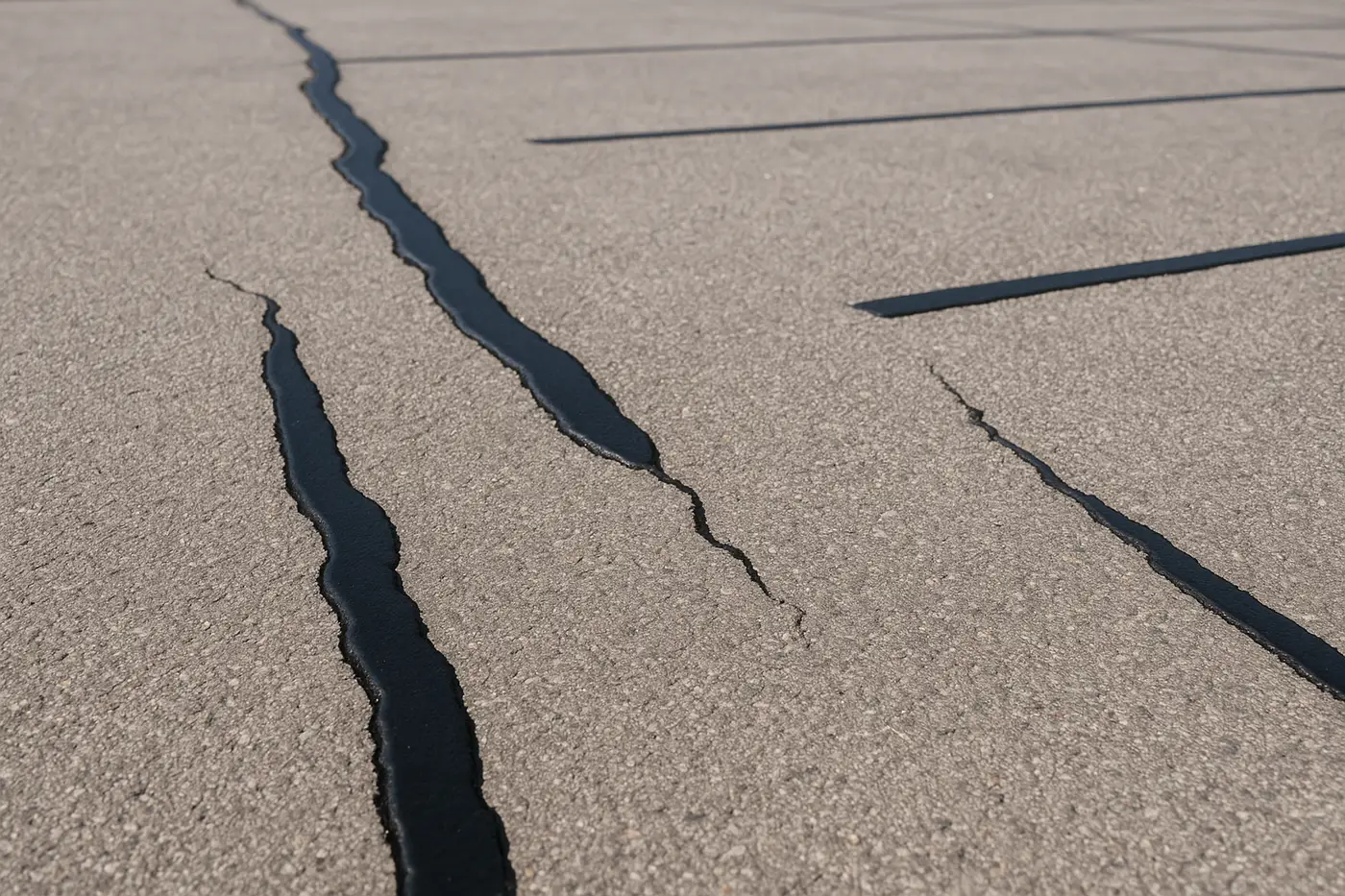
More urgent here than almost anywhere. On collapsible subgrade, a crack is a delivery route rather than a blemish.
Long drives on the hills and hobby farms, where the run-off has a long way to travel and picks up speed doing it.
A sealed surface is the first line of defence for the subgrade underneath. Here that is a structural point, not a cosmetic one.
A new wearing course where the ground below has stayed dry and the structure is genuinely intact.
Layout and accessible routes for visitor lots that fill completely on festival weekends.
Removing a spent surface without raising a lot above the historic kerbs and thresholds it has to meet.
What a crack costs, stage by stage
This is the escalation we see on collapsible ground, and the reason we push sealing here harder than we do anywhere else in the metro. Every step down this table costs several times the one above it.
| Stage | What is happening | When | What it takes to fix |
|---|---|---|---|
| 1A hairline crack opens | Thermal movement and ageing. Nothing structural has happened yet | Any season | Routing and sealing. The cheapest intervention available. |
| 2Water starts using it | The crack is now a path from the surface to the subgrade | The first heavy rain after it opens | Still sealing — but the clock has started. |
| 3The loess saturates | Wind-blown silt loses structure when it wets. Bearing capacity can drop sharply, and quickly | Can be a single storm | Full-depth repair of the affected area, once you can see it. |
| 4The surface deflects | The mat is spanning ground that is no longer supporting it | Weeks to months later | Excavation, subgrade replacement, and a new section over that zone. |
| 5Freeze-thaw takes over | Water in a failing base expands through 50 or more cycles a winter | The following spring | The failure spreads outward. What was one bay becomes several. |
| 6It reaches the edge | Bluff run-off scours the unsupported edge and undermines the kerb line | The second or third winter | Kerb replacement plus reconstruction — the most expensive outcome on this list. |
Working in Weston
Tarmasters is a Kansas City–owned paving contractor and the asphalt division of Ford Concrete and Paving, working the metro since 2014. Weston is a specific kind of job — small sites, difficult ground, and a historic setting where the work has to be tidy as well as sound.
Work here runs under City of Weston / Platte County codes. The downtown is a 19th-century streetscape, so accessible routes and thresholds are genuine constraints rather than checkboxes, and they are usually solved by regrading the approach rather than altering the building.
Insured and bonded. Measured estimate, fixed price, firm sequence, and a straight answer about what your surface needs.
Weston neighborhoods we serve
We cover the town and the surrounding hills — the Historic Main Street District, the Winery/Distillery Industrial Loop, and the MO-45 Retail Node, plus the rural drives and hobby farms around them. Access is off MO-45, MO-273, MO-371, and Main St.
- ★ Downtown Weston
- ★ Weston Heights
- ★ Bee Creek area
- ★ Historic Main Street District
- ★ Winery/Distillery Industrial Loop
- ★ MO-45 Retail Node
- ★ Weston Bend State Park Area
- ★ McCormick Distilling Campus
- ★ Holladay Distillery Area
- ★ Weston Brewing Company District
- ★ MO-273 Corridor
- ★ MO-371 Junction
- ★ Downtown Festival Grounds
- ★ South Weston Agricultural Zone
- ★ Main Street North End
Cities around Weston
East is Platte City and Smithville; across the river, Leavenworth and Lansing; south down the highway, Kansas City. Fort Leavenworth and Atchison sit inside the same run. Our full service area.
Weston paving questions
What is loess, and why does it matter under pavement?
Wind-blown silt, deposited in thick layers, and it behaves unlike ordinary clay. Weston sits on thick loess deposits — wind-blown silt that collapses under saturation. When moisture reaches this subgrade through cracked pavement, bearing capacity can drop 40% or more overnight. Every base design here requires moisture-barrier geotextile and careful compaction sequencing. That is the single most important fact about paving in this town: the subgrade is stable while it is dry and unreliable once it is not, so everything we build is aimed at keeping water away from it.
Why do you treat crack sealing as structural here?
Because on collapsible subgrade a crack is not a cosmetic problem — it is the delivery mechanism. Water that reaches the loess can take bearing capacity out from under a section faster than most people expect, and the surface will look intact right up until it deflects. Sealing is the cheapest structural work available in Weston, by a wide margin.
Our lot is on the bluff and the edges are crumbling. Why the edges?
Weston's bluff terrain produces steep grade changes within short distances. Water accelerates across lot surfaces, scouring asphalt edges and undermining curb lines. Crown profiles and inlet placement must account for the velocity of concentrated runoff — not just volume. At the edge the pavement has the least support and the water has the most speed, so that is where it wins. The fix is a kerb line that is properly bedded and drained, and inlets placed where the flow actually concentrates rather than where the plan assumed it would.
Does Weston really freeze more than the metro?
It cycles more. Weston's elevation and lack of urban heat-island buffering mean pavement surfaces freeze and thaw more frequently than in the KC metro core — often 50+ cycles per winter. Air-entrained concrete and properly sealed asphalt are non-negotiable for any surface expected to last. It is a genuine difference from paving in the middle of Kansas City, and it shows up in how quickly an unsealed surface deteriorates.
Can you work around festival and tourist weekends?
Yes, and it is the normal constraint here. The downtown fills with visitors on event weekends, so the sequence is planned around the calendar you give us. Paving needs its section completely clear for about a day with 24 to 48 hours before traffic returns, and we would rather work midweek in a quiet month than phase around a full lot.
Free estimates across the Kansas City metro.
Driveways, parking lots, and repairs across the Kansas City metro, since 2014.
Call Now: (816) 789-0700Tarmasters Asphalt Paving
Lee's Summit, MO 64063 | Serving the Kansas City metro | Insured | Bonded