Asphalt Paving in and Around Smithville, MO
A lake town's lots take a year's traffic in one season — so the work gets done in the quiet months, and it gets measured before we leave.
Tarmasters paves commercial lots and driveways across Smithville, Missouri. The subgrade is Haig series silty clay with plasticity readings above 30, and the ground is nearly level, so base isolation and a verified cross-slope decide the outcome. Insured, bonded, paving since 2014.
Smithville's commercial pavement has an unusual working life. A marina lot, a restaurant near the water, a golf complex, a park — these take most of a year's traffic across a handful of warm months, then sit nearly empty. That is not a small detail. It changes when work can be done, and it means a lot has to arrive at the start of the season finished rather than half-phased.
The technical side is less forgiving than it looks. The ground along the Little Platte floodplain is nearly level, so water only leaves a lot if the fall was built into it deliberately. And the clay beneath runs a plasticity index above 30 — high enough that base depth, not surface thickness, is what determines how long anything lasts.
The town is growing quickly, at around 11,025 people, with new retail along US-169 and a downtown in active redevelopment. We work it from Lee's Summit, insured and bonded, and we will tell you whether the right move is sealing before winter, resurfacing, or rebuilding to a grade that drains.
What we handle in Smithville
Commercial paving, driveways, and repair have dedicated Smithville pages. The rest run through the metro service pages.
Retail, marina, and recreation lots built to a verified cross-slope, and scheduled around the season that fills them.
Drives across the lakeside subdivisions and the older downtown streets, including long rural approaches.
Full-depth repair where standing water has softened the base — the common failure on flat ground here.
Best done in the autumn, once the recreation season is over and before the winter gets into anything.
The first maintenance cycle on the newer US-169 frontage lots, which are reaching it about now.
A new wearing course on older commercial property where the structure underneath is still carrying load.
Stall layout, trailer parking, and overflow marking for lots that have to absorb a summer weekend.
Cutting a lot back so a corrected fall can be built in without raising it above its kerbs.
Why proper prep matters here
Clay County's soil earns its name. Smithville sits on heavy plastic clay with plasticity indices routinely above 30. This material swells when wet and shrinks when dry, creating cyclical movement that cracks any pavement without proper base isolation. We over-excavate and install granular base layers thick enough to absorb that movement.
Smithville's terrain along the Little Platte floodplain is nearly level, which means parking lots without engineered cross-slope hold water. Standing water on Clay County subgrade accelerates base saturation and slab settlement faster than in hillier terrain. Every lot we pave here gets a minimum 2% cross-slope verified with laser grade. Because you get one window a year to do this work properly, it is worth knowing what a crew should be measuring rather than estimating. This is our list.
| What we check | How | Target | Why it matters here |
|---|---|---|---|
| Cross-slope | Shot with a laser grade across the finished surface, not eyeballed | A minimum of 2% on every lot we pave here | On nearly level floodplain ground, anything less and the lot holds water permanently |
| Subgrade condition | Proof-rolled under a loaded vehicle before any stone goes down | No pumping, no visible deflection | Plasticity readings here run above 30, so soft spots have to be found and removed first |
| Base thickness | Measured at multiple points across the lot as it is placed | The specified depth everywhere, not on average | An average is met by a thick corner and a thin middle. The thin middle is what fails. |
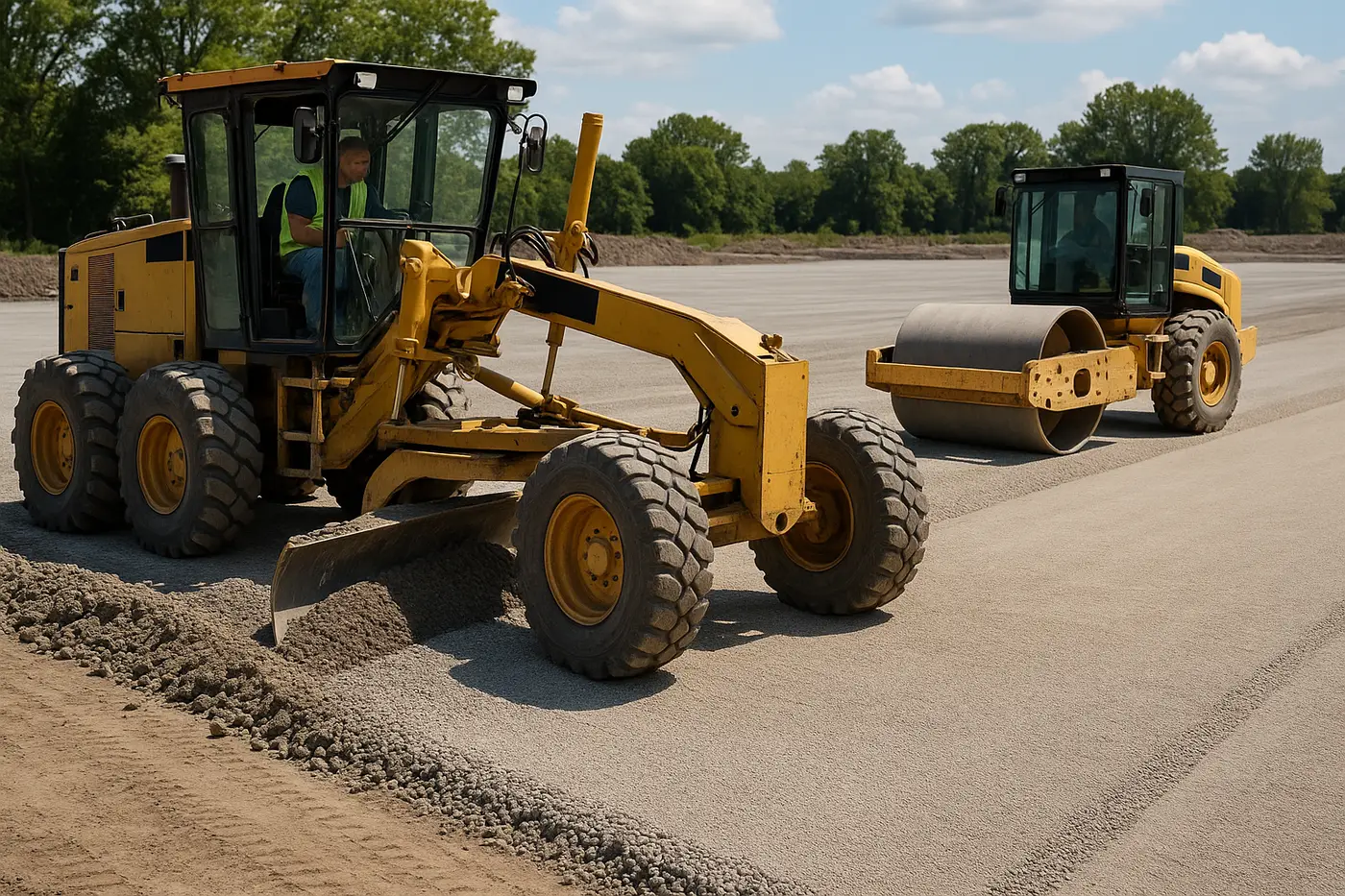
| Compaction | Rolled to density in lifts, each one before the next goes on | Full-width coverage with the roller pattern maintained | Uncompacted material consolidates under traffic instead, and that is a depression |
| Mat temperature | Checked at delivery and behind the paver | Hot enough to compact through the full lift | Cold mix cannot be brought back. It looks finished and is already failing |
| Water actually leaving | Walked after the first real rain, or hosed if there is no rain to wait for | No standing water anywhere on the surface | It is the only test that matters, and the only one you can repeat yourself |
None of that is unusual practice. What is unusual is being told about it — so ask whoever quotes your lot which of these they intend to measure, and which they intend to judge by eye.
Working in Smithville
Tarmasters is a Kansas City–owned paving contractor and the asphalt division of Ford Concrete and Paving, working across the metro since 2014 with our own crews, pavers, and grading equipment. Owning the grading side is what makes "verified to 2%" a commitment rather than an aspiration.
Work here runs under City of Smithville building codes. On commercial property, stormwater handling and accessible parking come into scope on a lot being re-laid — and on this ground, the stormwater side is the one that decides how long the surface lasts.
Insured and bonded. Measured estimate, fixed price, firm sequence, and a straight answer about what your surface needs.
Around Smithville
We cover the town and the lake area — the 169 South Character Area, the Downtown Community Oasis, the Employment Overlay District, and the Commercial Avenue Retail Strip — plus the residential streets and lakeside subdivisions around them. Access is off US-169, MO-92, Commercial Ave, Eagle Pkwy, and Liberty Rd.
Northland cities we also cover
Gladstone, Holt, and Plattsburg sit inside the same run. Our complete service area.
Smithville paving questions
When is the best time to repave a lot that serves the lake?
Autumn or early spring, either side of the season. Recreation traffic here surges hard in summer, and a marina, park, or restaurant lot cannot lose its capacity in the weeks that pay for the year. We would rather schedule the work into the quiet months and be genuinely finished before the season than phase around a full lot in July.
What does a plasticity index above 30 actually mean?
It is a measure of how much a soil will change volume with moisture, and above 30 is high. Clay County's soil earns its name. Smithville sits on heavy plastic clay with plasticity indices routinely above 30. This material swells when wet and shrinks when dry, creating cyclical movement that cracks any pavement without proper base isolation. We over-excavate and install granular base layers thick enough to absorb that movement. The practical consequence is that base depth and isolation are doing more work here than the asphalt on top, and a section designed for a milder subgrade will crack from below within a few years.
Why do you insist on 2% cross-slope?
Smithville's terrain along the Little Platte floodplain is nearly level, which means parking lots without engineered cross-slope hold water. Standing water on Clay County subgrade accelerates base saturation and slab settlement faster than in hillier terrain. Every lot we pave here gets a minimum 2% cross-slope verified with laser grade. On rolling ground you can get away with less because gravity helps. On level ground it is the only thing moving the water, so we shoot it with a laser grade and verify it rather than trusting the eye.
Our lot went in around 2022. Does it need anything yet?
Probably its first surface maintenance, yes. The newer frontage lots along US-169 are reaching that point now: crack sealing on cycle and a first sealcoat once the surface has cured and started to lose colour. That is a small job at this stage and a large one if it waits until the binder has properly oxidised.
Can you work around the ongoing road construction?
Yes — and it is worth planning for. Major work on the corridor changes traffic patterns and access temporarily, and construction vehicles put loads on frontage properties that were never designed for them. We factor current access into the sequence when we quote, rather than discovering it on the first morning.
Ready to pave it right?
Get a straight estimate and a clear timeline. Tarmasters Asphalt Paving handles driveways, parking lots, and repairs across the Kansas City metro.
Call Now: (816) 789-0700