
Asphalt Paving in Lathrop and Clinton County
Pavement here has to survive a 130-degree August surface and a February that freezes fifty times. One number on the mix ticket decides whether it does.
Tarmasters paves commercial lots and rural driveways across Lathrop, Missouri. The climate here spans 130-degree summer surfaces and 50 freeze-thaw cycles, over Grundy-Lagonda series clay that heaves seasonally — so binder grade and base isolation both have to be right. Insured, bonded since 2014.
Most of what decides how long a pavement lasts is under it — base depth, compaction, drainage. In Lathrop there is one exception that sits on the mix ticket, and hardly anyone asks about it: the binder grade. It is the performance rating of the asphalt cement holding the aggregate together, and it is specified against a temperature range.
This part of Clinton County asks for a wide one. Surface temperatures here climb past 130 °F in summer — dark pavement in direct sun runs far hotter than the air above it — and the winter delivers fifty or more freeze-thaw cycles. Binder that is too soft for the top end ruts under load; binder that is too brittle for the bottom end cracks from thermal contraction alone.
We work Lathrop from Lee's Summit — retail along the MO-116 strip and the I-35 Interchange Hub, plus rural drives and farmsteads out on MO-A. Insured and bonded, and happy to put the mix design in writing alongside the estimate — whether the job is repair or new pavement.
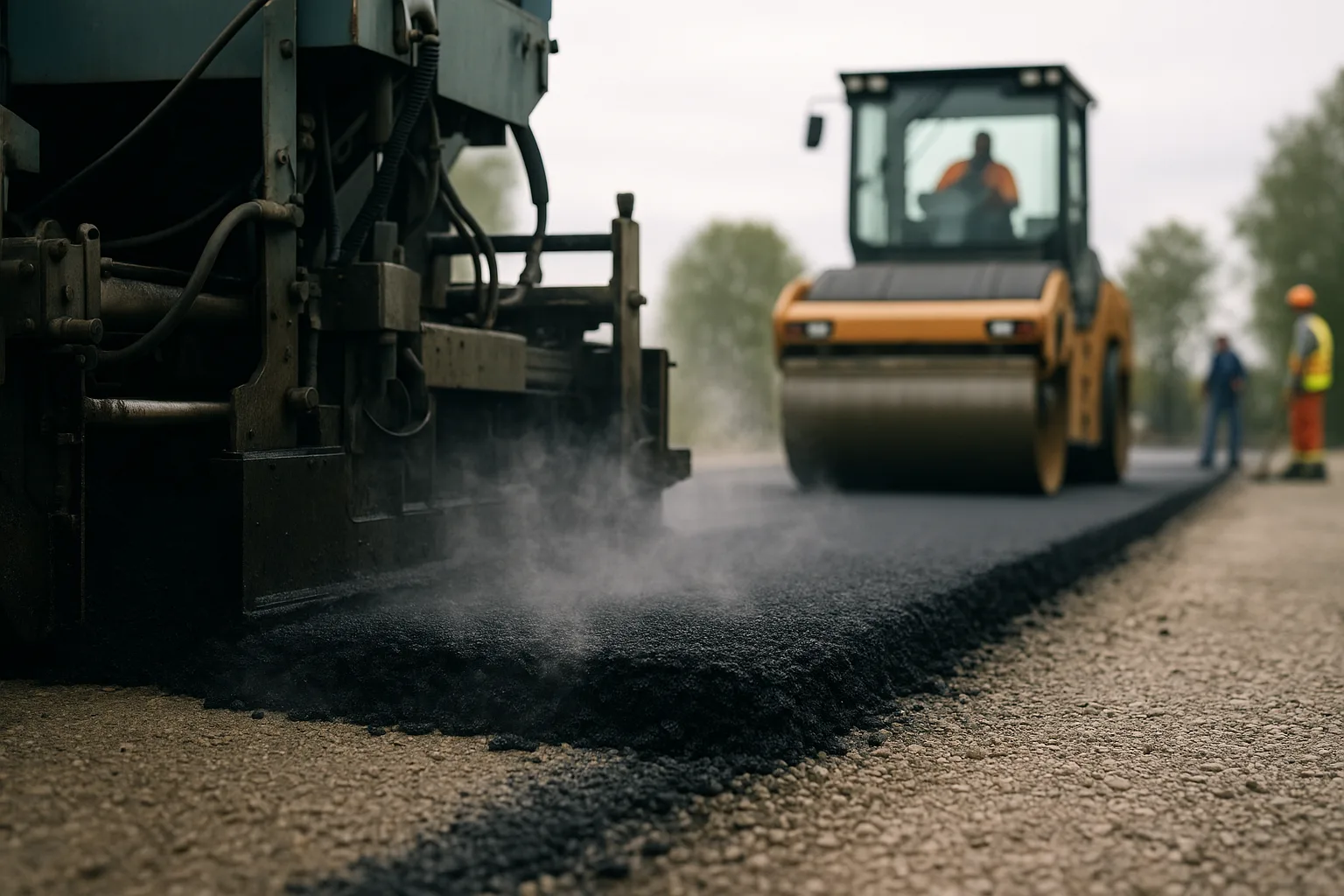
Built for Lathrop's ground
Lathrop sits on clay and clay-loam soils with high plasticity indexes. Seasonal moisture cycles cause the ground to swell in spring and shrink in late summer, generating heave pressures that crack any pavement built without proper base isolation and drainage control.
Lathrop's level topography provides almost no natural grade to move stormwater off lot surfaces. Without machine-graded crowns and perimeter curbing, water pools in low spots and accelerates stripping of the binder from the aggregate matrix.
Two specifications, two different jobs: the binder grade determines how the surface copes with temperature. The base determines how it copes with the ground moving underneath it. Getting one right does not compensate for the other, and a quote that mentions neither is a quote for square footage.
The number on the mix ticket, explained
Six things worth knowing about the material going onto your property. None of it is proprietary and all of it is on the paperwork — it is simply never explained.
| Item | What it means | What it means here |
|---|---|---|
| What "PG 64-22" means | Performance Grade. The first number is the highest pavement temperature the binder is designed for in Celsius; the second is the lowest. | PG 64-22 covers roughly 64 °C hot and −22 °C cold — which is what a Clinton County year actually asks for. |
| Why the high number matters | Above its rated temperature, binder softens and the mix can rut and shove under load rather than springing back. | Surface temperatures here run past 130 °F in summer, well above air temperature. Under-grade binder ruts. |
| Why the low number matters | Below its rated temperature, binder becomes brittle and the mat cracks from thermal contraction alone. | With 50 or more freeze-thaw cycles a winter, brittle binder means transverse cracking the first hard season. |
| What a wider spread costs | Polymer-modified grades widen the range at both ends, at a higher material price per ton. | Worth it on heavy-load surfaces and truck routes. Rarely worth it on a residential driveway. |
| Air entrainment, on the concrete side | Microscopic air bubbles deliberately introduced into concrete give freezing water somewhere to expand. | Non-negotiable for any kerb, gutter, or pad here. Without it, spalling starts within a few winters. |
| What to ask for | The mix design and binder grade being supplied, in writing, before the work is scheduled. | Any contractor can tell you this in thirty seconds. Whether they offer it unprompted is informative. |
Paving and repair in Lathrop
Commercial paving, repair, and driveways have dedicated Lathrop pages. The rest run through the metro service pages.
| Commercial Asphalt Paving | I-35 frontage | Retail, fuel-stop, and light industrial lots specified for the load and the temperature range they actually see. |
| Asphalt Repair | Most common | Full-depth repair of the alligator cracking that shows up on high-volume frontage lots. |
| Driveway Paving | Rural | Long approaches on acreage and farmsteads, and replacements on the older small-town stock. |
| Crack Sealing | Before winter | Closing thermal cracks before the cold opens them further. The cheapest work in the county. |
| Sealcoating | Sun protection | Slowing the oxidation that a run of 130-degree surface days drives through unshaded lots. |
| Overlays & Resurfacing | 1990s retail | A new wearing course on the retail stock from the 1990s expansion, where the base is still good. |
| Line Striping | Commercial | Layout, truck routing, and accessible parking for frontage and event property. |
| Asphalt Milling | Prep | Cutting a spent surface back to grade so the new one drains where the old one was meant to. |
Working in Lathrop
Tarmasters is a Kansas City–owned paving contractor and the asphalt division of Ford Concrete and Paving, working the metro since 2014 with our own crews and equipment. Lathrop sits at the northern end of our run up I-35, and haul time matters on a small job — mix has to arrive hot enough to compact through the full lift, which is a scheduling problem as much as a materials one.
Work here runs under City of Lathrop / Clinton County codes. On commercial property, drainage and accessible parking come into scope on a lot being re-laid, and both are cheaper to solve during a rebuild than afterwards.
Insured and bonded. Measured estimate, fixed price, firm sequence — and the mix design in writing if you want it, which you should.
Paving across the Lathrop area
Commercial work concentrates on the MO-116 Retail Strip and the I-35 Interchange Hub; residential and agricultural work runs out from the town centre across the surrounding acreages. Access is off I-35, MO-116, MO-A, and Main St.
Cities we cover nearby
Lawson, Plattsburg, Holt, Turney, and Cameron sit inside the same run. All 46 cities we serve.
Lathrop paving questions
What is a binder grade, and why should I care?
It is the performance rating of the asphalt cement holding your pavement together, and it is stated on the mix design. The two numbers describe the hottest and coldest pavement temperatures the binder is designed to handle. Get it wrong at the top end and the surface ruts in August; get it wrong at the bottom and it cracks in February. It is the least visible specification on a job and one of the most consequential.
Why does Lathrop need a wide temperature range?
Because the climate delivers both extremes. Lathrop's continental climate delivers 40 freeze-thaw cycles per winter and summer surface temps above 130°F. That thermal range demands PG 64-22 or higher binder grades and air-entrained concrete to resist both cracking and spalling. A surface here has to stay stiff enough not to deform in high summer and flexible enough not to fracture in deep winter, and that is exactly what a performance-graded binder is specified to do.
Is surface temperature really different from air temperature?
Considerably. Dark pavement in direct sun runs far hotter than the air above it, which is why a 95-degree day produces surface readings well past 130. That is the temperature the binder actually experiences, and it is why unshaded frontage lots age faster than the same pavement under trees.
How does Grundy-Lagonda series clay affect the build?
It swells in spring and shrinks in late summer, generating heave pressure that cracks anything built without proper base isolation and drainage control. The binder grade decides how the surface handles temperature; the base decides how it handles the ground. You need both right — one will not cover for the other.
Our lot ponds after rain. Is that fixable?
Usually. Lathrop's level topography provides almost no natural grade to move stormwater off lot surfaces. Without machine-graded crowns and perimeter curbing, water pools in low spots and accelerates stripping of the binder from the aggregate matrix. The correction is either a machine-graded reprofile of the low areas or added collection where the surface cannot be raised. We measure the existing fall before saying which, because the two are very different jobs.
Free estimates across the Kansas City metro.
Driveways, parking lots, and repairs across the Kansas City metro, since 2014.
Call Now: (816) 789-0700Tarmasters Asphalt Paving
Lee's Summit, MO 64063 | Serving the Kansas City metro | Insured | Bonded