Basehor Asphalt Paving
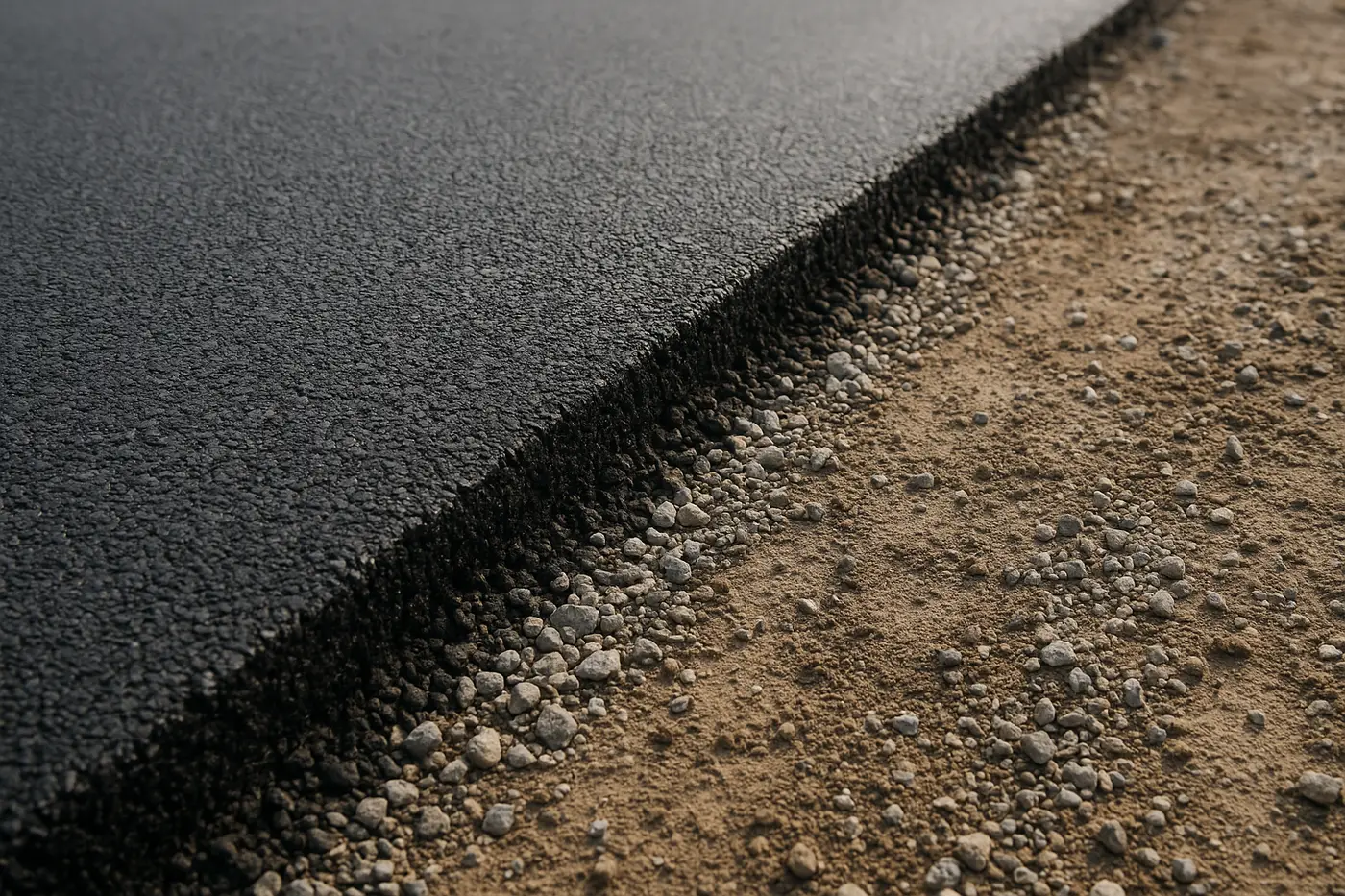
Asphalt bends and concrete does not. Every place the two meet is either a designed detail or a future trip hazard.
Tarmasters paves commercial lots and driveways across Basehor, Kansas. Over Grundy-Pawnee series clay with limestone scattered near the surface, bearing varies across a lot — and where asphalt meets concrete, the two materials move apart. We detail both. Insured, bonded since 2014.
Walk a newer Basehor retail development and count the places asphalt meets concrete: the walkway along the storefronts, the apron at the doors, the kerb line, the ring around every drainage casting, the edge of every landscape island. On a modern mixed-use site there can be hundreds of linear feet of it, and each foot is a place where two materials with completely different behaviour have been asked to stay level with one another.
They will not, unless the detail is designed. Concrete is rigid and stays where it was poured; asphalt is flexible and follows whatever the ground does. When the subgrade moves seasonally, one side lifts and the other does not. The result is a step — a maintenance problem, and on a pedestrian route, a liability.
Basehor is growing quickly, at around 7,564 people, with new retail along the US-24/40 corridor and residential expansion out toward 155th Street. We work it from Lee's Summit, insured and bonded, and because the concrete side is under the same roof we build both halves of the joint rather than repairing the half somebody else got wrong.
Built for Basehor's ground
The subgrade
Rock in patches, clay in between
Leavenworth County's glacial till includes scattered limestone near the surface, creating inconsistent bearing capacity even within a single lot footprint. Subgrade testing at multiple points is non-negotiable before any Basehor pour or HMA placement.
The winter
Fifty cycles on an open joint
Basehor averages 38 freeze-thaw cycles annually. Even small construction-era cracks or unsealed joints allow water penetration. Once trapped moisture freezes, it expands and breaks the bond between surface course and base — a failure mode that accelerates exponentially if left untreated.
Put the two together and the transition joints become the weak point twice over: uneven bearing means one side of a joint is more likely to move than the other, and once the joint opens, fifty freeze-thaw cycles a year work on whatever gets into it. That is why we treat these details as structure rather than as finishing.
Services for Basehor properties
Commercial paving, repair, and driveways have dedicated Basehor pages. The rest run through the metro service pages.
New retail and medical lots, with the walkway and apron transitions detailed rather than left to meet by accident.
Rebuilding the heaved and settled strips where asphalt meets concrete, which is where most complaints originate.
Closing construction-era cracks and unsealed joints before a winter gets water underneath the surface course.
Slowing oxidation on unshaded shopping-centre lots, most of which are young enough to protect properly.
New drives across the fast-growing subdivisions, including the apron where the drive meets a concrete walk.
Re-marking retail outparcels, where high turnover fades layout faster than owners expect.
A new wearing course on the small-town core property where the structure beneath is still sound.
Taking a heaved area back to grade so a new transition can be built level rather than layered over a step.
Six places asphalt meets concrete, and how each should be built
These are the details that decide whether a lot ages tidily or generates complaints. They cost very little to get right during construction and a great deal to correct afterwards.
| Where they meet | Why it moves apart | How we build it |
|---|---|---|
| Asphalt lot to concrete sidewalk | The concrete is rigid and the asphalt is flexible. Seasonal ground movement lifts one and not the other | A clean, sealed joint with the asphalt built up to meet the walk, and edge support under both sides. |
| Asphalt to concrete apron at a building | The apron is usually tied to the structure and does not move; the lot does | An expansion joint that can actually move, sealed and maintained, rather than butted material. |
| Asphalt to kerb and gutter | Water runs along this line, so any separation admits it straight into the base | Asphalt placed tight to the gutter pan and sealed, with the base carried under the joint. |
| Around a drainage casting | A rigid frame set in a flexible surface — the ring is the first thing to settle | A concrete collar to the casting, then asphalt tied into that rather than to the metal. |
| At an irrigated landscape island | Overspray keeps the ground beside the island saturated, and wet clay carries far less load | Adjust the heads, kerb the island, and keep the edge supported. The cheapest fix on this list. |
| Where a new phase meets an old one | Two surfaces of different ages, different stiffness, and different remaining life | Saw a clean vertical face, tack it, and seal the joint. A feathered edge fails within a season. |
Working in Basehor
Tarmasters is a Kansas City–owned paving contractor and the asphalt division of Ford Concrete and Paving, working the metro since 2014. On this particular problem that pairing is the whole point: a transition joint is half concrete and half asphalt, and when two contractors each build their own side, nobody owns the line between them.
Work here runs under City of Basehor / Leavenworth County building codes. On commercial property, accessible routes and stormwater come into scope on a lot being re-laid, and both intersect with exactly these details.
Insured and bonded. Measured estimate, fixed price, firm sequence, and a straight answer about what your surface needs.
Our Basehor-area coverage
Commercial work concentrates on the US-24/40 Retail Corridor, Wolf Creek Plaza, and the Basehor City Center; residential runs through the newer subdivisions. Access is off US-24/40, K-32, 155th St, Parallel Rd, and Leavenworth Rd.
Cities around Basehor
Edwardsville sits inside the same run. See every city we serve.
Basehor paving questions
Why does the joint between our lot and the sidewalk keep lifting?
Because the two materials do not move together. Basehor City Center and newer retail-residential developments use concrete sidewalks and aprons adjacent to asphalt lots. Differential movement between the two materials at transition joints causes heaving and trip hazards — especially where irrigation runoff saturates the subgrade. Concrete is rigid and stays where it is put; asphalt is flexible and follows the ground. When the ground beneath moves seasonally — and here it does — one side rises relative to the other, and the step that produces is both a maintenance problem and a liability.
Is that a trip hazard we are responsible for?
Generally, if it is on your property and open to the public, yes — and that is the practical reason to treat these joints as a designed detail rather than an afterthought. A vertical difference at a pedestrian route is the sort of thing that gets noticed by a visitor before it gets noticed by an owner. It is also inexpensive to correct while it is still small.
Can irrigation really cause pavement damage?
Regularly, and it is one of the most overlooked causes we see. Overspray onto the ground beside a landscape island or a walkway keeps that soil saturated through the growing season, and saturated clay carries a fraction of the load dry clay does. The pavement edge beside it loses support and starts breaking down. Moving two sprinkler heads is often a genuine pavement repair.
Why does bearing capacity vary in Basehor?
Because of what is under the topsoil. Leavenworth County glacial till includes scattered limestone near the surface, which means one part of a lot can sit on rock and another on clay. A single base design applied across that will crack where the bearing changes, so we test at multiple points before committing to a section.
Most of our commercial property is quite new. What should we be doing?
Sealing, and paying attention to the transitions. Nearly all the commercial pavement here dates from about 2015 onward, which puts it in the period where cheap interventions have their largest effect. Construction-era cracks and unsealed joints are the entry points, and closing them before a winter is the highest-return maintenance available.
Free estimates across the Kansas City metro.
Driveways, parking lots, and repairs across the Kansas City metro, since 2014.
Call Now: (816) 789-0700Tarmasters Asphalt Paving
Lee's Summit, MO 64063 | Serving the Kansas City metro | Insured | Bonded