Greenwood Asphalt Paving
The hardest problem on a Greenwood lot is rarely the parking. It is the route from the parking to the door.
Tarmasters paves driveways and commercial lots throughout Greenwood, Missouri, and regrades the accessible routes that older properties here rarely meet. Underneath it all is Wymore series expansive clay, among the most reactive in the state. Insured, bonded, working the metro since 2014.
Greenwood is a town of about 6,125 built around a Main Street whose storefronts date to around 1910. That is genuinely worth having, and it makes one part of our work much harder than it is anywhere else we go: getting a person from a parking stall to a front door along a route that actually complies.
On a modern site you design that route first and everything else fits around it. On a Main Street Historic District property almost every variable is fixed — the building's floor level, the walkway width, the kerb height, the distance available. The work is measuring what you have and finding the grade that fits inside it, which is paving work rather than paperwork.
We also do the straightforward jobs: retail pads at the MO-150 Commercial Node, drives across the newer subdivisions, and repair on lots that the clay has worked over. Based in Lee's Summit, insured and bonded, and honest about whether you need new markings, a resurface, or a regrade and rebuild.
Services for Greenwood properties
Commercial paving, repair, and driveways have dedicated Greenwood pages. Open any of the others for detail.
Commercial Asphalt Paving
Retail and service lots at the highway nodes, and the harder work of fitting compliant parking behind historic Main Street frontage.
Go to Commercial Asphalt Paving →Asphalt Repair
Full-depth repair where the clay has taken the base out, and edge repair where water has been standing against a curb line.
Go to Asphalt Repair →Driveway Paving
New drives across the 1990s–2010s subdivisions, and replacements on the older properties near the historic core.
Go to Driveway Paving →Line Striping
Stall layout and accessible-route marking — which on an older lot is usually a regrade question before it is a paint question.
Go to Line Striping →Overlays & Resurfacing
A new wearing course on the mid-century to 1990s retail pads along the MO-150 corridor.
Go to Overlays & Resurfacing →Sealcoating
The direct answer to oxidation in the unshaded highway-frontage lots, where UV does most of the ageing.
Go to Sealcoating →Crack Sealing
Keeping water out of a base sitting on some of the most reactive clay in the state.
Go to Crack Sealing →Asphalt Milling
Taking a surface down so a corrected grade can be built without raising the lot above its curbs and thresholds.
Go to Asphalt Milling →From the stall to the door, element by element
Six pieces make up an accessible route across a lot. This is what each one has to do, what usually goes wrong with it on an older Greenwood property, and what fixing it involves. Confirm current requirements with the city or your designer — what we can tell you is what the paving side of the fix looks like.
| Element | What it has to do | What usually goes wrong | The paving fix |
|---|---|---|---|
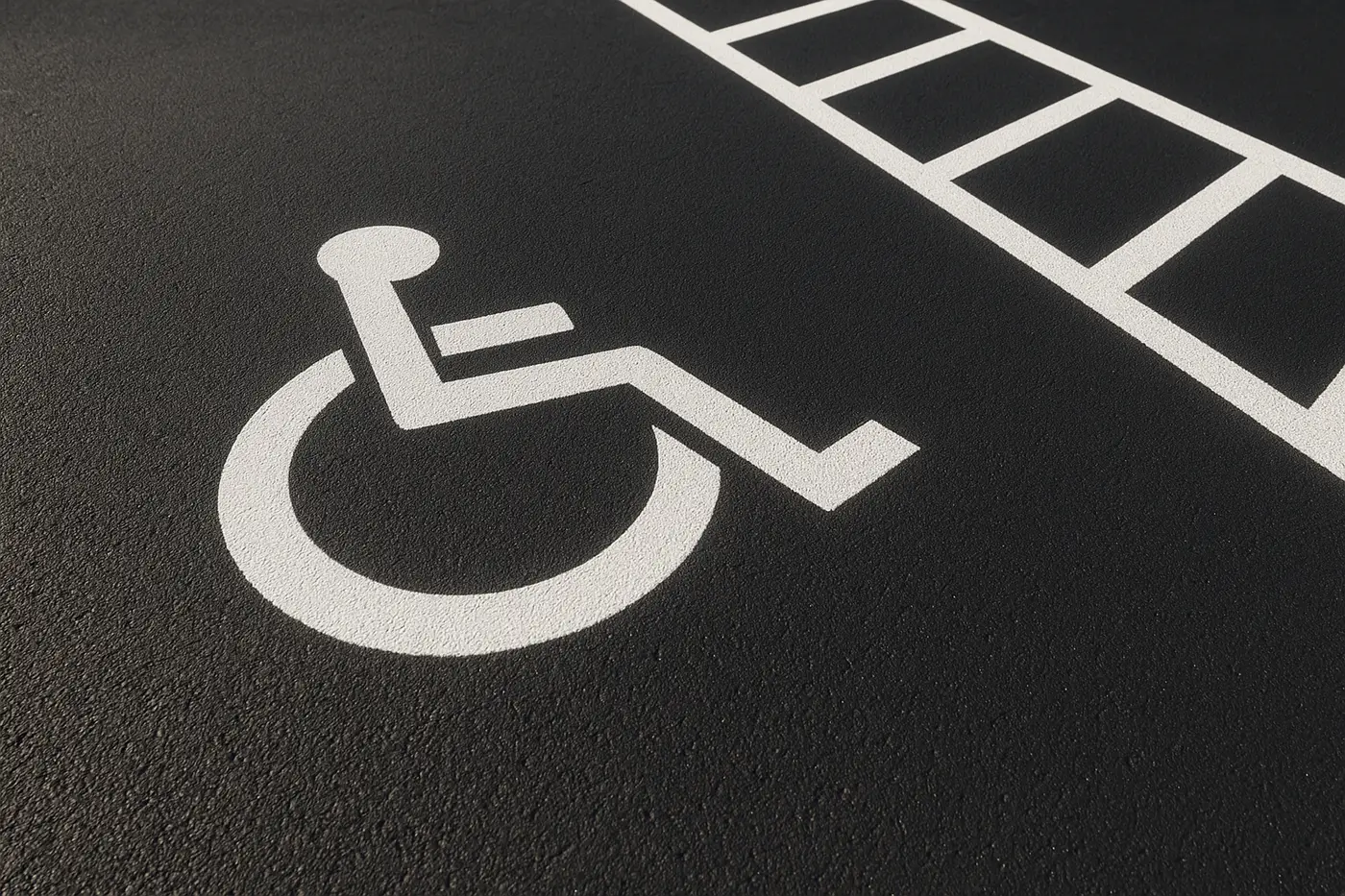
| Accessible stall | No more than 2% slope in any direction, on a stable, firm, slip-resistant surface | Years of patching around the stall have tilted it out of tolerance without anyone noticing | Mill and re-lay that bay to a corrected grade. Repainting a stall on a 4% slope changes nothing. |
| Access aisle | Level with the stall it serves, marked, and never used for parking | Marked in the wrong place, too narrow, or drains through the middle of it | Re-lay to match the stall and re-mark. Drainage moved to the edge, not across the aisle. |
| Route from stall to entrance | A continuous accessible path with limited running slope and cross slope | The path crosses a drive aisle at a slope, or ends at a kerb with no ramp | Regrade the crossing, or build a compliant kerb ramp with a landing at the top. |
| Kerb ramp | A defined slope with a level landing and flared sides where pedestrians cross them | Historic kerb heights make the standard ramp geometry impossible in the space available | Rework the surface either side to gain length, or relocate the route to a workable corner. |
| Threshold at the door | A minimal change in level, and a landing outside the door big enough to stand on | A 1910 building sits where it sits — the threshold cannot be lowered | Bring the outside surface up to the threshold with a graded approach rather than a step. |
| Surface condition along the route | Firm, stable, and free of gaps that catch a wheel | Spalled concrete walkway or an open joint between asphalt and walk | Replace the spalled panels and seal the joint. This is the cheapest item on the list. |
Doing it right in Greenwood
- ◆
Start under the surface
Jackson County sits on some of the most reactive clay in Missouri. Seasonal moisture changes cause subgrade volume swings of 3–6%, which pump and heave asphalt that wasn't installed with engineered base and proper drainage. Every Greenwood lot we build starts with subgrade stabilization.
- ◆
Move the water off, properly
Jackson County clay drains poorly on its own. Greenwood's flat commercial zones hold water against pavement edges after storms, accelerating curb deterioration and base saturation. Aggressive cross-slope and functional curb-and-gutter systems are non-negotiable here.
- ◆
Account for the sun
The retail lots along the highway corridor have essentially no shade, so oxidation is the dominant ageing mechanism there. Those properties benefit far more from sealing on cycle than from anything structural, at least until the surface starts opening up.
- ◆
Respect the pressure point
The junction of Main Street and MO-150 takes constant delivery and commuter braking. Lots with frontage there wear at the entrance long before they wear anywhere else, and building the approach heavier is cheaper than repairing it twice.
Where we work near Greenwood
We cover the whole town — the Main Street Historic District and the Greenwood Mercantile Area, the retail at the MO-150 Commercial Node, and the residential streets through Greenwood Estates and Lake Greenwood. Access is off US-71, MO-150, Main St, and Vest Ave.
Towns on every side
Greenwood sits between more cities than its size suggests. North is Lee's Summit and Blue Springs; west, Grandview and Belton; south, Raymore and Peculiar. Pleasant Hill falls inside the same run. See every city we serve.
Working in Greenwood
Tarmasters is a Kansas City–owned paving contractor and the asphalt division of Ford Concrete and Paving, working the metro since 2014. The concrete side matters on this particular work: walkways, kerb ramps, and thresholds are usually concrete, and an accessible route that crosses between two trades is exactly where the detail gets dropped.
Work here runs under City of Greenwood building codes. Insured and bonded — measured estimate, fixed price, firm sequence. And on the compliance side, we will tell you plainly what the surface work can achieve and where you need a designer rather than a paving contractor.
Greenwood paving questions
Why is accessible parking harder on a historic Main Street property?
Because almost everything is fixed. The building sits at the level it was built at in 1910, the walkway width is what it is, and there is rarely spare space to gain the length a compliant ramp needs. On a modern site you design the route first; here you work backwards from constraints you cannot move. It is solvable, but it takes measuring rather than assuming.
Can restriping bring an old lot into compliance?
Only if the slopes are already right, which on an older lot they usually are not. Accessible stalls and access aisles have limits on slope in every direction, and paint does not change a slope. Where the surface has been patched repeatedly around a stall, the fix is milling that bay out and re-laying it to grade — and then marking it.
How reactive is the Wymore series expansive clay here?
Very. Jackson County sits on some of the most reactive clay in Missouri, with seasonal subgrade volume swings of three to six per cent. That movement pumps and heaves asphalt that was not built on an engineered base with proper drainage, which is why every lot here starts with subgrade stabilisation rather than with the surface.
Our lot holds water against the curb after a storm. Does that matter?
Yes, more than it looks like it should. Standing water at the edge saturates the base and accelerates the deterioration of the curb line, and the clay beneath drains poorly on its own so it stays wet long after the rain stops. The answer is real cross-slope across the surface and a curb-and-gutter system that actually carries water off, rather than a deeper patch.
Why do the highway-frontage lots go grey faster?
Sun. The retail lots along the MO-150 corridor have very little shade, so UV works on the binder continuously and oxidises it. That is what turns a black surface grey and eventually starts it shedding stone. On a structurally sound lot it is a sealcoating problem, and it responds well if it is caught before the surface opens up.
Free estimates across the Kansas City metro.
Driveways, parking lots, and repairs across the Kansas City metro, since 2014.
Call Now: (816) 789-0700Tarmasters Asphalt Paving
Lee's Summit, MO 64063 | Serving the Kansas City metro | Insured | Bonded