Local Asphalt Paving in Grandview, MO
Distribution yards, retail strips, and residential drives — built for heavy axles and for the highway salt that arrives with every winter.
Tarmasters paves industrial, retail, and residential asphalt across Grandview, Missouri. Two things shorten pavement life here: Wymore series expansive clay beneath it, and the highway salt that reaches every property near the I-49 frontage each winter. We build for both. Insured, bonded, paving since 2014.
There is a difference in Grandview between a lot on the I-49 frontage and a lot a block east, and it is not the soil or the weather. It is the salt. Frontage properties absorb highway-grade spray through every winter, and that chloride concentration works on the curb line and the asphalt binder in a way that shortens the life of the surface by years.
Nobody prices for it. Two identical bids on two identical lots will assume the same maintenance cycle, and one of those lots is going to age noticeably faster. The right answer is not exotic materials — it is knowing which side of that line you are on and setting the sealing and crack-sealing cycle accordingly.
The rest of the city is a heavy-load market: the Port of Grandview and the Blue Ridge Industrial corridor carry serious Class 8 volume, and most retail here dates back far enough to be on a third or fourth lifecycle. We work all of it from Lee's Summit, insured and bonded, and we will tell you plainly whether you need repair, a structural overlay, or a rebuild.
Our Grandview service list
Commercial paving, repair, and driveways each have a Grandview page. The rest run through the metro service pages.
Distribution yards, staging aprons, and retail lots — with the section set by axle load rather than by square footage.
Full-depth repair of deformed queuing areas and the chronic potholes that develop in high-load industrial zones.
Structural overlays on retail strips now into a third or fourth lifecycle, where the base is still worth building on.
Replacements on the 1960s–80s ranch housing stock, where the original drive has long outlived its base.
The most direct defence against binder breakdown on frontage properties that take highway salt every winter.
Keeping brine out of the base. A crack that lets salt water in is worse than a crack that lets rain in.
Layout, truck routing, fire lanes, and accessible stalls across industrial and retail property.
Removing a spent surface to grade so an overlay does not raise the lot above its curbs and drainage.
What we get right on Grandview jobs
Two forces, working from opposite directions — one pushing up from below, one landing from above.
From below
Expansive clay and heavy axles
Grandview's subsoils swell when wet and shrink when dry, creating seasonal movement that cracks asphalt from below. Without 8–10 inches of engineered aggregate base and proper underdrain systems, even new installations will show distress within three years.
High Class 8 truck volume serving the Port of Grandview and Blue Ridge industrial corridors; heavy vehicle queuing causing asphalt deformation. Where trucks queue and sit, the section deforms under sustained load rather than wearing out — which is why those areas need a rebuilt structure, not a new surface.
From above
Highway salt, every winter
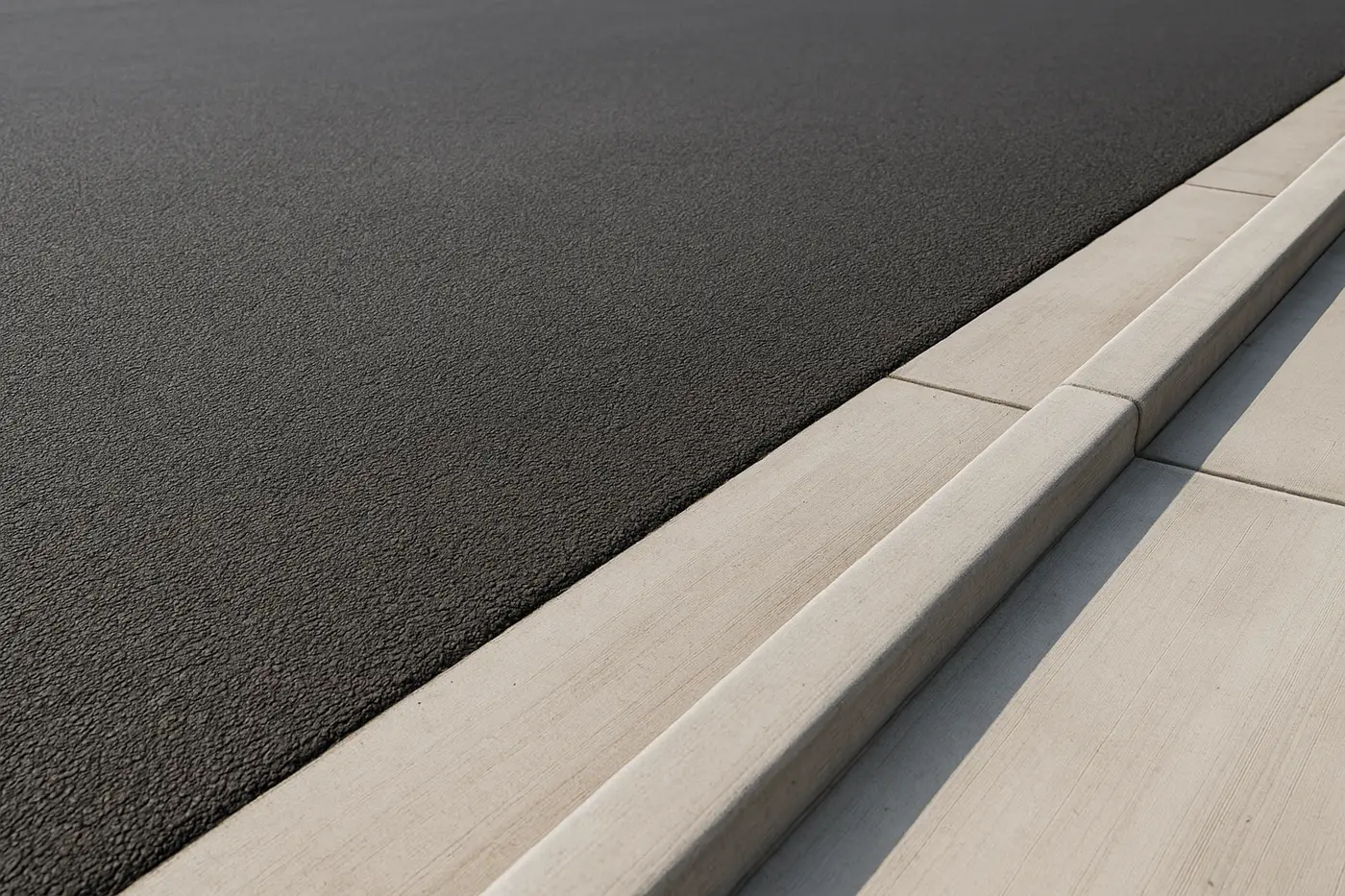
Commercial properties along the I-49 frontage road absorb highway-grade salt spray every winter. That chloride concentration accelerates curb deterioration and binder breakdown on adjacent parking surfaces, shortening pavement life by several years compared to properties even a block east.
With frost reaching about 36 inches and roughly 40 freeze-thaw cycles a year, brine that gets into an open crack has plenty of opportunity to do damage before spring.
What highway salt does to a frontage lot
Five parts of a property, what chloride does to each, and the counter-measure that actually works. If you own anything along the corridor, this is the maintenance plan.
| Part of the property | What the salt does | What counters it |
|---|---|---|
| Curb and gutter concrete | Chloride drives surface scaling and accelerates freeze-thaw damage at the most exposed element on the site | Air-entrained mixes on replacement, and drainage that carries brine away instead of ponding it at the curb line |
| Asphalt binder | Repeated salt-water cycling works at the bond between binder and aggregate, so the surface starts ravelling early | Sealcoating on cycle — the single highest-return maintenance item on a frontage lot |
| Open cracks | Brine freezes at a lower temperature than water, so it stays liquid and penetrates further before it expands | Crack sealing before winter rather than after it; the autumn window is the one that matters |
| Landscape islands and edges | Salt-laden run-off collects where the surface drains to soil, softening the ground at the pavement edge | Curbed islands and an edge detail that is supported rather than sitting on saturated fill |
| The base, over time | Whatever gets through the surface reaches the clay and keeps it wet in the season it is least able to drain | Underdrains at the low side, and the 8–10 in. engineered aggregate base this ground needs anyway |
Working in Grandview
Tarmasters is a Kansas City–owned paving contractor and the asphalt division of Ford Concrete and Paving, working across the metro since 2014. Grandview sits at the southern end of a run we make constantly, and the industrial work here is the kind that rewards building the section properly the first time.
Commercial jobs run under City of Grandview building codes. On a lot being re-laid, stormwater handling and accessible parking generally come into scope, and on industrial property the truck routing usually needs rethinking at the same time.
Insured and bonded. Measured estimate, fixed price, firm sequence, and a straight answer about what the surface needs.
Serving Grandview and nearby areas
Industrial and logistics work concentrates at Port of Grandview and Blue Ridge Industrial; retail at Truman's Marketplace and the Main Street District. Residential work runs through the ranch neighbourhoods off Blue Ridge Blvd and Main St, with highway access on I-49, US-71, MO-150.
- ● Meadowmere
- ● Longview Heights
- ● Bel-Aire
- ● Highgrove
- ● Timber Lakes
- ● Port of Grandview
- ● Main Street District
- ● Truman's Marketplace
- ● Blue Ridge Industrial
- ● I-49 Frontage Corridor
- ● MO-150 Commercial Strip
- ● Longview Lake Area
- ● View High District
- ● South Grandview
- ● Grandview Main Street District
- ● Blue Ridge Boulevard Corridor
Cities next to Grandview
North of the city line is Kansas City, with Raytown to the north-east. South and west are Belton and Raymore; east are Lee's Summit and Greenwood. See the whole service area.
Grandview paving questions
Does being on the I-49 frontage really shorten pavement life?
Measurably. Commercial properties along the I-49 frontage road absorb highway-grade salt spray every winter. That chloride concentration accelerates curb deterioration and binder breakdown on adjacent parking surfaces, shortening pavement life by several years compared to properties even a block east. It is the clearest example we can point to of two properties in the same city, with the same soil and the same weather, ageing at different rates because of what lands on them each winter.
What can be done about it?
Nothing stops the spray, but the sequence that works is unglamorous and effective: seal cracks every autumn so brine cannot get below the surface, sealcoat on cycle to protect the binder, keep the drainage moving so salt water leaves rather than sits, and use air-entrained concrete when curbs are replaced. Together those add years back.
Why does Wymore series expansive clay need such a deep base here?
Because the movement is real and the loads are heavy. Grandview subsoils swell when wet and shrink when dry, cracking asphalt from below, and the industrial side of the city puts Class 8 traffic on top of that. Without eight to ten inches of engineered aggregate base and proper underdrains, even brand-new pavement shows distress within about three years.
Our loading area is deforming where trucks queue. Is that a surface problem?
No, it is a structure problem. Where trucks sit stationary or move slowly under full load, the pressure is applied to the same spot for long periods and the section deforms rather than wears. An overlay will re-deform in the same place. What that area needs is a rebuilt section — deeper base, a binder course, and a mix suited to the shear.
How old is most of the commercial pavement here?
Older than it looks. Much of the commercial build-out followed the base and industrial boom of the 1960s and 70s, and most of those lots are on their third or fourth lifecycle now. That usually means a structural overlay rather than a surface treatment — and in the worst zones, reconstruction.
Ready to pave it right?
Get a straight estimate and a clear timeline. Tarmasters Asphalt Paving handles driveways, parking lots, and repairs across the Kansas City metro.
Call Now: (816) 789-0700