Commercial Asphalt Paving Across the Independence Area
Retail strips on Noland Road, truck entries off US-24, accessible routes that hold up to a compliance review — paved over Jackson County clay and built to be inspected.
Tarmasters resurfaces and rebuilds commercial lots throughout Independence, Missouri — retail along the Noland Road corridor, industrial pavement off US-24, and the accessible routes that come with them. Over Wymore series expansive clay we build the base and the drainage first, then the section. Insured and bonded, paving since 2014.
In Independence, something usually forces the question
Very few commercial lots here get repaved because someone decided it was time. A tenant changes and the building permit brings the parking into the conversation. An insurer or a buyer walks the property. The entrance finally breaks up where the trucks turn in. Something forces it — and by then the work is usually bigger than it would have been.
The reason is the inventory. The retail strips along Noland Road and US-40, and much of what surrounds the Independence Center District, were built 30 to 40 years ago — before the current accessible-parking standards and well before anyone was designing for the freight volume now running through Carefree Industrial Park and the US-24 corridor.
So the useful thing we can do on this page is show you what the standard actually asks for, before anyone quotes you a number for meeting it.
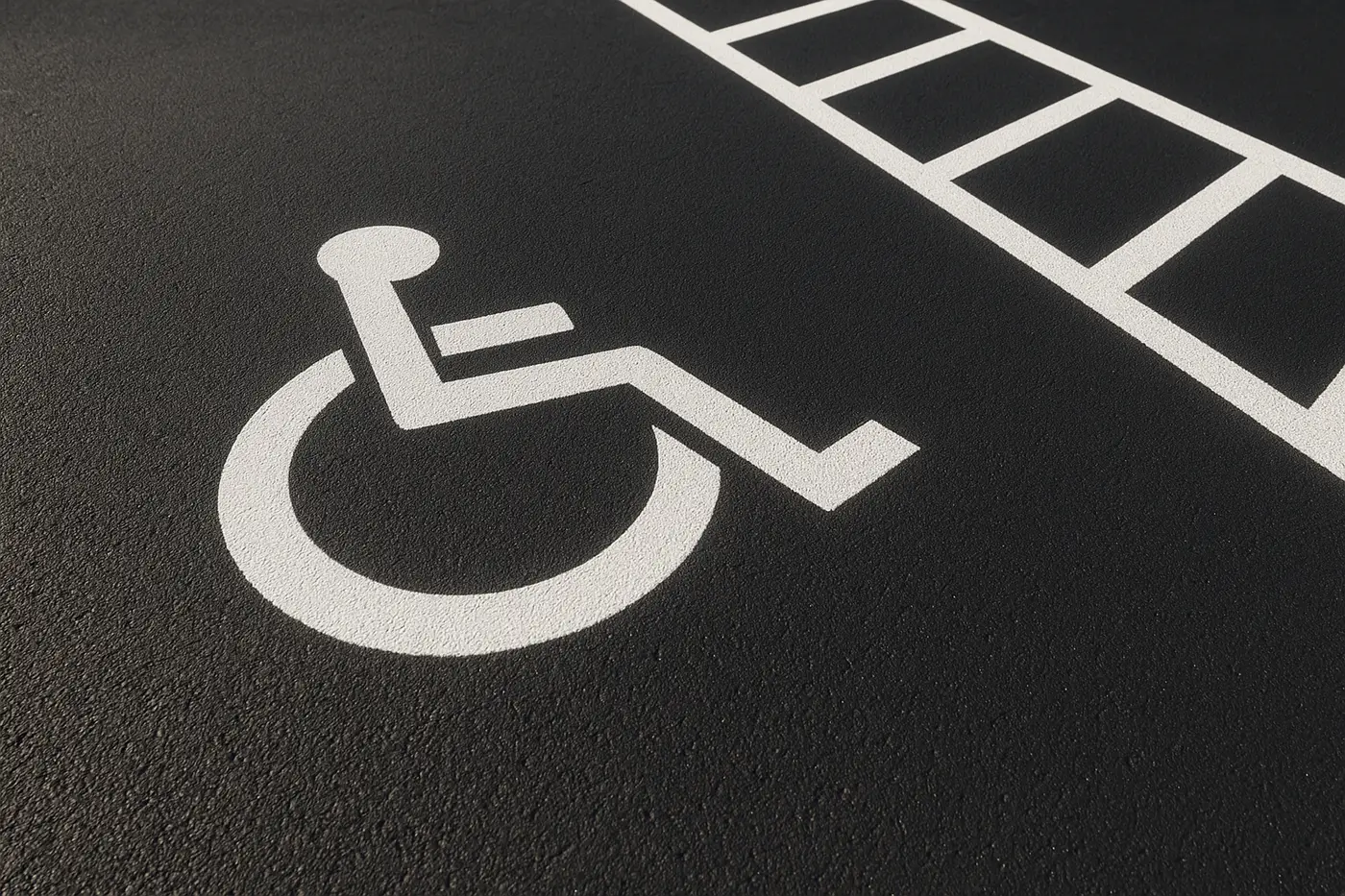
Accessible parking, by the numbers
Count your stalls, read across. This is the part of a repave that gets discovered late and costs the most to fix afterwards, and almost no paving contractor puts it in front of you before the bid.
| Total spaces in the lot | Accessible spaces required |
|---|---|
| 1 – 25 | 1 |
| 26 – 50 | 2 |
| 51 – 75 | 3 |
| 76 – 100 | 4 |
| 101 – 150 | 5 |
| 151 – 200 | 6 |
| 201 – 300 | 7 |
| 301 – 400 | 8 |
| 401 – 500 | 9 |
| 501 – 1,000 | 2% of the total |
| 1,001 and over | 20, plus 1 for each 100 (or part) over 1,000 |
And the geometry that goes with them
- Van-accessible share
- At least 1 of every 6 accessible spaces, and never fewer than 1
- Car space width
- 96 in. minimum
- Van space width
- 132 in., or 96 in. alongside a 96 in. access aisle
- Access aisle width
- 60 in. minimum, marked, and level with the space it serves
- Slope in the space and aisle
- No steeper than 1:48 (about 2%) in any direction
Figures follow the 2010 ADA Standards for Accessible Design. Requirements change with the facility type and the scope of work, and Independence applies its own permitting on top — confirm the specifics with the city before building to them. The slope limit is the one that most often turns a striping job into a grading job.
Building for Independence's conditions
Wymore
series expansive clay under the whole city
40
freeze-thaw cycles in a typical year
36 in.
frost depth the base has to sit beneath
42 in.
of rain a year looking for a way in
Jackson County's clay soils swell when saturated and shrink during dry spells. This volume change cracks pavement from below, especially on flat lots near Noland Road that lack engineered drainage. Every Independence project needs geotechnical-aware base design.
Two things make that worse in this city specifically. The flat older lots off Noland Road were built with limited fall, so water that should leave the property instead sits on it and soaks the clay from above. And the freight moving to and from Carefree Industrial Park and the underground warehouse complexes puts heavy-axle braking and turning loads onto pavement that was never specified for them. Clay, water, and truck loads compound — which is why we seal cracks early and design the fall before we design the section.
What a rebuild actually involves
Four questions worth asking any contractor bidding your lot. Here are our answers.
What happens to the old surface
On the aged Noland Road and US-40 strips, the surface is rarely the whole problem — 30 and 40-year-old lots usually have base failure underneath the alligator cracking. Where the base is still competent we mill off the worn course and overlay. Where it is not, that section comes out entirely. Cores tell us which, and we would rather core it than sell you the wrong one.
What goes under the new asphalt
Crushed limestone base, placed and compacted in lifts, thickened where trucks run. Over Wymore series expansive clay we add a geotextile separator wherever the clay would otherwise pump fines up into the stone and turn two layers into one soft one. Soft subgrade gets undercut and replaced rather than bridged over.
How the asphalt itself is built up
A coarser binder course does the structural work; a finer surface course is the wearing layer. Both are rolled to full density while still hot, because compaction lost as the mat cools cannot be recovered later. Truck approaches get a heavier binder — or concrete where trailers pivot in one spot.
What happens at the entrances
The first thirty feet inside an entry off M-291 or US-24 takes braking and turning load from Class 8 traffic that the rest of the lot never sees. Those radii are built full depth, tied properly into the public approach, so the shoving and rippling does not simply come back in the same place.
Depending on what the cores show, the job is an overlay, milling back to elevation, sectional repair, or a full rebuild — and we will tell you which before you buy the wrong one.
The work, step by step
Site visit, stall count, and slope check
We measure the lot, count what is striped, and shoot the grades on the accessible spaces — so the compliance question is answered on day one, not discovered mid-job.
Cores where the answer is not obvious
Existing thickness and base condition, in writing. On a lot this age it is the difference between a sound overlay and a surface that cracks through in two winters.
Fixed estimate, sequenced by section
What gets rebuilt, what gets overlaid, what gets left alone — priced separately, so you can stage the work across budget years if you need to.
Build, phased around your hours
Removal, base, paving, and compaction section by section, with an entrance and a route through kept open. A paved section is out of service for roughly a day.
Layout, striping, and a walk-through
Accessible spaces, aisles, fire lanes, and traffic flow marked to the layout we agreed, then walked with you before the crew leaves.
Straight answers, in writing
Tarmasters is the asphalt division of Ford Concrete and Paving — Kansas City–owned, run out of Lee's Summit, insured and bonded, and paving across the metro since 2014. Independence is a twenty-minute run from our yard, which is why we will come and measure a lot before quoting it rather than pricing off an aerial photo.
What you get is a measured fixed price, a phase map, core results where we took them, and a clear statement of what we are not doing. If your lot needs less work than you were told, that is what the estimate will say.
Where we work near Independence
Commercial pavement here clusters around the I-70/M-291 interchange and runs out along the older highway frontage:
- · Independence Center District
- · Noland Road Corridor
- · Carefree Industrial Park
- · The historic Independence Square
- · US-24 Industrial Corridor
- · M-291 Commercial Corridor
- · Blue Ridge Crossing
- · Little Blue Parkway / EastGate
Commercial paving in the surrounding cities
There is more on commercial lots generally, striping and layout, our other Independence services, and the areas we cover.
What Independence property owners ask
We are re-tenanting a strip center. Does that pull the parking into current standards?
Often, yes — alterations to a facility generally have to bring the altered elements into compliance, and parking is one of the elements that gets looked at. We are paving contractors rather than your code consultant, so confirm the trigger with the city and your architect. What we can tell you is the pavement side: how many accessible spaces the stall count calls for, whether the existing slopes are inside the limit, and whether that can be solved in the layout or needs grading work.
Can we just restripe the accessible spaces where they need to be?
Only if the ground under them already meets the slope limit. An accessible space and its access aisle cannot be steeper than roughly 2% in any direction, and paint does not change slope. On the older Independence strips built before the current standards, the accessible stalls were frequently laid out wherever there was room, which sometimes means the only compliant location is somewhere the lot has to be regraded. We measure it before promising anything.
Our entrance ruts and bunches up where the trucks turn in. Why only there?
Because that is where the load is worst. Heavy vehicles coming off M-291 and US-24 brake and steer at the same time in the same few feet, which puts shear into a mat that was designed for cars rolling straight. The rest of the lot can be perfectly sound while the entry is finished. The repair is a full-depth rebuild of that radius with a heavier section, not a patch over it.
Our lot dates from the original Independence Center era. Is another overlay worth buying?
Sometimes, and sometimes it is throwing good money after bad. A lot from that era has usually been overlaid at least once already, which means it may have no elevation left — the drainage the site was designed with is now buried under two inches of asphalt, so water sits where it never used to. If cores show a competent base and there is room to work with, mill and overlay is good value. If not, sectional reconstruction costs more once instead of a little every few years.
Free estimates across the Kansas City metro.
Driveways, parking lots, and repairs across the Kansas City metro, since 2014.
Call Now: (816) 789-0700Tarmasters Asphalt Paving
Lee's Summit, MO 64063 | Serving the Kansas City metro | Insured | Bonded