Liberty Commercial Asphalt Paving
Logistics pavement off I-35, retail lots along MO-152, and the older surfaces around the Square — built for Clay County's silty clay and the loads above it.
Tarmasters builds and maintains commercial pavement across Liberty, Missouri — heavy-duty truck courts in the Clay County logistics corridors, retail lots on MO-152, and aging surfaces around Historic Liberty Square. Over Haig series silty clay that means controlled compaction and real base thickness. Insured and bonded, paving since 2014.
Half this city's pavement is brand new — and that is when it needs attention
Liberty is unusual in that its commercial inventory sits at two extremes. The build-out along MO-152 and through the Liberty Commerce Center put a large amount of pavement down between roughly 2018 and 2024. Meanwhile the surfaces around Historic Liberty Square and the older I-35 frontage are well into the rehabilitation end of their lives.
Owners of the older lots generally know they have a decision coming. Owners of the newer ones usually assume they have nothing to think about for a decade — and that is the expensive assumption. Everything that determines whether new commercial asphalt reaches twenty years happens in the first five.
So here is the schedule, plainly. If your lot is newer, this is the whole conversation.
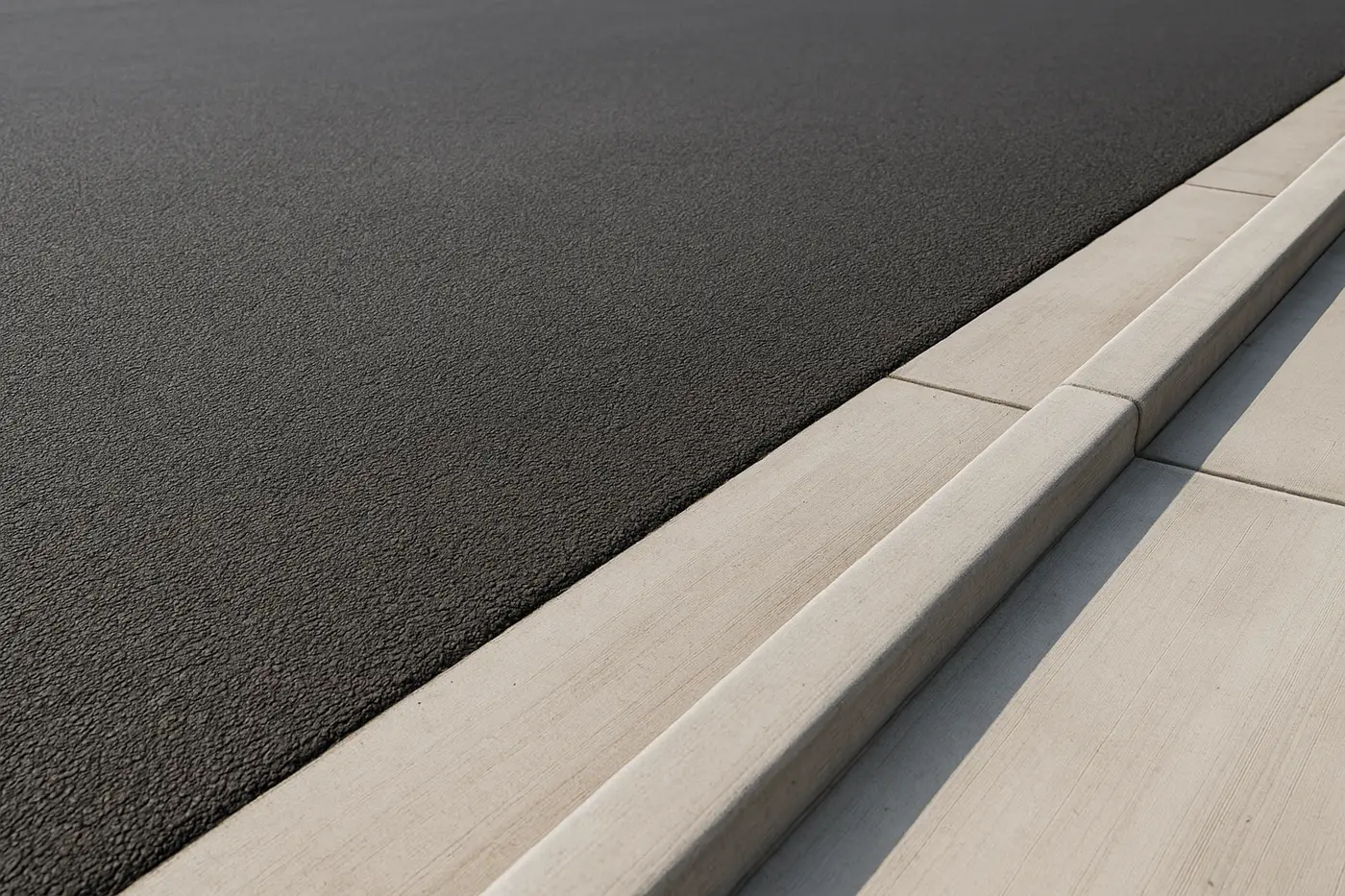
The care schedule for new commercial pavement
Nobody hands you this when the lot is finished. Put it in your maintenance calendar and the asset behaves very differently.
First 60–90 days
Let it cure. No sealer.
New asphalt still has to release its volatiles. Sealing too early traps them and softens the surface you just paid for.
Year 1–2
First sealcoat, and set the crack-inspection habit
This is the window that protects the binder from UV before it hardens. Miss it and the surface goes brittle years ahead of schedule.
Year 2–5
Seal any crack over about a quarter inch, every year
A sealed crack is a maintenance line item. An open one over clay is a base repair within a few winters.
Year 5–10
Seal cycle every 2–3 years; restripe as markings fade
Cheap years. Pavement in this band that has been maintained rarely needs anything structural.
Year 10–20
Assess the base, then overlay the surface course when it is spent
Done at the right time this is a resurfacing job. Left too long it becomes a reconstruction.
The two items doing most of the work there are crack sealing and sealcoating. Neither is exciting and both are a fraction of what structural repair costs once the water has been in the base for three winters.
Why a light-duty section dies at an industrial gate
Liberty's logistics corridors are the reason we quote entrances separately from the rest of a property. The distribution and manufacturing sites feeding off I-35 generate constant heavy-vehicle turning movements in a very small area.
What fails
A standard three-inch parking-lot section under repeated Class 8 turning can be finished inside two years. It does not wear out — it deforms. The mat ruts, then shoves into ridges, and the base beneath it works loose because the load is arriving as shear rather than straight down.
Patching that is money in a hole. The section was never right.
What holds
Full-depth design: on the order of 8 to 12 inches of compacted aggregate base, placed in lifts, with thicker asphalt courses above it — or concrete at the gate and the dock apron, where trailers pivot on the spot.
It costs more per square foot across a small area, and it is the difference between rebuilding an entrance every two years and not thinking about it.
How we build for Liberty's weather and soil
Clay County's namesake soil has extreme shrink-swell behavior. During dry spells it contracts and cracks; after rain it expands with enough force to heave pavement sections. Every Liberty project requires moisture-controlled compaction and adequate granular base thickness to isolate the slab from subgrade movement.
There is a detail here worth knowing if you have owned property on both sides of the river. The Haig series silty clay under Liberty is influenced by the Missouri River valley and holds moisture longer than the upland clays elsewhere in the metro — so the seasonal movement carries further into the dry months rather than stopping when the rain does. Pavement over it spends more of the year being flexed.
Add roughly 40 freeze-thaw cycles, frost reaching 36 inches, and 42 inches of annual rain, and the practical instruction is short: keep water out of the base, compact at the right moisture, and give the clay enough stone above it that it never sees a concentrated wheel load. The MO-152 retail lots need one thing on top of that — stiffer mix through the stop-and-go drive aisles and turning radii, where surface wear runs well ahead of the rest of the property.
From grade to final coat
Survey and subgrade
Grades shot, drainage traced, and the subgrade checked for moisture and bearing. On Clay County clay this is where a job is won or lost, and it happens before a price is written.
Fixed estimate by zone
Entrances, truck routes, and parking areas priced as separate specifications rather than one blended number — because they are not the same build.
Removal and repair
Old surface off by milling or full removal, soft subgrade undercut and replaced, and separator fabric where the clay would migrate into the stone.
Base in lifts, compacted wet-right
Crushed aggregate placed in layers and compacted at controlled moisture, then proof-rolled under load so any soft spot shows up now rather than under new asphalt.
Binder, surface, and layout
Both courses rolled to density while hot, accessible stalls and aisles set to grade during the work, then striping once the surface has cured.
The handover
A walk-through, and the care schedule above with your dates filled in — including when the first seal is due on what we just built.
Who you would be dealing with
Tarmasters is the asphalt division of Ford Concrete and Paving — Kansas City–owned, based in Lee's Summit, insured and bonded, paving across the metro since 2014. Liberty sits at the north end of the area we cover, and we run our own crews and plant logistics, so a Northland schedule is one we can actually hold to.
Practically, that means a measured fixed price, specifications written per zone rather than averaged across the site, and an honest read on timing. If your newer lot needs sealing rather than paving, we will quote sealing — the paving work will still be there in ten years, and it will be smaller if you maintain it now.
Around Liberty
We take commercial work anywhere in the city, though it concentrates in a handful of places — the logistics and industrial ground off I-35, the retail corridor on MO-152, and the older core:
The same crews cover the neighboring markets — commercial paving in Kansas City, MO, Independence, Kansas City, KS, and Leavenworth.
More detail on what commercial work involves, our full range in Liberty, and the cities we serve.
Liberty commercial paving questions
Our lot is only a few years old. Is there anything to do yet?
Yes, and it is the cheapest work you will ever buy on that lot. New commercial pavement wants its first seal once it has properly cured — generally inside the first year or two — because that is what keeps ultraviolet light from hardening the binder. After that it is an annual look for cracks and a seal cycle every couple of years. Lots built around here since about 2018 are exactly at that decision point now.
Why do industrial entrances off I-35 fail so much faster than the rest of the yard?
Because a truck entering a site brakes, turns, and accelerates in the same few square feet all day, and that combination puts shear into the mat rather than straight compression. A section built to a light-duty specification can be finished inside a couple of years at an entrance like that. What holds up is a full-depth design — on the order of 8 to 12 inches of compacted aggregate base with thicker asphalt lifts above it, or concrete at the gate itself.
What makes Clay County soil different from the clay elsewhere in the metro?
Haig series silty clay holds moisture longer than the upland clays on the Missouri side, which means the seasonal ground movement runs further into the dry months instead of settling down. It also swells hard: after heavy rain it expands with enough force to lift a pavement section. That is why we compact to a controlled moisture content and put enough granular base between the clay and the asphalt to isolate one from the other.
We own a building on the Square. Can accessibility be improved without spoiling the streetscape?
Usually, and it is worth taking seriously — the buildings around Historic Liberty Square predate the current standards, so narrow walks, ramp slopes over the limit, and missing detectable warnings are common. On the pavement side the fixes are targeted: regrading a specific approach, relocating accessible stalls to where the slope actually works, and rebuilding a ramp landing. Anything touching the historic streetscape needs the city in the conversation early rather than late.
Free estimates across the Kansas City metro.
Driveways, parking lots, and repairs across the Kansas City metro, since 2014.
Call Now: (816) 789-0700Tarmasters Asphalt Paving
Lee's Summit, MO 64063 | Serving the Kansas City metro | Insured | Bonded