Driveway Paving in Leawood
Where the edges, the apron, and the joint at the border matter as much as the mat.
Tarmasters paves residential driveways across Leawood, Kansas. North of 119th the ground is Martin-Woodson series clay-loam; south of it, newer development sits partly on alluvial soils that settle unevenly. Different problems, and the finish has to be right either way. Insured and bonded since 2014.
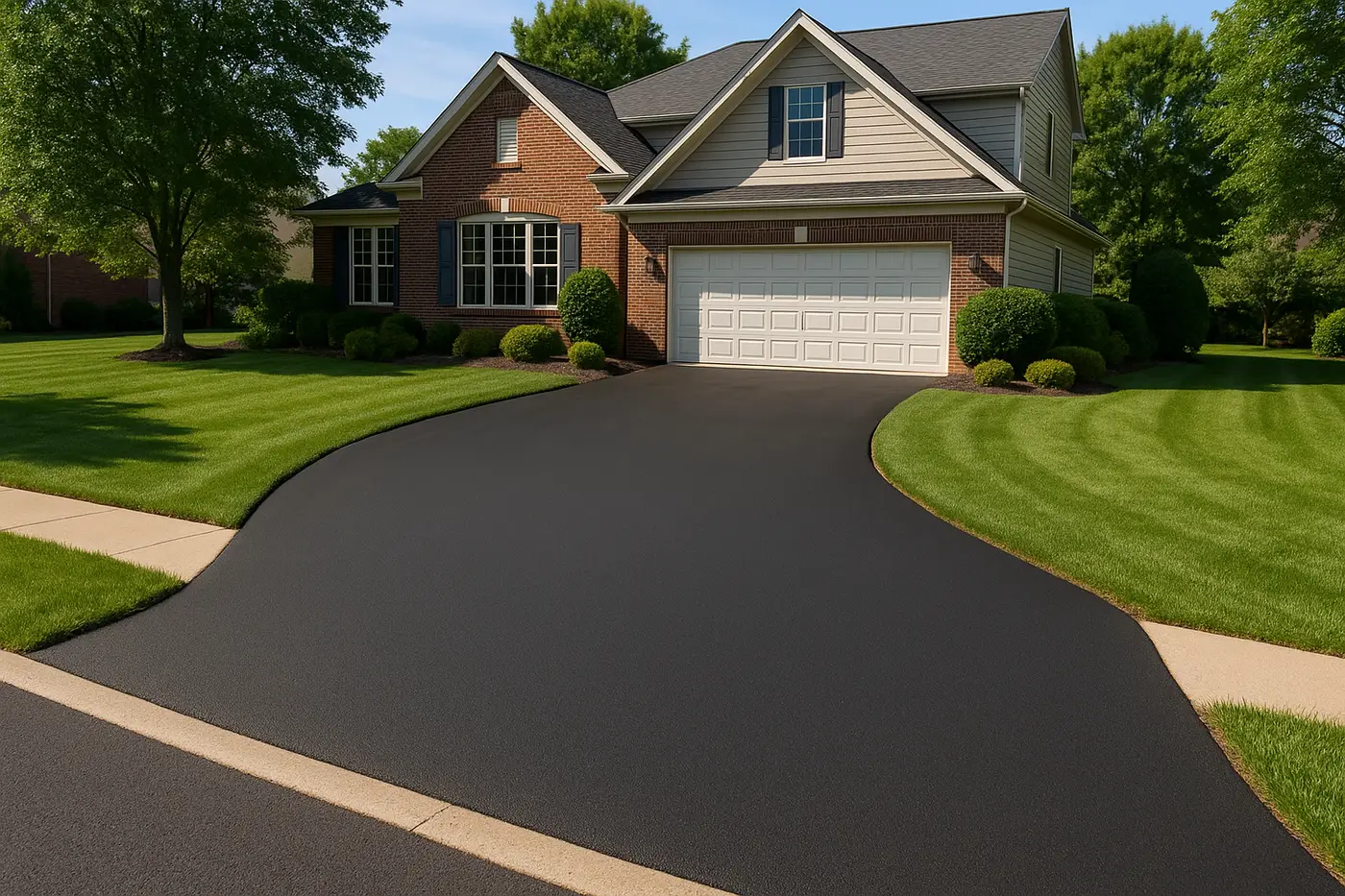
A driveway in Leawood is judged on two things that have nothing to do with each other. One is whether it lasts, which is decided under the surface. The other is how it looks from the street in year five — the line of the edges, the joint where the asphalt meets a stone border, whether the apron sits flush at the curb, and whether the lawn beside it still looks untouched.
Both are buildable. Neither happens by accident. Parking lots at the office and retail properties are commercial asphalt paving in Leawood, and failed sections are asphalt repair.
What a lasting Leawood job takes
North of 119th, in the established neighborhoods, the issue is Martin-Woodson series clay-loam: it takes on water and swells, dries and shrinks, and moves the ground under the mat by an inch or two through a season. The answer is depth — compacted crushed limestone spreading load across that movement, with a separator where the clay is wet.
South of 119th the problem changes. Newer development there sits on alluvial soils near the Blue River drainage, which compact unevenly under load — so the failure shows up as localized settlement and ponding on drives barely twenty years old, rather than as clay cracking. Same city, different diagnosis, different repair.
1–2 in.
seasonal ground movement on this clay
38
freeze-thaw cycles a winter
34 in.
frost depth
What each option actually buys you
Four different jobs get pitched to solve the same complaint. Here is what each one fixes, what it does not, and how long it holds its appearance.
| Work | What it fixes | What it does not | Appearance | When it is right |
|---|---|---|---|---|
| Sealcoat | Color and surface protection — slows the oxidation that turns black asphalt grey | Does not fill working cracks, level a dip, or add any structural life | Looks new for 2–3 years | A sound drive you want to keep looking sharp, on a regular cycle |
| Crack seal | Keeps water out of the base through the cracks that already exist | Visible as dark lines. It is maintenance, not cosmetics | Function lasts 3–5 years; appearance is honest rather than pretty | Every drive here, on a 2–3 year rhythm, from the first crack onward |
| Resurface | A genuinely new surface — color, texture, and a fresh wearing course | Does not fix a base that has failed, and old cracks can reflect through if they are not addressed | Looks new for 8–12 years if the base under it is sound | Base proof-rolls tight, surface is worn or cracked through |
| Replace | Everything — grade, base, surface, edges, apron | Does not need doing as often as it is sold | Looks new for 8–12 years and lasts 15–20 with maintenance | Settlement, connected cracking, or a drive that moves under load |
The first two are covered on sealcoating and crack sealing; the third is an overlay.
The driveway work we do in Leawood
Replacement
Old drive out, ground corrected, base rebuilt, new drive laid with the edges and apron detailed properly. The answer where settlement or connected cracking has taken hold.
Resurfacing
A new wearing course on a base that still carries. The best-value option on the established north-side drives, where the original build was usually adequate.
Widenings and turnarounds
Extra width, parking courts, and turnarounds on the larger lots. Built to the same depth as the existing drive so the seam between them does not open.
How a Leawood project runs
-
01 Survey and protect
Measure, take elevations, and agree what needs protecting — irrigation heads, lighting, stone borders, and the lawn either side.
-
02 Remove cleanly
Old surface out with the excavation kept tight to the drive line. On a maintained landscape the edges of the work are as visible as the drive itself.
-
03 Proof-roll and correct
Subgrade loaded to find the soft areas. South of 119th, where alluvial soils near the Blue River compact unevenly, this is where the dips get explained.
-
04 Base and grade
Crushed limestone compacted in lifts with a geotextile separator over wet clay, and fall set so water leaves rather than collecting.
-
05 Pave and finish
Hot mix rolled to density while hot, edges cut straight and supported, apron flush at the street, and the site left clean.
How we work on a maintained property
Tarmasters is Kansas City–owned, the asphalt division of Ford Concrete and Paving, insured and bonded, paving across Johnson County since 2014.
On these properties the job is not finished when the asphalt is down. Irrigation and lighting get marked before the machines arrive, the excavation stays tight to the drive line, the lawn edge gets repaired, and the site is cleaned. The estimate is measured and fixed, and it says which of the four options above your drive actually needs.
Nearby Leawood communities
North of 119th — the established side
Wilshire, Worthington, Leawood Estates, Meadow Lane, and the streets off Roe Ave and State Line Rd. Mature lots, clay movement, and drives on their second or third surface — often good candidates for a resurface.
South of 119th — newer, and settling
Ironhorse, Tuscany Reserve, Whitehorse, and Bridle Ridge, out toward 135th St. Younger drives where dips and ponding point at the ground rather than the asphalt.
We are next door constantly — Overland Park driveways, Lenexa, Olathe, and across State Line in Kansas City, Missouri. The service page is asphalt driveway paving, and the service areas page has the rest.
Leawood driveway questions
Our drive is barely twenty years old and it has dips in it. Why?
Newer development south of 119th Street sits partly on alluvial soils near the Blue River drainage, and those soils compact unevenly under load. The result is localized settlement — dips, ponding, and early cracking on drives that are not old at all. It is a base problem rather than a surface one, so resurfacing over it puts a new skin on the same movement. The fix is to open up the settled areas, correct what is under them, and rebuild.
How do you keep the job from tearing up the landscaping?
By agreeing the boundaries before anything starts. We mark irrigation heads and lighting, keep the excavation tight to the drive line, run plant and haul-off along a set route, and repair the lawn edge where the machine has to sit. It is not complicated work, it is just work that has to be planned rather than dealt with afterwards. On most Leawood lots the finish at the edges is what people notice first.
Can asphalt look right next to a stone or brick border?
Yes — the detail that matters is the joint. A clean cut, a supported edge, and the asphalt brought up flush rather than lapping over the border keeps the line sharp. Same at the apron: the tie-in to the street should be flush with no lip and no feathered edge, because a feathered edge is where the surface starts breaking away.
How often should it be sealed?
Sealcoat every two to three years keeps the color and slows oxidation; crack sealing happens as cracks appear rather than on a fixed date. With about 38 freeze-thaw cycles a winter and frost reaching 34 inches, an open crack through one season is a wider crack the next. Sealing new asphalt too early is the one mistake worth avoiding — the surface needs a season to cure first.
Driveway estimates in Leawood
Tarmasters Asphalt Paving — measured pricing, a build that suits the ground, and a finish that still looks right in year five.
Call Now: (816) 789-0700