Riverside Asphalt Paving
On river bottomland the water that ruins a base does not fall on it. It rises into it.
Tarmasters paves heavy-duty industrial yards, commercial lots, and driveways across Riverside, Missouri. The ground is Wabash-Haig series alluvial clay on river bottomland, where a shifting water table can wet a base from underneath, so free-draining aggregate and underdrains are standard. Insured, bonded since 2014.
Most drainage conversations are about getting rain off a surface. In Riverside there is a second one that matters more. The industrial ground here sits on Missouri River bottomland, and the water table under it moves with the season — wicking moisture upward into unbound base material without a drop of rain falling on the lot.
A base wet from below loses a large share of its strength, and the failure that produces looks inexplicable from the top: a well-graded lot with no ponding, coming apart anyway. The defence is specified before anything is built — free-draining aggregate, underdrains that actually discharge somewhere, and a section designed for the ground as tested rather than as assumed.
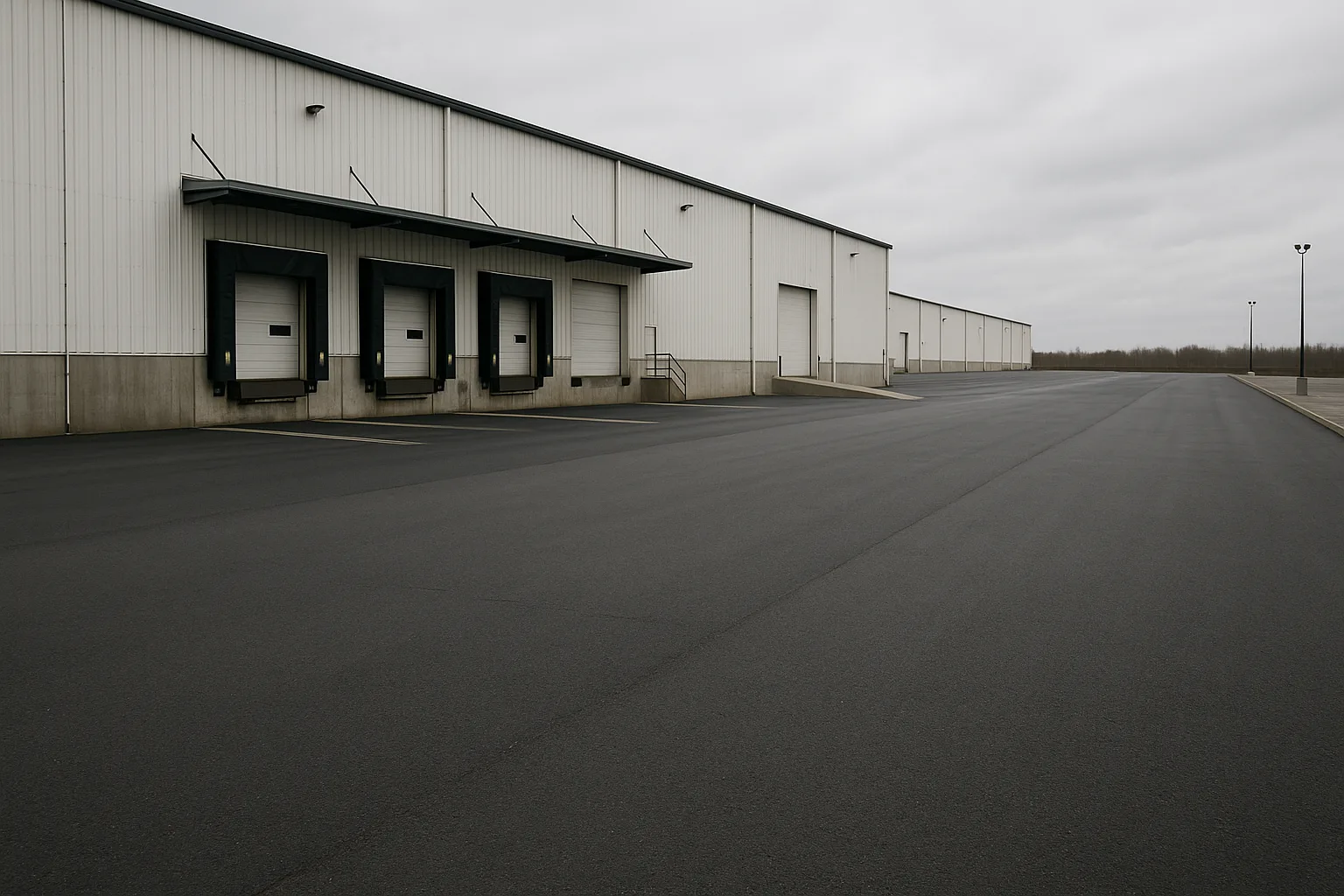
Riverside is a small city carrying enormous industrial weight — the Horizons Business Park, the Riverside 69 Industrial corridor, and constant Class 8 traffic serving the automotive supply chain. Above the flats, the Briarcliff and bluff-side residential areas are ordinary suburban ground. We work all of it from Lee's Summit, insured and bonded, and honest about whether you need repair, resurfacing, or a rebuilt section.
Five things we establish before designing a section here
River bottomland does not reward assumptions. These are the questions that come before a number, and the reason two quotes on the same lot can differ by a great deal.
Where does the water table sit, and how far does it move?
This is the question that separates river-bottom paving from everything else. A water table that rises seasonally can wick moisture up into an unbound base by capillary action — no rain required. A base that is wet from below loses a large share of its strength, and no surface treatment fixes it. Free-draining aggregate and underdrains are the answer, and they have to be designed in from the start.
Does bearing capacity change across the site?
On this ground it usually does. Bearing here can shift from stable sandy-loam to saturated silt inside the same lot, so each section wants its own Proctor test before a base design is committed. A single specification applied across a whole site is not efficiency — it is a guarantee of uneven settlement somewhere on it.
What is the levee doing for this property?
Flood risk here is moderate to high and managed through levee protection, and that context matters to insurers, to lenders, and to how a site is designed. It does not change how asphalt is built, but it does change how seriously the drainage and the outfall side of a project should be taken.
What actually parks on it?
Riverside carries some of the heaviest sustained truck traffic in the metro, serving the automotive supply chain and the logistics parks. The turning stress at the I-635 and MO-9 interchanges shows up in adjacent pavement as shoving and rutting. Where trucks turn and stop, the section has to be built for shear, not just for weight.
How old is what is already there?
Two very different answers in one city. The levee-adjacent lots are forty years old or more and are generally into reconstruction. The Horizons-era industrial pavement from the 2010s onward is high-spec, heavy-load construction in a prime maintenance window — where sealing and joint work now avoids a rebuild later.
Building for Riverside's conditions
Properties near E.H. Young Riverfront Park and the older industrial parcels along the river deal with seasonal water table fluctuations that wick moisture into subbase material. We specify free-draining aggregate bases and underdrains on these lots to keep the structural section dry.
Water reaches a pavement base by six routes, and only two of them are the ones people picture. Here is the full list and what stops each.
| Where it comes from | How it reaches the base | What stops it |
|---|---|---|
| Rain landing on the surface | Straight down through any open crack or joint | Crack sealing on cycle and a surface without open joints |
| Run-on from adjacent property | Across the surface, then into the base at the lowest point it finds | Interception at the boundary — a swale, a kerb, or an inlet before it arrives |
| A seasonally rising water table | Upward, by capillary action, into unbound base material | Free-draining aggregate and underdrains — the defining detail on bottomland |
| Water trapped in the base with no outlet | It does not need to reach anywhere. It is already there and cannot leave | An outlet: daylighted edge drains or a tie-in to the storm system |
| Melt and brine in winter | Into cracks at temperatures where plain water would already be frozen | Seal before winter, and keep the drainage path clear so brine leaves rather than sits |
| Irrigation and landscape overspray | Into the ground at the pavement edge, softening support where it is thinnest | Adjust the heads. It is the cheapest pavement repair available |
What we pave in Riverside
Commercial paving, repair, and driveways have dedicated Riverside pages. The rest run through the metro service pages.
Industrial yards, truck courts, and entertainment-district parking built on a subgrade tested section by section.
Rebuilding rutted and shoved areas where sustained Class 8 turning load has deformed the section.
Drives across the bluff-side and Briarcliff residential areas, above the bottomland ground.
A new wearing course on the Horizons-era pavement, where the structure is sound and worth protecting.
Cutting deformed surfaces off to a clean grade — the honest first step on a rutted industrial lot.
Keeping surface water out matters more here, because the base is already fighting water from below.
Truck routing, loading-bay layout, fire lanes, and high-volume event parking.
Binder protection on sound pavement. It does nothing for a base that is saturated.
Where we pave around Riverside
Industrial work concentrates at Horizons Business Park and Riverside 69 Industrial; retail and entertainment along the MO-9 Commercial Corridor. Residential work runs above the flats. Access is off I-635, MO-9, NW Vivion Rd, Tullison Rd, and Platte Purchase Dr.
Cities around Riverside
Immediately south and east is Kansas City, north is Platte City and Smithville, north-east is Liberty, and across the state line we cover Shawnee. We also run east to Independence. Parkville and Gladstone sit inside the same run. Every city we serve.
Working in Riverside
Tarmasters is a Kansas City–owned paving contractor and the asphalt division of Ford Concrete and Paving, working the metro since 2014 with our own crews and equipment. On industrial ground here the value is in the investigation as much as the paving — knowing what is under a lot before committing to a section.
Work runs under City of Riverside / Platte County codes. On a working industrial site the constraint is usually keeping truck access live throughout, so the lot is phased and the routes are agreed before anything starts.
Insured and bonded. Measured estimate, fixed price, firm sequence, and a straight answer — even when it means telling you the scope is larger than you hoped.
Riverside paving questions
What is capillary rise, and why does it matter here?
Water moving upward through fine material against gravity, drawn by surface tension in the pore spaces. On Missouri River bottomland with a seasonally fluctuating water table, that can carry moisture up into a pavement base without a drop of rain falling. A base saturated from below loses strength, and the surface above it fails in ways that look inexplicable from the top.
Why test each section of a lot separately?
Because the ground genuinely differs across it. Riverside sits on Missouri River bottomland where bearing capacity can shift from stable sandy-loam to saturated silt within the same lot. Each section requires individual Proctor testing before we commit to a base design — a single spec across the whole site guarantees uneven settlement. Testing each area and designing the base to match is more work up front and considerably less work three years later.
What are underdrains and do we really need them?
A perforated pipe in a stone envelope, set below the pavement structure, that gives water a route out of the base. On upland ground they are often unnecessary. On the older industrial parcels near the river, where the water table fluctuates seasonally, they are what keeps the structural section dry — and they only work if they discharge somewhere real.
Our loading area is rutting even though it was built recently. Why?
Sustained heavy turning is a different load case from rolling traffic. Where Class 8 vehicles turn and stop repeatedly in the same few metres, the pavement is worked in shear rather than compression, and a section built to a standard commercial spec deforms under it. Rebuilding that zone with a deeper base and a binder course is the fix — resurfacing it is not.
Is the residential side different from the industrial side?
Quite different. The bluff-side and Briarcliff areas sit above the bottomland and behave like ordinary suburban ground — normal drives, normal sections, normal maintenance. It is down on the river flats that the water table, the variable bearing, and the truck loads all arrive at once.
Ready to pave it right?
Get a straight estimate and a clear timeline. Tarmasters Asphalt Paving handles driveways, parking lots, and repairs across the Kansas City metro.
Call Now: (816) 789-0700