Asphalt Paving in Louisburg and Miami County
How close you are to the interchange changes what your lot needs. It is the most useful thing to know about paving in this city, and almost nobody prices for it.
Tarmasters paves commercial lots and driveways across Louisburg, Kansas. Freight funnelling through the US-69 and K-68 interchange means nearby lots need stiffer mixes and deeper bases than standard retail specs, over Cherokee-Parsons series clay. Insured, bonded, working the region since 2014.
There is a simple fact about paving in Louisburg that almost never appears in a quote: how far your property is from the US-69 and K-68 interchange changes what your lot has to be built to withstand. Heavy regional freight is funnelled straight through the commercial core, and every acceleration, braking, and turning movement puts force into the pavement sideways rather than downward.
Within roughly a quarter mile of those ramps, a standard retail specification is not enough. Those lots want a stiffer binder grade and a thicker base, or the surface shoves — ripples and humps pushed up where vehicles slow. A property a mile down the road sees a fraction of that, and building it the same way is money spent on capacity it will never use.
Louisburg is a growing exurb of about 4,955 people, with retail along Amity Street, an industrial park, schools, and a genuine autumn tourism surge. We work it from Lee's Summit, insured and bonded, and we will tell you which zone your property is in before quoting a commercial build, repair, or resurfacing.
The base under a Louisburg job
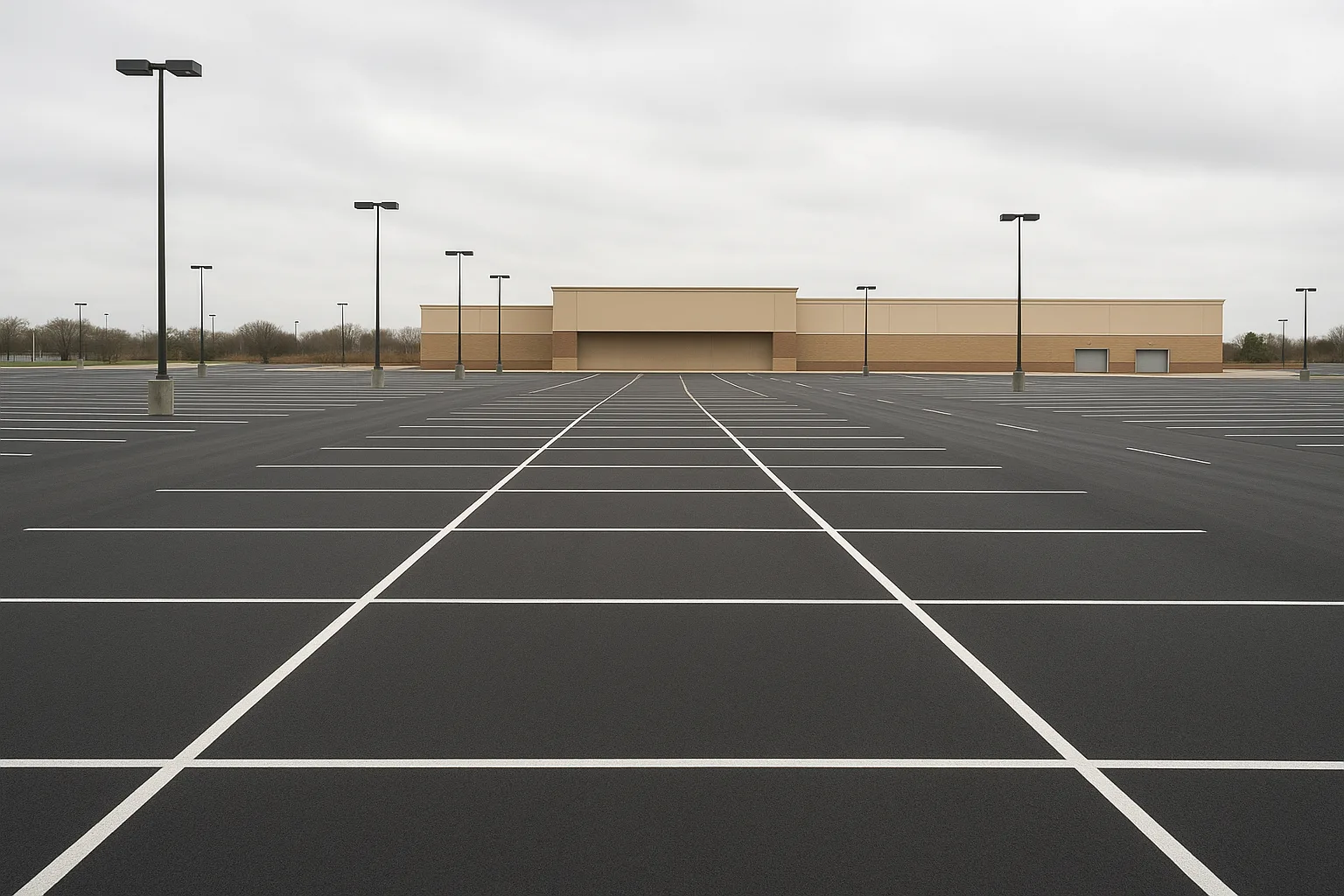
Miami County soils share the expansive clay profile found across the KC metro's southern tier. Wet seasons cause heave; dry spells cause shrinkage. Without a properly compacted aggregate buffer — typically 8 to 10 inches — that differential movement transmits directly into the asphalt surface as cracking and settlement.
Freeze-thaw action has caused visible spalling on sidewalks and curb faces along the K-68 retail corridor. Failed concrete creates trip hazards and code violations that reflect on adjacent property owners, even when the damage is on shared access infrastructure.
Two variables, not one: the ground sets the minimum base depth, and the traffic sets what has to go on top of it. Most of the city's retail and school lots date from the 1990s to 2010s and are entering a rehabilitation window — which is the right moment to correct a section that was under-built for its location the first time.
Six zones, six different sections
Where a property sits in this city is a design input rather than an address. This is how we read it before pricing anything.
| Zone | What the traffic does there | What the section needs |
|---|---|---|
| Within about a quarter mile of the ramps | Constant acceleration, braking, and turning by heavy regional freight | Stiffer binder grade and a thicker base than a standard retail spec. Entries and drive aisles heavier again. |
| Corridor frontage beyond the ramps | Steady traffic at speed, with turning concentrated at each entrance | Standard commercial section across the bays, with a heavier approach and drive aisle. |
| The Amity Street retail strip | High turnover, light vehicles, constant low-speed turning into stalls | Conventional commercial build. The wear here is surface polishing and layout, not structure. |
| Industrial park access | Loaded trucks at low speed, often standing while loading | Deeper base with a binder course, and concrete where vehicles routinely sit. |
| School and civic lots | Empty most of the week, then buses and a full crowd within an hour | Section sized for the bus route and the peak, not for the weekly average. |
| Seasonal-surge overflow | Very heavy use for a few autumn weekends and almost nothing the rest of the year | Either built properly as pavement or defined and managed as overflow. The middle option becomes mud. |
The useful consequence is that two identical-looking lots in this city can honestly carry very different prices, and the cheaper one is not always the corner being cut.
Paving and repair in Louisburg
Commercial paving, repair, and driveways have dedicated Louisburg pages. The rest run through the metro service pages.
| Commercial Asphalt Paving | Corridor | Retail and industrial lots with the section set by how close the property is to the interchange. |
| Asphalt Repair | Most common | Rebuilding shoved and rutted areas near the ramps, plus potholes on aging retail access roads. |
| Driveway Paving | Residential | New drives across the growing subdivisions and long approaches on the larger lots. |
| Overlays & Resurfacing | Rehab window | Mill-and-overlay on the 1990s–2010s retail and school lots now entering a genuine rehab window. |
| Crack Sealing | Preventive | Proactive sealing on lots that are still structurally sound, which describes most of the city. |
| Line Striping | Layout | Stall layout, fire lanes, accessible parking, and event overflow marking for the seasonal surge. |
| Sealcoating | Protection | Binder protection on sound surfaces, once the repairs that matter have actually been done. |
| Asphalt Milling | Prep | Taking deformed depth off to a clean grade before a heavier section goes back in its place. |
Working in Louisburg
Tarmasters is a Kansas City–owned paving contractor and the asphalt division of Ford Concrete and Paving, working the region since 2014 with our own crews and equipment. On a job near the ramps, the specification is the whole conversation — mix stiffness and base depth are what stand between a lot and a shoved surface, and neither is visible once the work is finished.
Work here runs under City of Louisburg / Miami County building codes. The city requires off-street parking to be surfaced when a property expands, and on frontage property the condition of shared walkways comes into the same conversation. Both are worth confirming with the city before a plan is fixed.
Insured and bonded. Measured estimate, fixed price, firm sequence, and a straight answer about what your surface needs — including when your location means it needs less.
Around Louisburg
Commercial work concentrates on the K-68 (Amity St) Retail Strip, the Louisburg Industrial Park, and the 69-Hwy Interchange Commercial; residential runs through the newer subdivisions and the small-town core. Access is off US-69, K-68 (Amity St), Metcalf Rd.
Cities around Louisburg
Osawatomie and Drexel sit inside the same run. All 46 cities we serve, across Kansas and Missouri.
Louisburg paving questions
Does being near the interchange really change what our lot needs?
Yes, and it is the most useful thing to know about paving in this city. The US-69/K-68 interchange funnels heavy regional freight through Louisburg's commercial core. Constant acceleration, braking, and turning at this junction creates shear forces that push and deform conventional asphalt. Lots within a quarter mile of this interchange need stiffer binder grades and thicker base sections than standard retail specs. A property a mile down the road sees a fraction of that, and building it to the same heavier specification would be money spent on capacity it will never use.
What is shoving, and how is it different from cracking?
Shoving is the pavement physically moving — ripples and humps pushed up where vehicles brake and turn repeatedly. Cracking is fracture; shoving is deformation. It matters because they need opposite work: a crack can be sealed or overlaid, while a shoved area has to be removed and rebuilt, because nothing has broken and the cause is still there.
How deep does the base need to be over Cherokee-Parsons series clay?
Typically eight to ten inches of properly compacted aggregate. Miami County soils share the expansive profile found across the metro's southern tier — heave in wet seasons, shrinkage in dry ones — and without that buffer the differential movement transmits straight into the asphalt as cracking and settlement. Near the interchange, add the load on top and the number goes up rather than down.
Our zoning requires paved parking. What counts?
Asphalt or concrete, in practice — the city requires off-street parking to be surfaced when a property expands, and gravel does not satisfy that. It is worth confirming the current wording with the city before planning, since requirements are revised over time. What we can tell you is what each surface will actually do under the traffic your property sees.
The sidewalk out front is spalling. Is that our problem?
Often, yes, even where it is shared access infrastructure — a deteriorating walk in front of your property reflects on you and can become a trip hazard and a code issue regardless of who built it. Freeze-thaw damage along the retail corridor is visible on plenty of frontage here. It is generally cheap to address at the partial-depth stage and expensive once panels have to be replaced.
Free estimates across the Kansas City metro.
Driveways, parking lots, and repairs across the Kansas City metro, since 2014.
Call Now: (816) 789-0700Tarmasters Asphalt Paving
Lee's Summit, MO 64063 | Serving the Kansas City metro | Insured | Bonded