Asphalt Paving in Harrisonville, MO
Where trucks run daily, the answer is not a thicker base — it is asphalt all the way down.
Tarmasters paves industrial, retail, and residential asphalt across Harrisonville, Missouri. Distribution traffic here runs into the hundreds of Class 8 movements a day, so industrial lots need full-depth sections rather than a surface over stone — over high-plasticity Lagonda series clay-loam. Insured, bonded, since 2014.
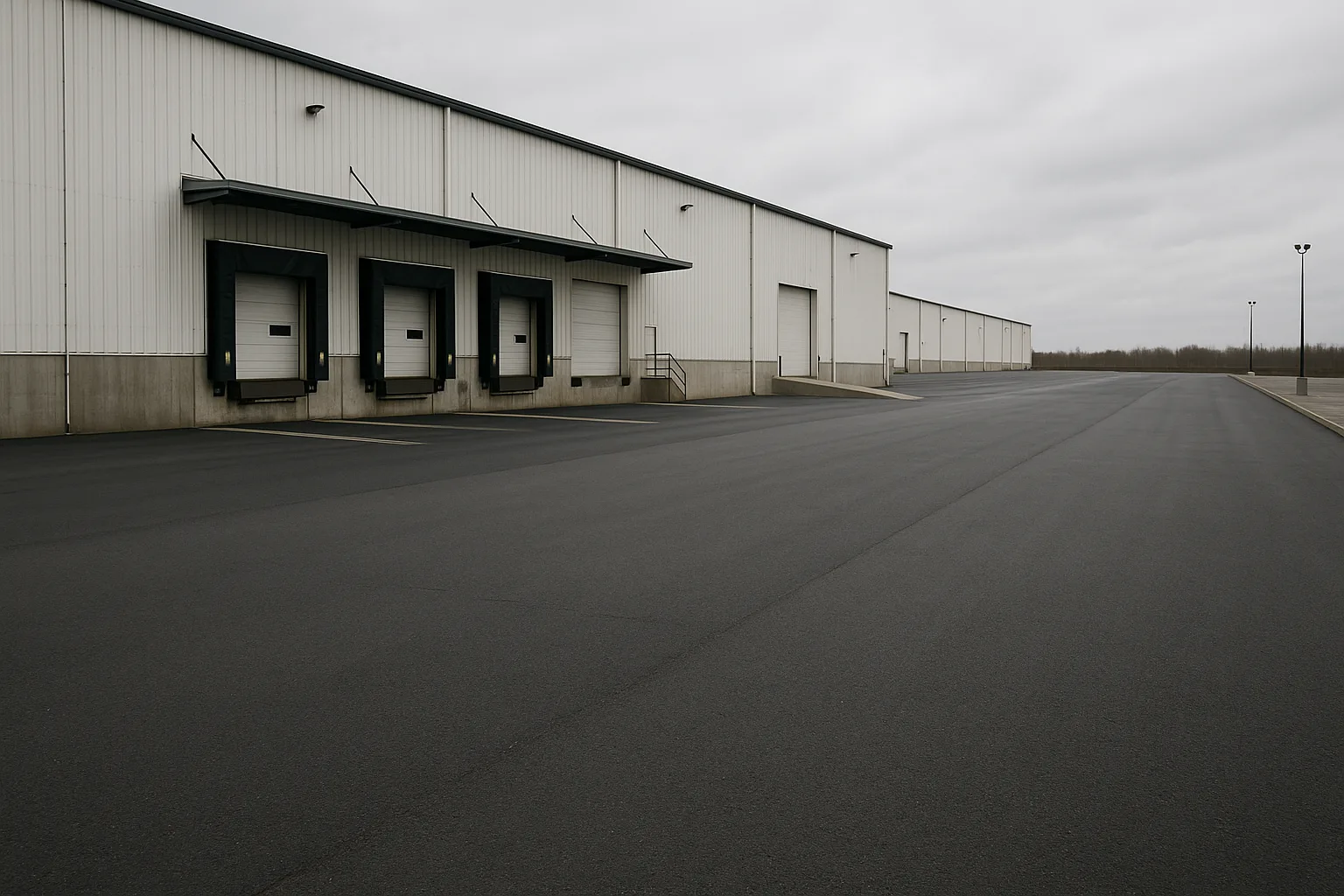
Harrisonville is a town of about 10,121 with an 825,000 square foot distribution centre in it. That single fact reorganises everything about how pavement gets built here. Hundreds of Class 8 movements a day, plus chemical haul routes serving the manufacturing side, put loads on industrial access roads that no ordinary commercial section survives.
The answer on those routes is not more stone under the same asphalt. It is full-depth asphalt — a pavement built entirely from bound material, from the prepared subgrade up, with no unbound stone layer in it at all. The whole section then behaves as one slab, and that is why it holds where a conventional lot ruts.
It is not the answer everywhere, and we will tell you when it is not. Most of what we do here is ordinary: retail lots along the Belt Highway, work around the Historic Courthouse Square, drives across the subdivisions. Based in Lee's Summit, insured and bonded, and straight about which commercial build your property actually justifies.
Our Harrisonville services
Commercial paving, repair, and driveways have dedicated Harrisonville pages. Open the others for detail.
01Commercial Asphalt Paving
Industrial access roads, loading bays, and retail lots — built full-depth where the traffic justifies it and conventionally where it does not.
Commercial Asphalt Paving →02Asphalt Repair
Full-depth patching on the pothole-prone access roads near the rail spurs, and repair on aging Belt Highway retail.
Asphalt Repair →03Driveway Paving
Replacements on the older downtown properties and new drives across the 1980s–2000s subdivisions.
Driveway Paving →04Overlays & Resurfacing
A new wearing course where the structure is sound — common on the Commercial Street corridor.
Overlays & Resurfacing →05Crack Sealing
Deferred sealing is the single biggest cause of pothole formation here. It is also the cheapest thing to fix.
Crack Sealing →06Sealcoating
Slowing oxidation on the aging retail lots along the Belt Highway, where the surface has gone grey.
Sealcoating →07Line Striping
Truck routing, fire lanes, stall layout, and the accessible parking a medical campus is held to.
Line Striping →08Asphalt Milling
Removing a failed surface to grade — and on a full-depth section, recovering material worth reusing.
Asphalt Milling →Full-depth asphalt versus a conventional section
The two ways to build a pavement, side by side, and where each one earns its money in this town. Ask any bidder on an industrial lot which they are pricing — the answer tells you a great deal.
| Conventional (aggregate base) | Full-depth HMA | |
|---|---|---|
| What it is | Compacted aggregate base with an asphalt surface on top | Asphalt from the subgrade up — a binder-rich base course under the surface course, no stone layer |
| Typical depth here | 8 in. of aggregate under 3 in. of asphalt for commercial parking | 6–8 in. of asphalt placed in lifts, designed for 80,000-lb gross vehicle weights |
| How it handles heavy axles | Spreads load through the stone; fine for cars, marginal under constant Class 8 traffic | The whole section works as one bound slab, which is why it holds where a conventional lot ruts |
| Behaviour on plastic clay | Depends heavily on base compaction and moisture conditioning being right | Less sensitive — there is no unbound layer to contaminate or pump |
| Water | An unbound base can hold water and lose strength if drainage fails | Effectively impermeable through the section; the risk moves to what happens at the edges |
| Cost and when it is worth it | Lower first cost. Correct for parking, light commercial, and residential | Higher first cost, lower lifetime cost anywhere trucks run daily — the distribution and haul routes |
What a lasting Harrisonville job takes
- ➤
A base sized for plastic clay
Harrisonville's subgrade contains high-plasticity clay that swells with seasonal moisture and shrinks during dry spells. This cyclical movement cracks asphalt from below if the aggregate base isn't thick enough to absorb it. Every commercial job here requires a minimum 8-inch compacted aggregate base with proper moisture conditioning.
- ➤
Sealing that does not get deferred
Harrisonville typically sees 38 freeze-thaw cycles per winter. Each cycle forces water deeper into any existing crack or void. Combined with Cass County's clay, this creates rapid base saturation and pothole formation—especially on lots where crack sealing has been deferred.
- ➤
A section matched to the route
Access roads near the rail spurs and the routes off MO-291 and I-49 carry the heaviest traffic in Cass County. Those want full-depth. The employee parking beside them does not, and building it that way is money wasted.
- ➤
Honesty about the old retail
The Square and the Commercial Street corridor are into full rehabilitation, and the Belt Highway lots have oxidised well past what a sealcoat will hide. Those are overlay and reconstruction conversations, not maintenance ones.
Where we work near Harrisonville
Industrial work concentrates at the Harrisonville Industrial Park; retail at the North 291 Retail Corridor and along the Belt Highway; institutional work around the Cass Regional Medical District. Residential runs through Creekstone Estates, North Woods, Original Town, and The Vineyards. Access is off I-49, MO-291, MO-7, and Commercial St.
Cities around Harrisonville
Archie sits inside the same run. See every city we cover.
Working in Harrisonville
Tarmasters is a Kansas City–owned paving contractor and the asphalt division of Ford Concrete and Paving, working the metro since 2014 with our own crews, pavers, and rollers. Placing a full-depth section properly is a compaction problem more than anything else — it goes down in lifts, and each one has to be rolled to density before the next.
Work here runs under City of Harrisonville / Cass County codes. On the Square, the National Register designation shapes what can be done; on industrial property it is stormwater and truck routing. Insured and bonded — measured estimate, fixed price, firm sequence, and a straight answer about which section your property justifies.
Harrisonville paving questions
Why does standard asphalt fail so fast on industrial lots here?
Because of the volume and the weight. The Walmart Distribution Center alone generates hundreds of Class 8 truck movements daily, and Church & Dwight's chemical haul routes add concentrated axle loads on industrial access roads. Standard 3-inch residential-grade asphalt fails in months under these conditions—Harrisonville industrial lots need 6–8-inch full-depth HMA sections designed for 80,000-lb gross vehicle weights. A three-inch residential-grade surface simply is not a structure for that. It is not a materials problem — the same asphalt performs perfectly well on a car park across town.
What is full-depth asphalt?
A pavement built entirely from asphalt, from the prepared subgrade up, rather than an asphalt surface sitting on a layer of crushed stone. A binder-rich base course goes down first in lifts, then the surface course. Because every layer is bound together, the whole section works as one slab and distributes heavy axle loads far better than an unbound base can.
Is full-depth always the right answer?
No, and we will say so. It costs more up front, and for a car park, a church lot, or a driveway it is money spent on capacity you will never use. Full-depth earns its cost where loaded trucks run daily — distribution access, haul routes, loading bays. Everywhere else, a properly built conventional section is the honest recommendation.
How does Lagonda series clay-loam factor in?
The clay here is high-plasticity: it swells with seasonal moisture and shrinks in dry spells, and that movement cracks asphalt from below wherever the base is too thin to absorb it. On conventional work that means a minimum eight-inch compacted aggregate base with proper moisture conditioning. Full-depth sections are less sensitive to it, because there is no unbound layer to lose strength.
Can you work around the Historic Square?
Yes, with the usual caveat that the Square is a National Register district and the constraints there are historic ones — fixed grades, fixed thresholds, and accessible routes that have to be made to work inside them. That work is measuring and regrading rather than simply repaving, and we price it that way.
Free estimates across the Kansas City metro.
Driveways, parking lots, and repairs across the Kansas City metro, since 2014.
Call Now: (816) 789-0700Tarmasters Asphalt Paving
Lee's Summit, MO 64063 | Serving the Kansas City metro | Insured | Bonded