Guide
How We Handle a Paving Job, Start to Finish
Every phase, what actually happens in it, and what you should be looking at as the owner.
An asphalt job runs in eight phases: walk-through and estimate, grading for drainage, subgrade prep, base placement and compaction, paving, rolling while hot, finishing the edges and transitions, then cure guidance and follow-up. Most of what decides how long it lasts happens before any asphalt arrives on site.
Most people never see the part of a paving job that matters. By the time a driveway or lot looks finished, the decisions that determine whether it lasts eight years or twenty were made days earlier — in the grade, the subgrade, and the base.
This is the whole sequence, written out. Use it to follow your own job, or to ask better questions of whoever is quoting it. Each phase includes what to look for, because knowing what should be happening is what makes a quote comparable to another quote.
The eight phases
Walk-through & estimate
We measure the area, look at the existing base where it is visible, and check how the site drains. You get a fixed number, a timeline, and a written scope before anything is committed.
What to look for: An estimate that names base depth and asphalt thickness. If those numbers are missing, there is nothing to compare against another quote.
Grading for drainage
The site gets shaped so water runs off the finished surface. On a replacement that often means correcting a grade that has been sending water the wrong way for years.
What to look for: Ask where the water is intended to go when the job is finished. A contractor who cannot answer that has not planned it.
Subgrade prep
Old surface out, subgrade proof-rolled to find soft spots. Anything soft gets dug out and replaced rather than bridged over, because it will find its way to the surface later.
What to look for: Whether soft areas are being repaired or simply covered. This is the step most often skipped on a cheap bid.
Base, built and compacted
Crushed stone placed and compacted in lifts, at a depth matched to the load. On the expansive clay common across this metro, a geotextile separator often goes in to stop clay migrating up into the stone.
What to look for: That the base is compacted in layers rather than dumped and rolled once. A deep layer compacted in a single pass is only dense at the top.
Paving
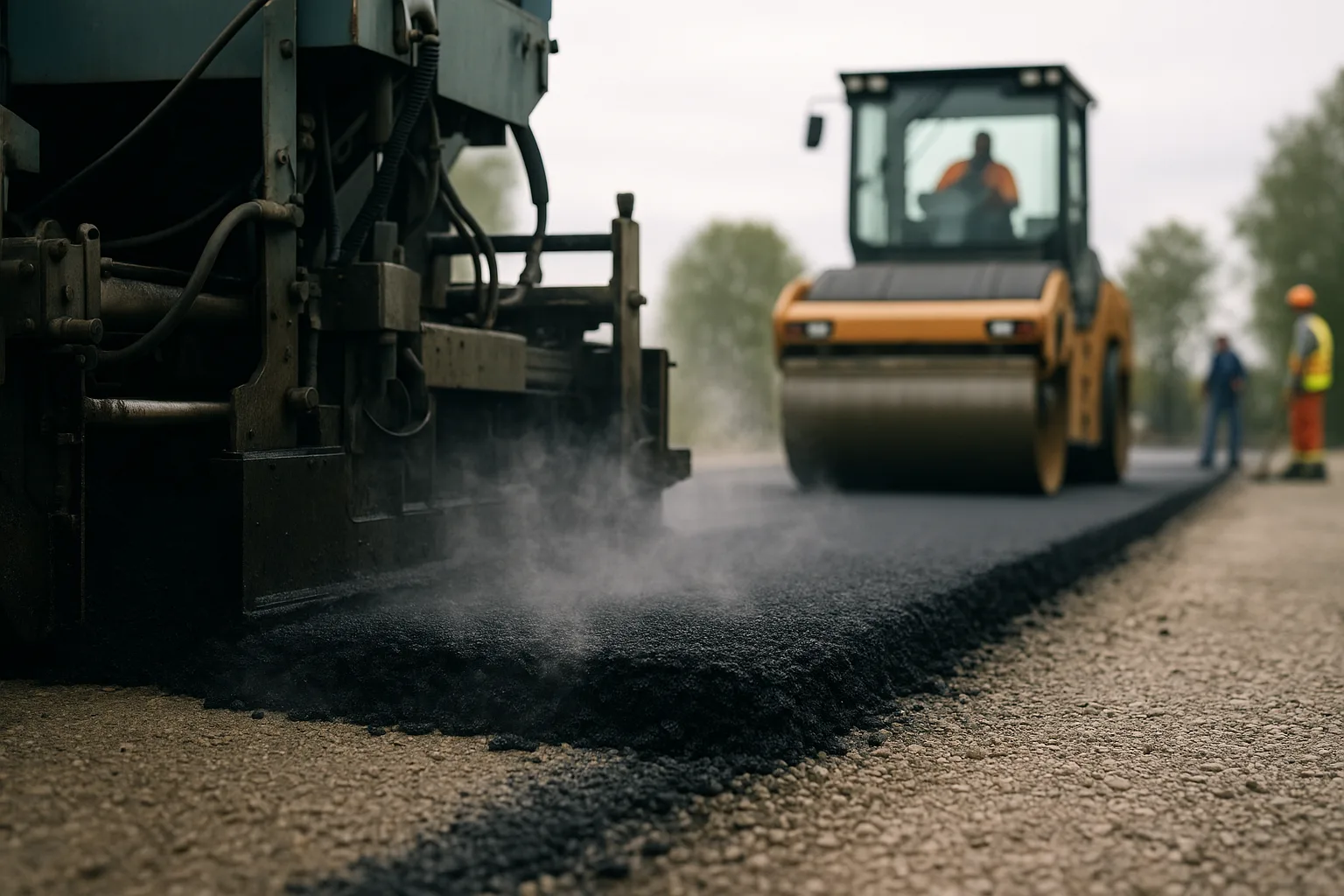
Hot mix laid at the thickness the use calls for. Heavier commercial work goes down in two courses — a coarser binder for strength, then a finer surface course on top.
What to look for: That the thickness matches what was quoted, and that the mat is being laid at temperature rather than after it has cooled in the truck.
Rolling to compaction
Rollers work the mat while it is still hot. This is the step that decides service life: density is what makes asphalt effectively waterproof, and once the mat cools you cannot put it back.
What to look for: Rolling starting promptly and continuing while the surface is still hot. Waiting is how you get a porous surface that takes on water.
Edges, transitions, clean-up
Edges supported, tie-ins made at garage slabs, streets, and neighbouring pavement so there is no lip to catch a plow or trap water. Site cleaned, and you are told when it is ready for traffic.
What to look for: Supported edges. On a driveway with no curb, an unsupported edge is the first thing to crumble.
Standing behind it
We tell you the cure timeline for your job and the weather it went in under, and what maintenance it will want and when.
What to look for: A straight answer about what is normal in the first weeks — soft asphalt marking under point loads is expected, not a defect.
The responsibility map
Who handles each phase, and where the job changes hands. We handle all of it in-house, so there is no hand-off — which mostly matters because hand-offs are where accountability goes missing when something needs sorting out later.
| Phase | Who does it | Hand-off | Why it matters |
|---|---|---|---|
| Walk-through & estimate | Owner / estimator | None | The person who prices it has seen the site. |
| Grading & drainage | Our grading crew, our equipment | None | The grade is set by the same team that will pave over it. |
| Subgrade prep | Our grading crew | None | Soft spots found here are fixed here, not reported to someone else. |
| Base placement & compaction | Our crew, our compaction equipment | None | Depth and lift count are our call and our responsibility. |
| Paving | Our paving crew, our paver | None | Same team that built the base lays the mat on it. |
| Rolling | Our crew, our rollers | None | Timing is coordinated on site, not between two companies. |
| Edges & clean-up | Our crew | None | Nobody leaves before the transitions are right. |
| Follow-up & warranty questions | Same office, same phone number | None | You call the people who did the work. |
More about the company on the about page.
The same sequence, different specification
These phases do not change between a residential drive and a commercial lot. What changes is the specification inside them — base depth, asphalt thickness, and whether the build needs a binder course under the surface course.
A driveway carries cars, so the section is thinner and the edges matter more. A parking lot carries delivery vehicles that concentrate weight in the same places every week, so it gets a deeper base and often two courses. Both come back to the same principle: the base carries the load, not the surface.
Work that is not a full build — repair, overlays, sealcoating — runs a shorter version of the same discipline.
Questions about the process
How long does a typical job take?
Most residential driveways are a single day on site once the schedule opens up. Larger commercial lots run a few days depending on scope, how much tear-out and base work is involved, and how many phases the property needs to stay operational. Asphalt also needs dry weather in a workable temperature range, so rain moves dates — you get a firm timeline with the estimate and a call if weather changes it.
Can we stay open while a commercial lot is done?
Usually. Most commercial work is phased so at least one entrance and a route through stay usable. Paving is the stage that needs its section completely clear, and that section is out of service for about a day. You get the phase map with the estimate, including which rows close on which days and where deliveries should come in.
What happens if you find something unexpected once you open it up?
We stop and tell you before doing anything about it. Where the base condition genuinely cannot be known until the surface comes off, we say that in the estimate and give you the cost of both outcomes up front, so the number does not move without a conversation.
What should I expect in the first few weeks?
New asphalt is drivable long before it is fully cured. Early on it stays soft enough that a kickstand, trailer jack, or jack stand can dent it, and turning the wheel while stopped can scuff it. Sitting in the same spot on a hot afternoon can press in tire impressions. All normal, all temporary — give it a few weeks of ordinary use.
Free estimates across the Kansas City metro.
Driveways, parking lots, and repairs across the Kansas City metro, since 2014.
Call Now: (816) 789-0700Tarmasters Asphalt Paving
Lee's Summit, MO 64063 | Serving the Kansas City metro | Insured | Bonded